Skip to content
See the World Through ScienceA project of ALLATRA

Swiss Glaciers Lost More Than 5% of Their Ice in One Year
Environment

Republish this story

Our work is licensed under Creative Commons BY-NC 4.0. You may republish this piece for free — with credit to ALLATRA Media and a link to the original, unedited beyond length trims, and not for commercial use.

Read the full license

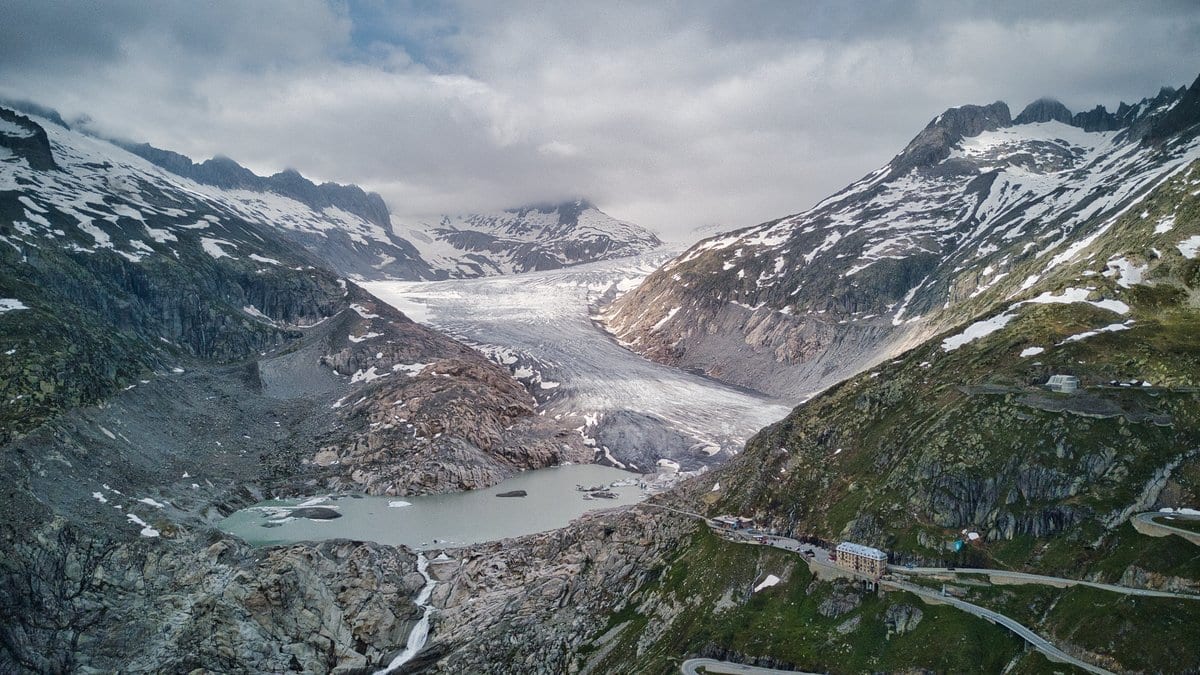
The tongue of the Rhône Glacier in the Swiss Alps ends in a gray meltwater lake ringed by bare rock, with a mountain road switchbacking up the slope at right.
The Rhône Glacier above Gletsch in Valais, photographed in June 2023. GLAMOS counts the Rhône among four glaciers that melted more in 2026 than in any year it has measured."Rhonegletscher im Juni 2023" by Daniel Reust, via wikimedia, CC-BY-SA-4.0

Swiss glaciers lost more than 5% of their remaining ice over the 2026 melt season, the Swiss Glacier Monitoring Network (GLAMOS) and the Swiss Academy of Sciences' Commission for Cryosphere Observation reported Oct. 1. They place the year just behind 2022, the worst in their records.

According to the commission's release, the meltwater is for now still easing Switzerland's summer water shortages, but that effect is already diminishing as the ice-covered area shrinks. The organizations also warn Alpine glaciers have no chance of surviving in the long term under conditions like these.

Mean thickness fell by 2.5 to 4 meters across individual glaciers over the summer. Almost 20% of the country's ice volume has now gone in the past five years alone. Several small glaciers have vanished altogether, among them the Bella Tola Glacier and the Griessfiren/Plattalvafirn.
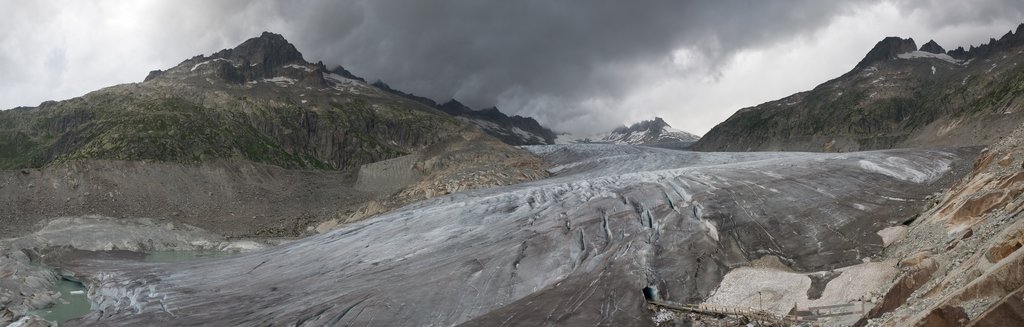
A wide panorama across the debris-streaked surface of the Rhône Glacier, with meltwater pooling at the ice edge on the left.
Rock debris darkens the surface of the Rhône Glacier, and meltwater pools along its edge (illustrative). A dirtier surface reflects less sunlight away and melts faster. – "Rhonegletscher" by Ikiwaner, via wikimedia, CC-BY-SA-3.0

Snow depths at every elevation ran far below the long-term average through the winter, which the release attributes mainly to low precipitation. Every month from May to September was dry and brought at least one heatwave, and the protective snow cover on the glaciers was partly gone by the June heat. The freezing level stood above 4,000 meters on 76 days, a record.

The year did not quite match 2022 despite higher temperatures: the release notes that many glaciers carried slightly more snow than they did then, and less Saharan dust settled on the surface, so more sunlight was reflected away. Four glaciers were exceptions. GLAMOS records the Allalin, Clariden, Aletsch and Rhône as having melted more in this year than in any year it has measured.

Sources

Spot an error?

Spot an error?

Report an error

Spotted a mistake on this page? Tell us what's wrong and our editors will take a look.

What kind of problem?

Only if you'd like us to be able to follow up. We won't use it for anything else.

We correct mistakes openly. Select any text to flag it. Fixes are logged under our Corrections Policy.

Report an error

Reporting on

Swiss Glaciers Lost More Than 5% of Their Ice in One Year

What kind of problem?

Only if you'd like us to be able to follow up. We won't use it for anything else.

We read every report. Corrections are logged publicly.