Every One of 18 Salmon Sharks Had Human-Made Particles in Its Stomach
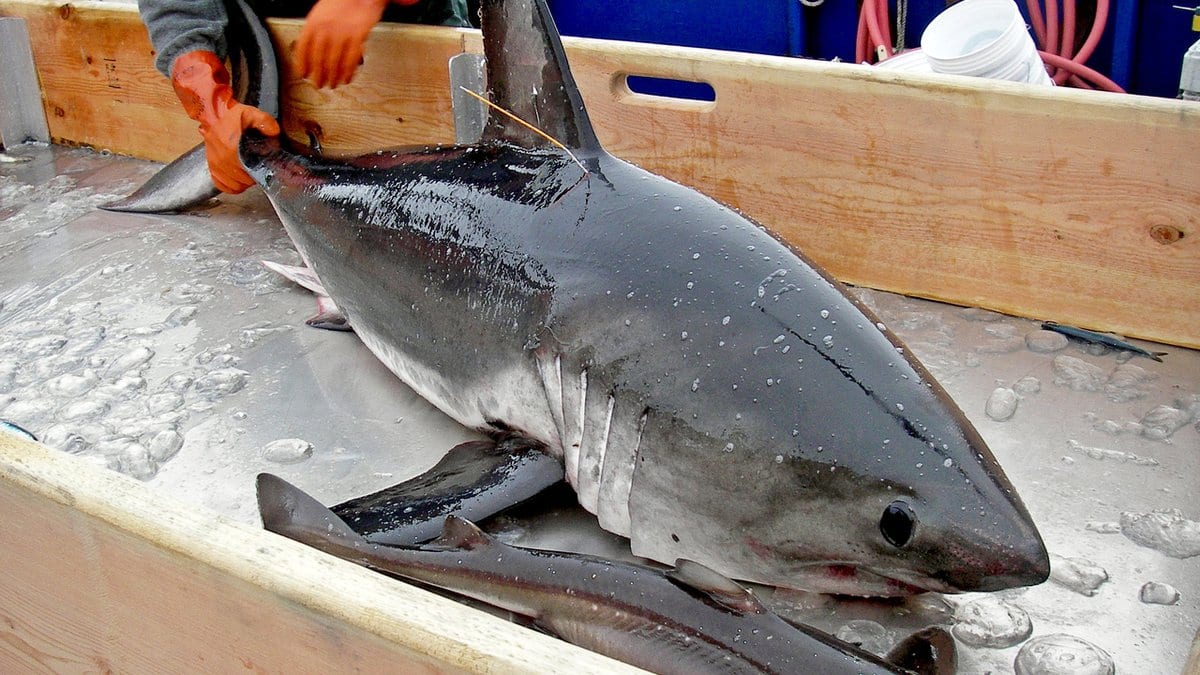
Researchers at Oregon State University found human-made microparticles in the stomach of every one of 18 salmon sharks collected off the Oregon coast between 2022 and 2024, an average of 25.6 microparticles per animal.
Maddie English, Taylor K. Chapple and colleagues published the count Nov. 9, 2026, in Microplastics and Nanoplastics, writing that the effects of these particles on large ocean predators have been measured poorly, which limits what anyone can say about how the particles get in and what they do there.
Most of what the group counted was not confirmed plastic. Fibers and fragments dominated, and white and black were the most common colors. Infrared spectroscopy confirmed about 16% of the microparticles as synthetic polymers, mainly polyethylene, polypropylene and polyamide; the rest was largely cellulose of human origin, whose readings came closest to cotton.
Microplastics themselves were found in all but three of the stomachs. The authors write that salmon sharks showed higher detection rates and heavier particle loads than other studies have reported for sharks, skates and rays. The work counts what the animals had swallowed and tests nothing about effects on their health.
Salmon sharks are warm-bodied hunters that work both the coast and the open North Pacific. The authors say that mix of high energy demand, broad diet and polluted habitat made the species worth checking, and they describe the study as the first evidence of microparticle and microplastic ingestion in salmon sharks.
Observers with NOAA's At-Sea Hake Observer Program supplied the stomachs, and student funding from Oregon State University paid for the work, through the Mamie Markham Research Award and the H. Richard Carlson Scholarship. The journal is publishing the paper early, as a peer-reviewed accepted version that will be replaced by a final one.
Sources
- Microplastics and NanoplasticsPeer-reviewed