Each Summer, Seawater Creeps Into a River on Top of a Greenland Ice Shelf
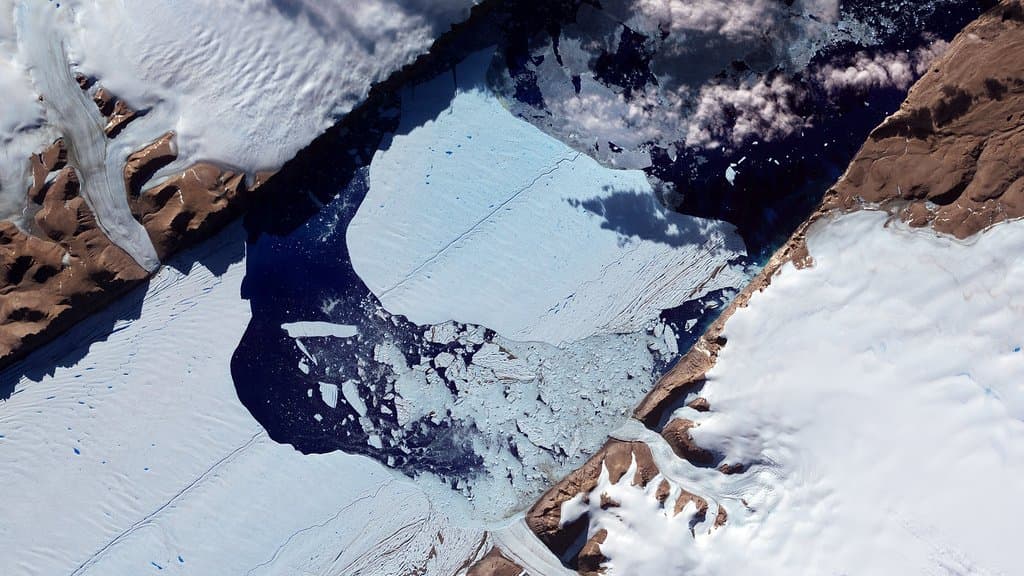
A meltwater river on Greenland's Petermann Ice Shelf cut its bed below sea level in most summers from 2014 to 2018, letting seawater run inland to form an estuary that broke its link to the ocean again each winter, researchers reported Sept. 21, 2026, in the journal The Cryosphere.
The study, led by Michela Savignano of the University of Colorado Boulder, rests on a new way to measure how fast a river's bed drops using paired WorldView satellite images and matching elevation models. The authors present it as a way to gauge channels that the ICESat-2 laser satellite rarely passes over twice, and say such rates may show where estuaries could form elsewhere.
The authors report that along the final 5 km of channel before the ice front, the bed dropped about 3 centimeters a day in both 2014 and 2016. The pattern reversed along the channel. In 2014 cutting was fastest at the ice front, at 4.0 cm a day. In 2016 it was slowest there, 2.2 cm a day, and the channel grew wider and flatter: 25 m across on average, against 20 m two years earlier. Modeled meltwater runoff was almost identical in the two seasons.
Savignano and colleagues attribute the reversal to the estuary: once the tide pushes seawater up the channel, the outward flow slows and warm, salty water melts the channel walls rather than its floor. The reading rests on the imagery and modeled runoff, not on measurements in the water.
The record stops in 2018, when a rift cut across the river channel. The authors write that estuary weakening and thinning above a channel melted into the shelf's underside likely drove the rift, and that a roughly 75 km² piece breaking away along it on Aug. 4, 2026, suggests even limited seawater intrusion may weaken a shelf.
The imagery the method needs is not openly available: access requires a commercial license or a federally funded grant, which the authors call a practical constraint on wider use. They suggest testing freely available Sentinel-2 or Landsat data at coarser resolution.
