Dinosaur Leg Bone Holds Molecules From Blood, and Specks That Might Be Blood Cells
An international research team reports heme, the iron-bearing molecule that carries oxygen in blood, in the limb bones of a 115-million-year-old dinosaur. It also reports tiny structures inside the bone's blood channels that it describes as "inferred to be red blood cells." The paper appeared Nov. 2, 2026, in Proceedings of the National Academy of Sciences.
The paper opens by stating that detection of ancient biological molecules in vertebrate fossils "remains controversial because labile compounds degrade quickly and are highly susceptible to contamination," and the three analyses it reports are aimed at that problem: whether what is in the bone came from the animal or from its surroundings.
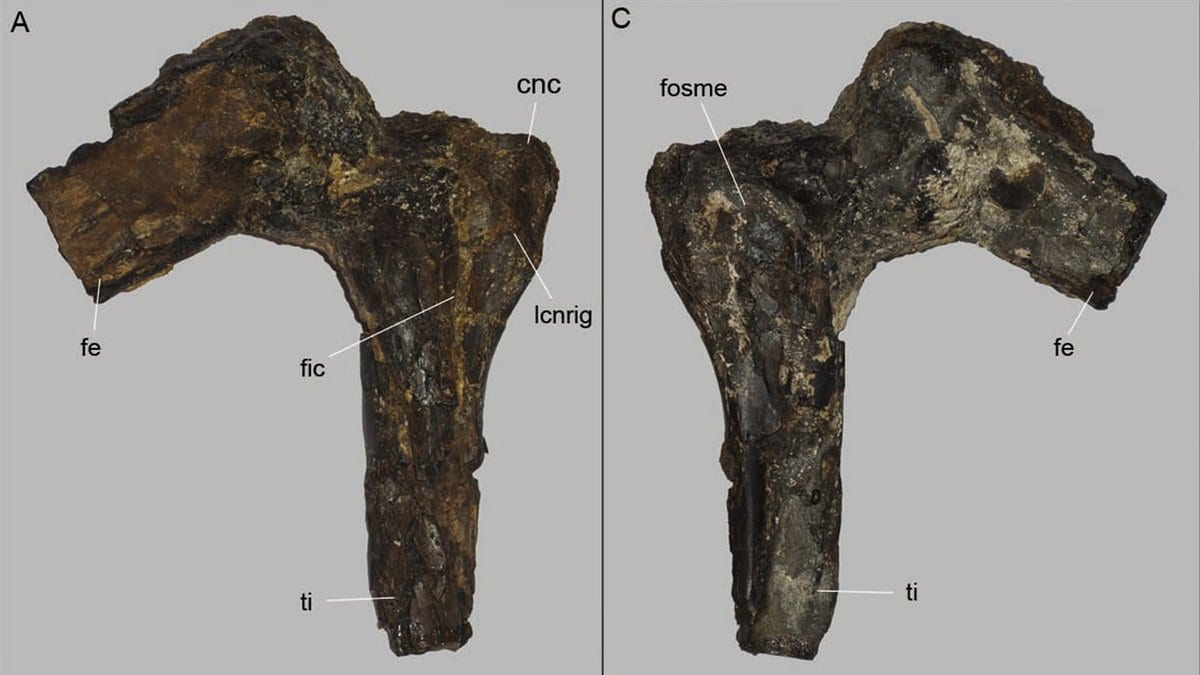
The bones belong to Aratasaurus museunacionali, a theropod dinosaur from northeastern Brazil. Using liquid chromatography and mass spectrometry, the authors identified parent and altered forms of heme B as the main heme-derived molecules in an extract of the bone. The surrounding rock instead carried the signatures of chlorophyll, the green pigment of plants, and of its bacterial counterpart. That contrast is the team's argument that the molecules came from the animal itself rather than from the rock around it.
The team aimed two more methods at the structures themselves. Raman spectroscopy, a laser technique, found heme's chemical signature in them. Electron microscopy found iron, nitrogen and carbon, the elements of heme, alongside hausmannite, a manganese mineral the paper describes as stabilizing them.
The authors conclude that "These results demonstrate blood-derived biomolecules in mineralized red blood cells of a dinosaur."
Kliti Grice of Curtin University in Perth, Australia, is the paper's first author, and Alexander W. A. Kellner of the Museu Nacional in Rio de Janeiro is its senior author. Their co-authors work in Australia, Japan, Brazil, Germany and the United States.
Sources
- Proceedings of the National Academy of SciencesPeer-reviewed