Airborne Plastic Lands on Everest in Every Season, a Year of Sampling Shows
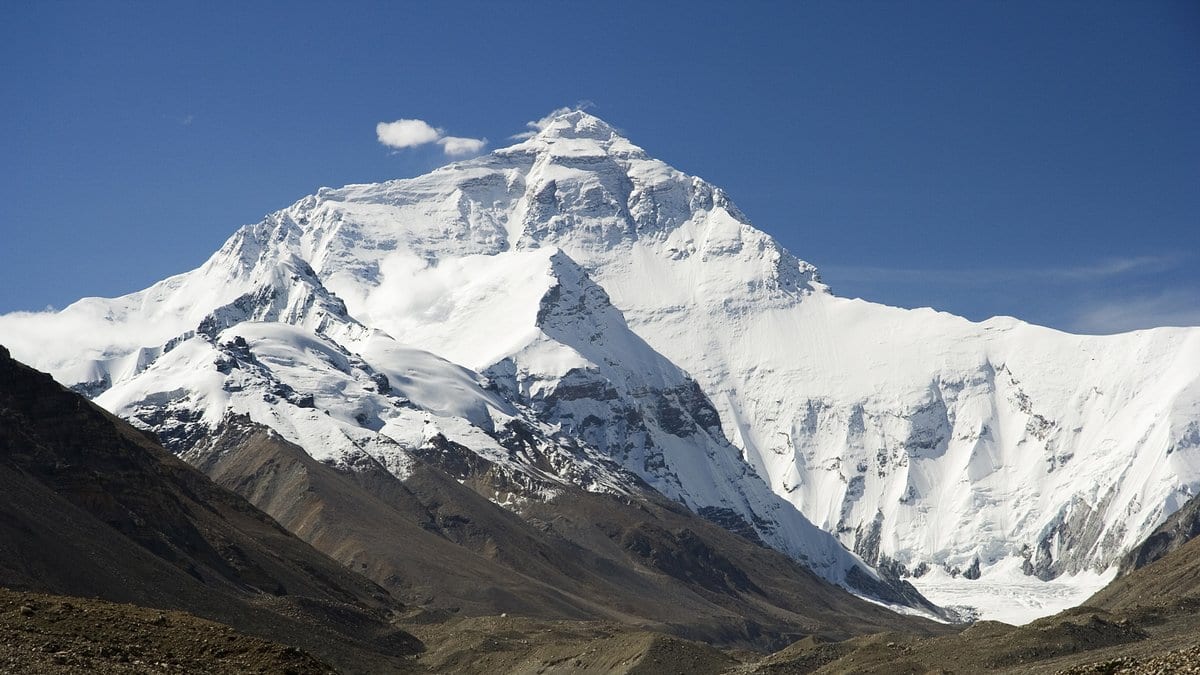
A year of deposition sampling on the northern slope of Mount Everest found airborne plastic arriving in every season. Yanhua Wang of Shaanxi Normal University, Baoshan Xing of the University of Massachusetts Amherst and colleagues collected dry, wet and total deposition at two sites and counted both microplastic and nanoplastic particles.
The authors write that the atmosphere's input of plastic to the Third Pole is still poorly constrained, and that their campaign was built to measure it directly. The Third Pole is the name researchers use for the Tibetan Plateau and the high ranges around it. The paper appeared open access in Communications Earth & Environment on Oct. 30, 2026.
The authors report microplastic deposition of 64.0 particles per square meter per day at Qomolangma Station against 23.0 at Everest Base Camp, and attribute the gap to differences in terrain and in human activity between the two sites. Fragments dominated what came down, mainly polyamide, better known as nylon, along with polyethylene terephthalate and polyethylene. Nanoplastic levels, sampled in five representative months, were also higher at Qomolangma Station, and that finer fraction carried polyvinyl chloride and polypropylene too.
The seasons split the delivery route: monsoon months brought more plastic down in rain, carried from nearby, while non-monsoon months received plastic transported long distances from inland.
Scaling those deposition rates up, the authors estimate an annual input of 56.4 tons of microplastic to the Tibetan Plateau above 4,000 meters; that number is an extrapolation from two sampling points on one slope, not a measured regional total.
The authors conclude that the atmosphere is an efficient route for plastic into the region, and they describe the ecological risk as potential, alongside what they call low ambient concentrations. The work was funded by the National Natural Science Foundation of China, and the paper carries a transparent peer review file.
Sources
- Communications Earth & EnvironmentPeer-reviewed