A 10% Methane Cut Would Add Four Years to the Carbon Budget, Study Finds
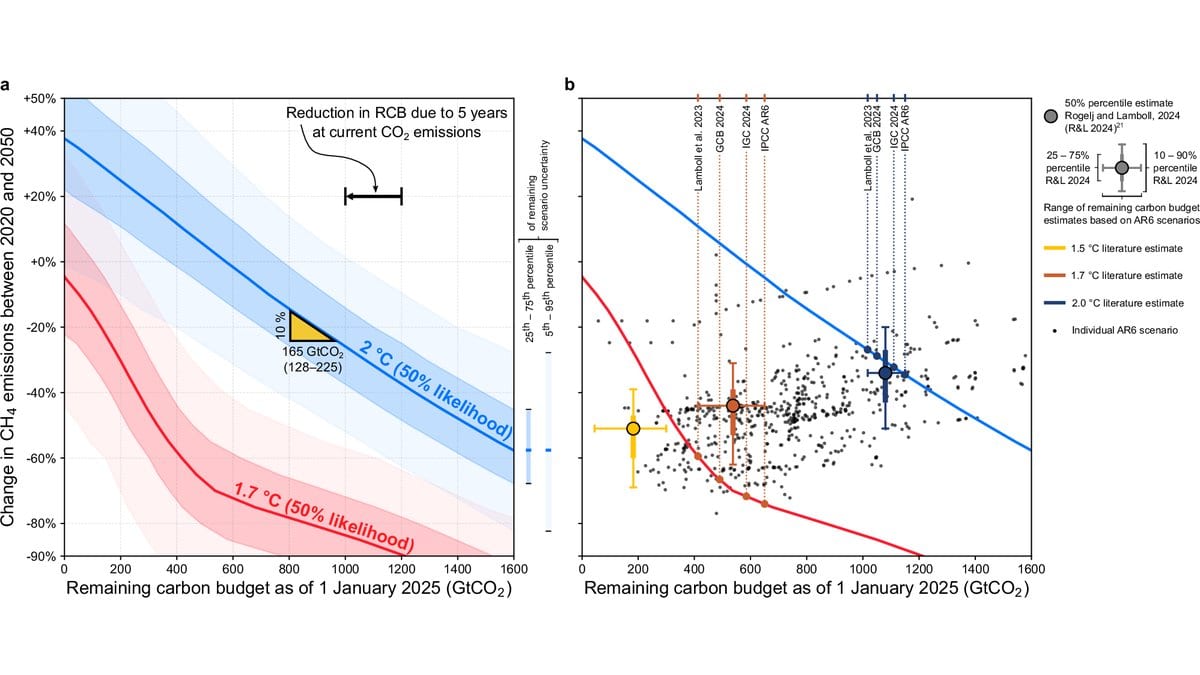
A modeling study published Sept. 1 in Communications Earth & Environment calculates that an additional sustained 10% cut in methane emissions held to 2050 (about 35 MtCH₄ per year, or megatons of methane) would increase the remaining carbon budget compatible with 2 °C of warming by about 165 GtCO₂, or gigatons of carbon dioxide. Authors Konstantin Weber, Reto Knutti, Lena Brun and Cyril Brunner give a 5th–95th percentile range of 128–225 GtCO₂ and call the central figure equivalent to about four years of current global CO₂ emissions.
The numbers are scenario outputs, not observations. Instead of the cost-optimized pathways of integrated assessment models, the economic models most climate assessments draw on, the team paired straight-line emission reductions running to a chosen net-zero year with a separate range of methane trajectories, then ran each combination through FaIR, a simple climate model calibrated to the IPCC's Sixth Assessment Report.
Across that scenario space, the authors report that methane from human activity currently contributes more than 0.6 °C to global warming; that without methane mitigation, peak warming exceeds 1.7 °C at 50% likelihood for every net-zero CO₂ target year they tested; and that the likelihood of staying below 2 °C drops below 50% once net zero CO₂ is reached after 2050.
The paper also concludes that limiting warming to 1.5 °C "is no longer plausible," a finding the authors draw from their own scenario set: reaching that limit at 50% likelihood, they write, would require eliminating all human CO₂ and methane emissions by about 2028 along a straight-line path starting in 2024.
The paper reports that this effect of methane mitigation on remaining carbon budgets is considerably larger than previous estimates, and states that the trade-off applies to scenarios with linear methane changes to 2050 and net zero CO₂ reached later this century.
Sources
- doi.orgPeer-reviewed