Earthquakes May Be Feeding a Carbon Sink in the Japan Trench
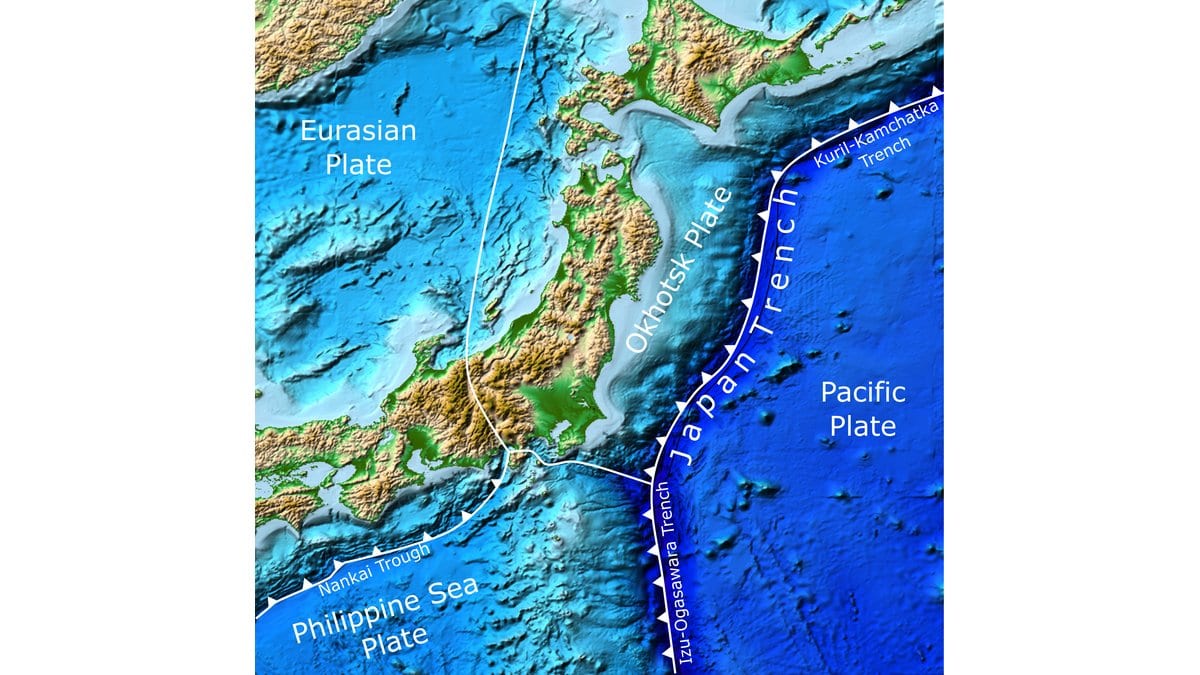
Sediments in the Japan Trench deeper than 7,000 meters hold widespread calcium carbonate that formed in place, and the carbon in it came from dead organic matter rather than from seawater. Yongxin Liu, Rui Bao and colleagues at Ocean University of China report the finding in Nature Communications, published Nov. 3, 2026.
The paper says little is settled about how carbonate forms and is buried below the carbonate compensation depth, the level past which seawater dissolves it. Shallow marine carbonate, by contrast, is recognized as a key agent in deep carbon cycling. The authors describe the trench deposits as an underappreciated carbon sink and a possible route for organic carbon into the deep Earth.
The authors put the flux of carbonate derived from organic carbon in the Japan Trench at about 28.6 teragrams of carbon per million years. A teragram is a million metric tons. Depletions in stable and radiocarbon isotopes point to the organic source, which the authors say was most likely delivered by deep-sea landslides.
Earthquakes enter the account as a proposal rather than a measurement. The authors propose that earthquake-driven influxes of organic matter into the trench may have kept carbonate forming there over long periods. Their isotopic modeling also suggests that where this carbonate is carried down with the subducting plate, it can give fluids released in the subduction zone off northeast Japan a negative carbon-isotope signature.
Co-authors are at the University of New Hampshire, the Woods Hole Oceanographic Institution, Shanghai Ocean University, the Geological Survey of Japan and the University of Innsbruck. The paper is open access; Nature Communications has published the accepted, peer-reviewed version ahead of the final one.
Sources
- Nature CommunicationsPeer-reviewed