A Vermont Stream Shows How Much Carbon Crushed Rock Actually Removes
Over two years, 9.5% to 11% of the carbon dioxide that crushed basalt could in theory remove from the air left a Vermont watershed, dissolved in its stream, a team led by Yale University researchers reported Sept. 30, 2026, in the open-access journal Nature Water.
Enhanced weathering means spreading powdered silicate rock on farmland so that it dissolves and takes carbon dioxide out of the air. The study notes that few field observations exist to evaluate the method; most estimates come from laboratories and soil plots, which do not track the products on their way underground to a stream. The authors tested a whole watershed as the unit of measurement instead.
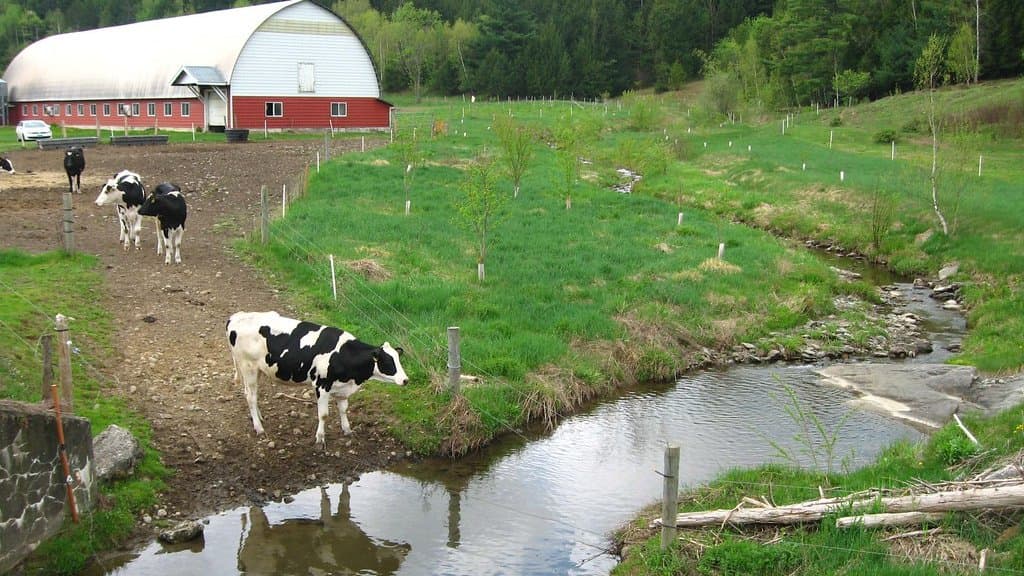
The powder went onto 8.9 hectares of hayfield and pasture in a headwater catchment of the Sleepers River Research Watershed in June 2023, at 20 metric tons per hectare. Stream alkalinity, the dissolved form the captured carbon travels in, rose within a month and stayed above an estimate of what the stream would have carried without the basalt.
Against an untreated watershed nearby, the authors attributed 7% to 17% of the stream's alkalinity to the basalt in the summer and fall of both years. In winter, when flow and temperature were lowest, the effect was too small to separate from zero. They tie the swing to temperature, which speeds dissolution, and to the paths the water takes.
The lower end of the range is the researchers' conservative accounting, which sets aside the alkalinity that carbonate in the basalt itself could have produced; the upper end credits all the exported alkalinity to the silicate. Both estimates sit near the upper limit soil-column models allow, generally under 10% export after two years across most of the United States. The authors write that removal will be comparatively inefficient in temperate watersheds and that rock spread close to a stream shows up fastest in its chemistry. They say monitoring must run long enough to catch products still moving underground and call for trials in other climates.
The streamwater chemistry and analysis code are posted on Zenodo and GitHub.
Sources
- Nature WaterPeer-reviewed