How Chalky the Dust Is Changes How Acidic the Air Gets, a Model Finds
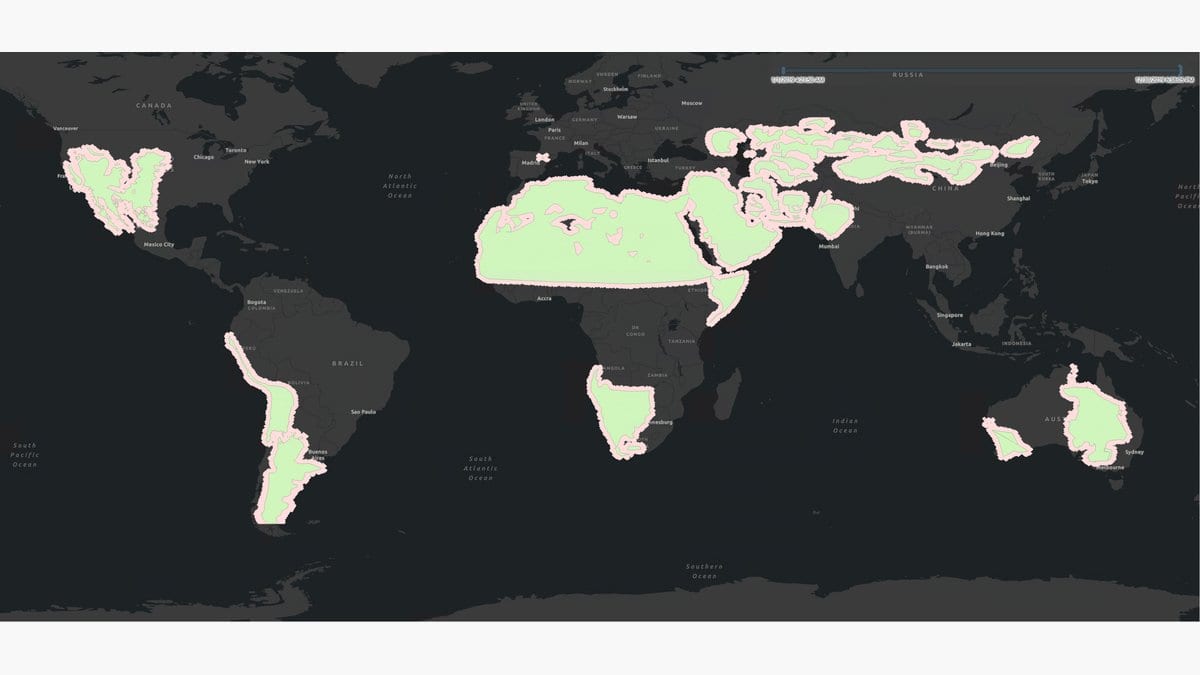
A research group led from the Barcelona Supercomputing Center has combined mineral maps of the world's dust sources, measured from orbit by NASA's EMIT imaging spectrometer, with a global air chemistry model. The authors report that resolving calcite desert by desert, instead of assuming one worldwide average, shifts regional annual mean aerosol pH by -0.6 to +0.5 units. Calcite is the alkaline mineral of chalk and limestone, and how much calcite the dust carries depends on which desert the wind lifted it from.
Their stated reason for the work is that dust's effects on air quality and climate stay uncertain while its mineral makeup is poorly known. On their results, the acidity shifts reorganize where airborne nitrate forms and how it splits between gas and particles. They also change how often extreme nitrate episodes occur, most of all where dust mixes with human-made pollution. pH runs on a logarithmic scale, so one unit is a tenfold change in acidity.
EMIT measured minerals, not acidity — the instrument reads the composition of dust source regions from orbit, while the pH and nitrate figures come out of the model those minerals were fed into. The study appeared Nov. 20, 2026, in Nature Communications. The group reports local changes above 1 pH unit across substantial areas of the most affected dust regions, and says the EMIT-derived calcite brings the model closer to airborne observations.
The comparison does not carry across to dust's effect on sunlight. On the authors' account, the radiative effect of calcite-driven changes in these particles is small beside the effect of regional variation in how strongly iron oxides, the dark minerals in dust, absorb light. Their own conclusion is that calcite variation strongly shapes the chemistry that happens on particle surfaces, while iron oxides dominate dust's radiative impact.
The paper is open access. Springer Nature says the version now posted is an early one, shared to give faster access to accepted research, and that it will be replaced by the final version of record.
Sources
- Nature CommunicationsPeer-reviewed