Skip to content
See the World Through ScienceA project of ALLATRA
Source: Peer-reviewed1 source

Earth Has Become Less Dusty Since 2003, and That Has Added a Bit of Warmth
Environment

Republish this story

Our work is licensed under Creative Commons BY-NC 4.0. You may republish this piece for free — with credit to ALLATRA Media and a link to the original, unedited beyond length trims, and not for commercial use.

Read the full license

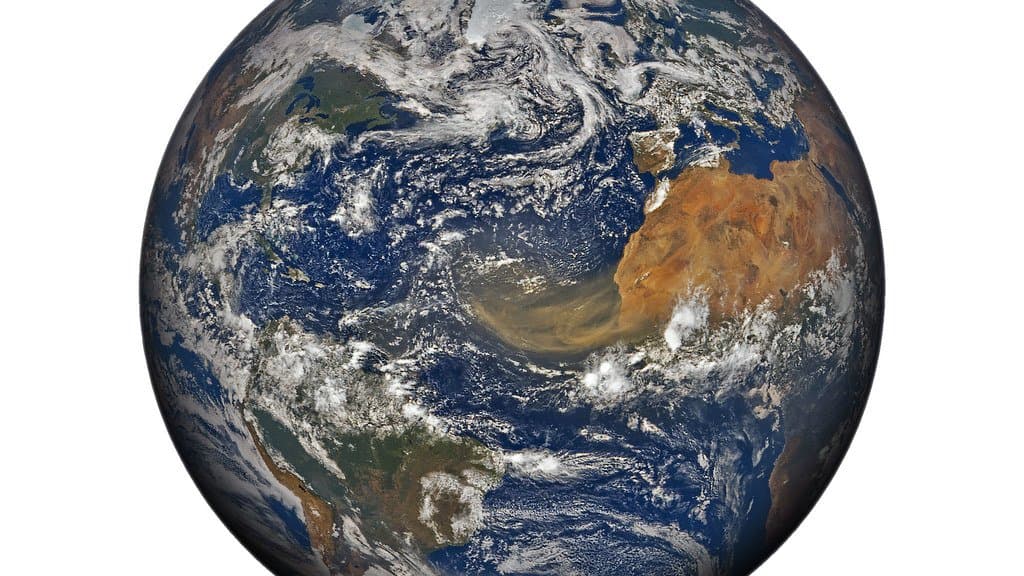
Full-disk satellite view of Earth centered on the Atlantic, with a tan plume of Saharan dust streaming west from North Africa across the tropical ocean.
Saharan dust streams west across the tropical Atlantic in a full-disk view of Earth (illustrative). North Africa is the world's largest source of atmospheric dust."Dust Storm from Africa" by sjrankin, via flickr, BY-NC · BY-NC

A new study reports that the amount of dust suspended in Earth's atmosphere fell by roughly 10% between 2003 and 2023, and that the decline has made a modest contribution to the warming observed over those two decades.

Ashok Kumar Gupta of Vanderbilt University and Jasper F. Kok of the University of California, Los Angeles, and colleagues reconstructed the global dust cycle by combining measurements from satellite-borne lidar, infrared sounders and multispectral imagers with three aerosol reanalyses and a network of ground-based sun-photometer sites. The paper was published Sept. 18, 2026, in Science Advances.

Satellite records show that North Africa, the planet's largest dust source, saw its dust optical depth drop by −10 ± 8% over the period, and Asia saw a comparable decline of −10 ± 12%. The authors describe the overall convergence across independent instruments as "the strongest evidence to date that the planet has become less dusty in the early 21st century."
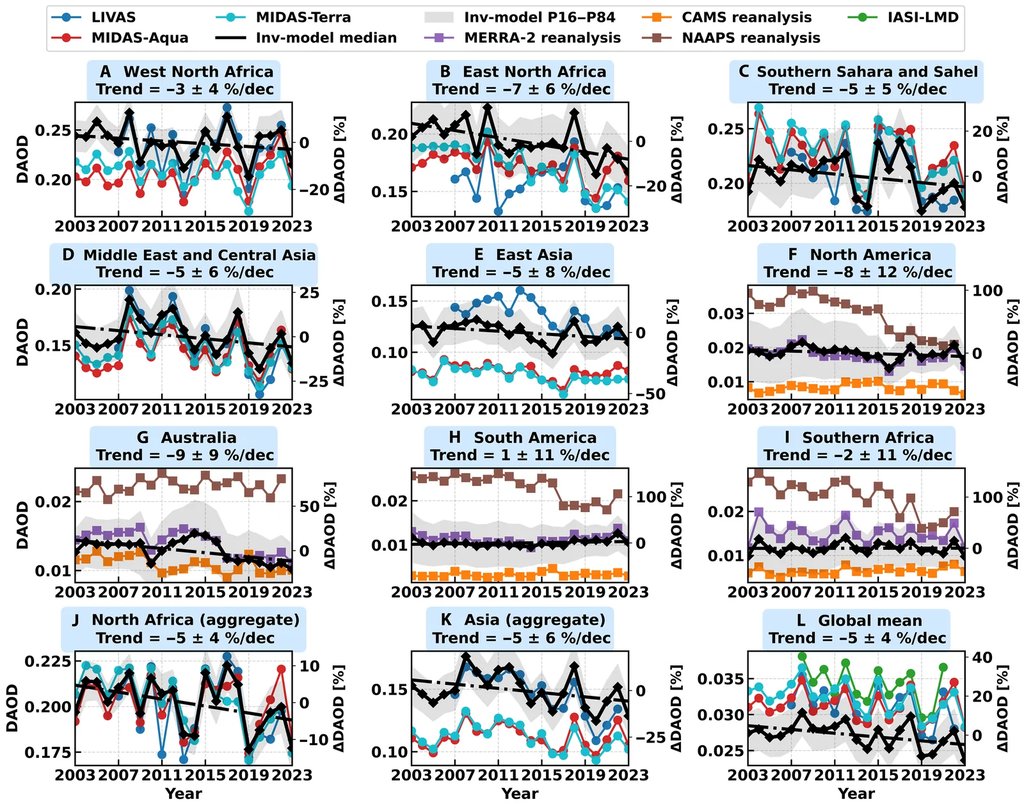
A twelve-panel chart of annual mean dust optical depth from 2003 to 2023 for nine dust source regions, North Africa and Asia combined and the globe, with declining trend lines.
Annual mean dust optical depth from 2003 to 2023 over the main dust source regions (panels A to I), over North Africa and Asia combined (J and K), and over the globe (L). The global panel falls by about 10 percent across the record. – Fig. 3 from Ashok Kumar Gupta, Jasper F. Kok, Vassilis Amiridis, Antonis Gkikas, Konstantinos Rizos, Emmanouil Proestakis, Stavros-Andreas Logothetis, Eleni Marinou, Carlos Pérez García-Pando (2026), "A global decline in atmospheric dust during the 21st century", Science Advances – CC BY, resized

Because desert dust particles scatter and absorb sunlight, they exert an overall cooling effect. A decline in dust therefore lets slightly more solar energy reach the surface. The study estimates that the dust drop produced a positive effective radiative forcing of +0.02 ± 0.05 watts per square meter over 2003–2023, an uncertainty range that spans zero, which the authors acknowledge, noting that declining dust "might have modestly contributed to the rapid warming of the past two decades." This specific phrasing is the researchers' own; the dominant drivers of recent warming are well-established greenhouse gas forcing, which the study does not address.

The paper notes that the causes of the dust decline remain an open question.

Sources

Spot an error?

Spot an error?

Report an error

Spotted a mistake on this page? Tell us what's wrong and our editors will take a look.

What kind of problem?

Only if you'd like us to be able to follow up. We won't use it for anything else.

We correct mistakes openly. Select any text to flag it. Fixes are logged under our Corrections Policy.

Report an error

Reporting on

Earth Has Become Less Dusty Since 2003, and That Has Added a Bit of Warmth

What kind of problem?

Only if you'd like us to be able to follow up. We won't use it for anything else.

We read every report. Corrections are logged publicly.