Skip to content
See the World Through ScienceA project of ALLATRA
Source: Peer-reviewedScientific Reports1 source

A Five-Year Reef Experiment Shows What Helps Corals Recover After a Heatwave
Environment

Republish this story

Our work is licensed under Creative Commons BY-NC 4.0. You may republish this piece for free — with credit to ALLATRA Media and a link to the original, unedited beyond length trims, and not for commercial use.

Read the full license

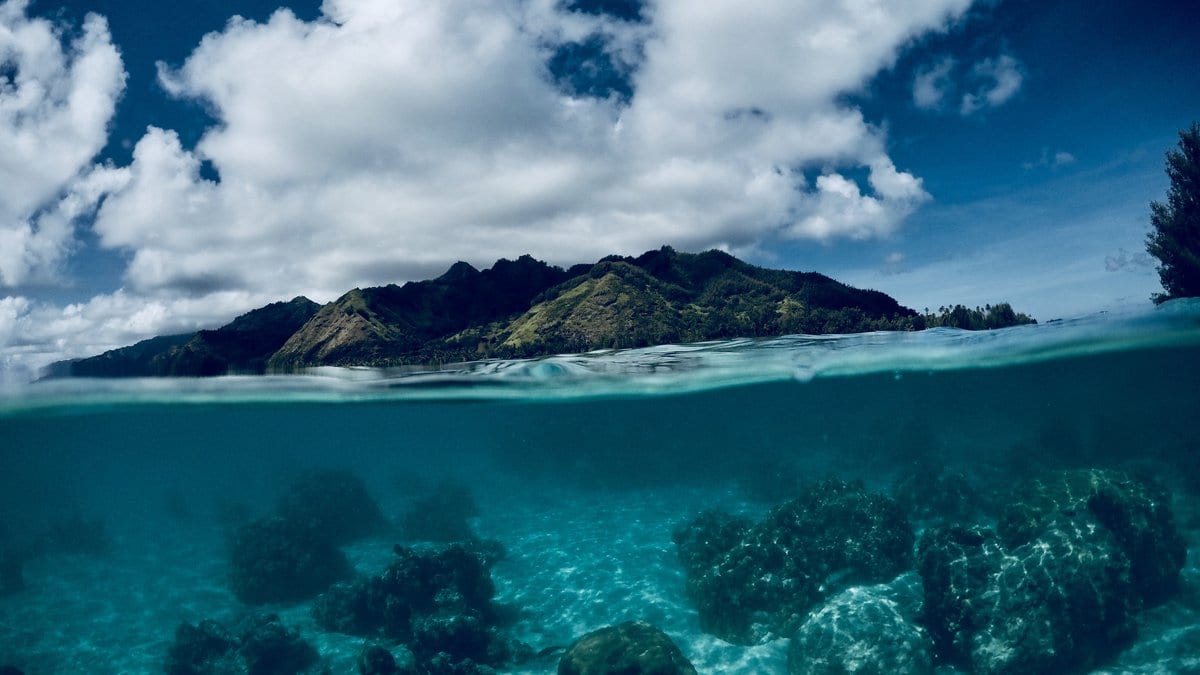
An over-under view of the lagoon at Moorea: rounded coral heads on the shallow sandy bottom below the waterline, and the island green ridges under cloud above it.
Coral heads in the shallow lagoon at Moorea, French Polynesia, photographed July 7, 2018 (illustrative). The experiment ran for five years on the island's northern forereef, at about 10 meters depth."Les coraux de Moorea" by Enzo Eymenier, via Wikimedia Commons, CC BY-SA 4.0

A five-year experiment on one reef in Moorea, French Polynesia, found that nutrient pollution and fishing pressure helped decide which corals survived after two marine heatwaves, while making little difference during the heat itself. Alex D. Vompe of Pennsylvania State University, Rebecca L. Vega Thurber of the University of California, Santa Barbara, and colleagues published the work Nov. 16, 2026, in Scientific Reports.

The paper concludes that some corals recover better where local seawater nutrient levels and fish populations are managed, and that the species the team followed differed enough that no single conservation approach suits all of them.

One of the two stresses was imposed; the other arrived. Beginning in 2018, the team set up eight plots on the island's northern forereef, fertilized half of them with slow-release garden fertilizer, and enclosed naturally growing colonies in wire mesh whose hole size let in progressively more fish, from near-total exclusion to open access. The heatwaves came on their own, in 2019 and 2020. Fertilizing was stopped a year before the experiment ended.
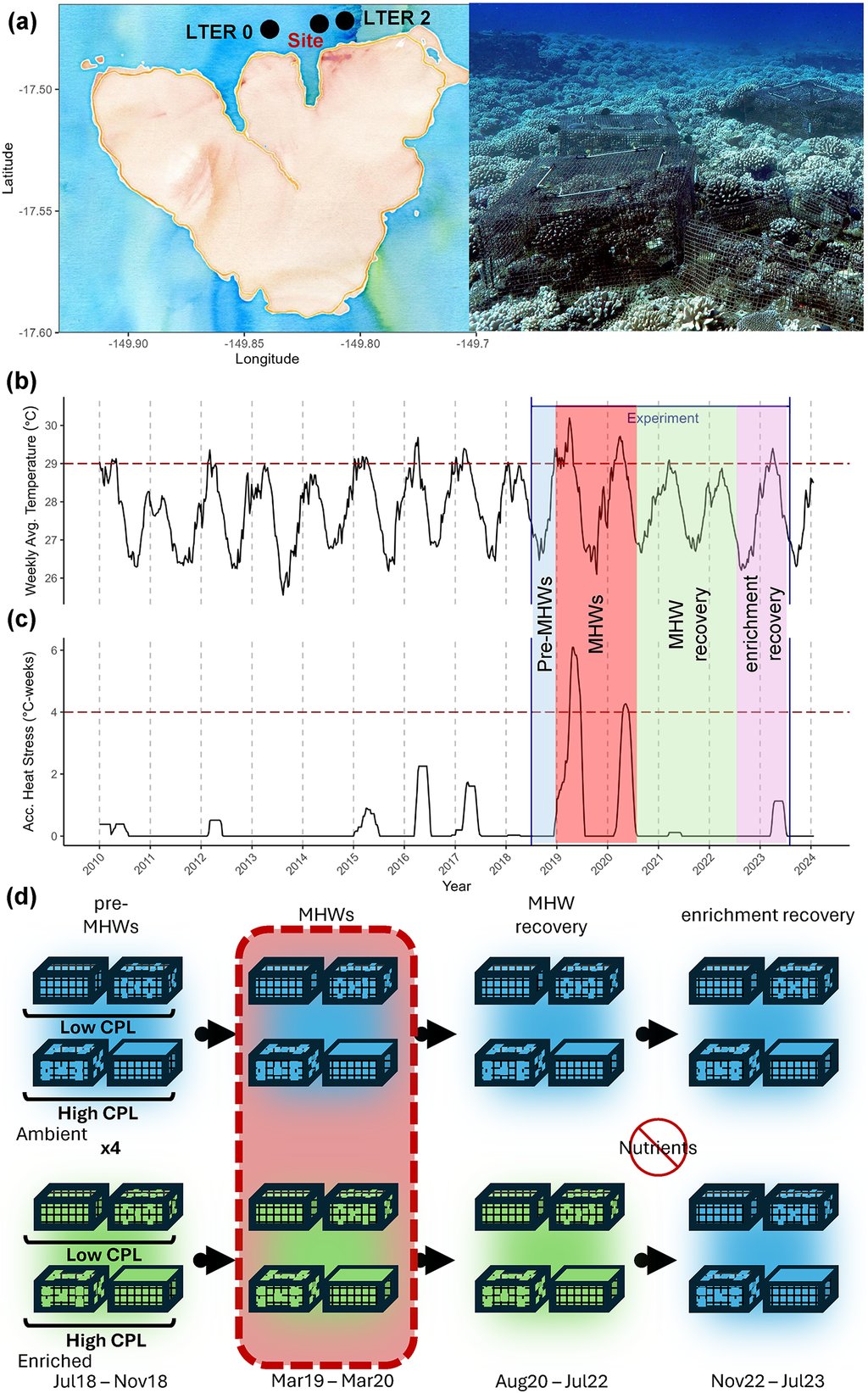
A four-part figure: a map of Moorea marking the experiment site on the north shore, a photograph of an underwater plot, a weekly ocean temperature trace with two heat stress periods shaded, and a diagram of the nutrient and consumer treatments across four experiment stages.
The site on the north shore of Moorea, the weekly ocean temperature record that caught two marine heatwaves in 2019 and 2020, and the layout of the nutrient and consumer treatments across the four stages of the experiment, which ran from July 2018 to July 2023. Figure 1 from Alex D. Vompe, Connor L. Draney, Kelly E. Speare, Noe Castañeda, Hannah E. Epstein, Denise P. Silva, Rowan H. McLachlan, Mackenzie A. Kawahara, Thomas C. Adam, Deron E. Burkepile, Thomas J. Sharpton, Rebecca L. Vega Thurber (2026), "Nutrients and consumer pressure influence coral and microbiome recovery following sequential marine heatwaves", Scientific Reports — CC BY 4.0, resized

The team reports that during the heatwaves, the treatments had no significant effect on how much coral tissue died. The differences showed up in the recovery years and pointed in opposite directions by species. Porites lobata lost more tissue in fertilized plots that fish could not reach; Acropora retusa lost less in fertilized plots that fish could reach. A year after the fertilizer was removed, both species were still dying faster where nutrients had once been elevated and fish were scarce. Pocillopora corals came through the heat best, then kept losing tissue through the recovery period whatever their plot.

In P. lobata, the decline of its dominant bacterial partner, Parendozoicomonas haliclonae, tracked closely with tissue loss and began before the first heatwave. The authors describe the bacterium as a possible indicator of coral health, or a candidate probiotic.

The experiment sampled 240 colonies. Ninety-three lost all their living tissue before it ended and were replaced by others in the same plots.

Sources

Spot an error?

Spot an error?

Report an error

Spotted a mistake on this page? Tell us what's wrong and our editors will take a look.

What kind of problem?

Only if you'd like us to be able to follow up. We won't use it for anything else.

We correct mistakes openly. Select any text to flag it. Fixes are logged under our Corrections Policy.

Report an error

Reporting on

A Five-Year Reef Experiment Shows What Helps Corals Recover After a Heatwave

What kind of problem?

Only if you'd like us to be able to follow up. We won't use it for anything else.

We read every report. Corrections are logged publicly.
