Marshall Islands Corals Show Central Pacific El Niño Activity Rose Over the Last Two Millennia
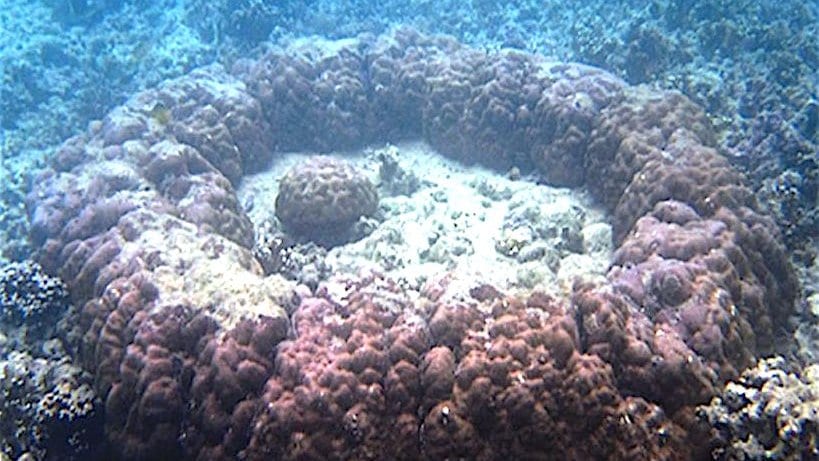
Coral skeletons from a Marshall Islands atoll have yielded a monthly-resolution temperature record spanning three windows of the past 1,500 years, and the comparison suggests that Central Pacific El Niño events became more frequent or intense over the last two millennia while their eastern counterparts did not.
Oliver Knebel of MARUM (University of Bremen) and colleagues, including senior author Eberhard Gischler, analyzed Porites microatolls from Arno Atoll across three dated periods: 484–560 ± 6 CE, 1273–1332 ± 4 CE and 1954–2017 CE. The team used strontium-to-calcium ratios in the coral skeletons, a proxy for sea surface temperature, and compared the results against independent Central Pacific oxygen-isotope records. The paper was published Sept. 4, 2026, in Communications Earth & Environment.
The thirteenth-century window showed significantly colder conditions and reduced temperature seasonality compared to today, consistent with the other Central Pacific records from the same period. In the sixth-century window, negative temperature anomalies in the coral record "likely relate to the 536 and 540 CE volcanic eruptions."
On the central question of El Niño's long-term behavior, the authors write that comparison with Central Pacific records "suggests that Central Pacific El Niño activity increased between the first and second millennium of the Common Era, while Eastern Pacific El Niño activity remained largely stable, or may even have been stronger than today." The phrasing reflects how the paper characterizes its own conclusion: a suggestion from comparison, not a directly measured trend.
The corals also captured how temperature extremes affected growth differently across periods: thermal anomalies disrupted calcification only in the modern samples, indicating reduced tolerance in present-day corals when conditions approach the population's thermal limit.
The study is open access under a CC BY 4.0 license.
Sources
- www.nature.comPeer-reviewed