Alaska's Volcano Watchers Forecast Nine Ash Clouds. Then They Published Their Misses.

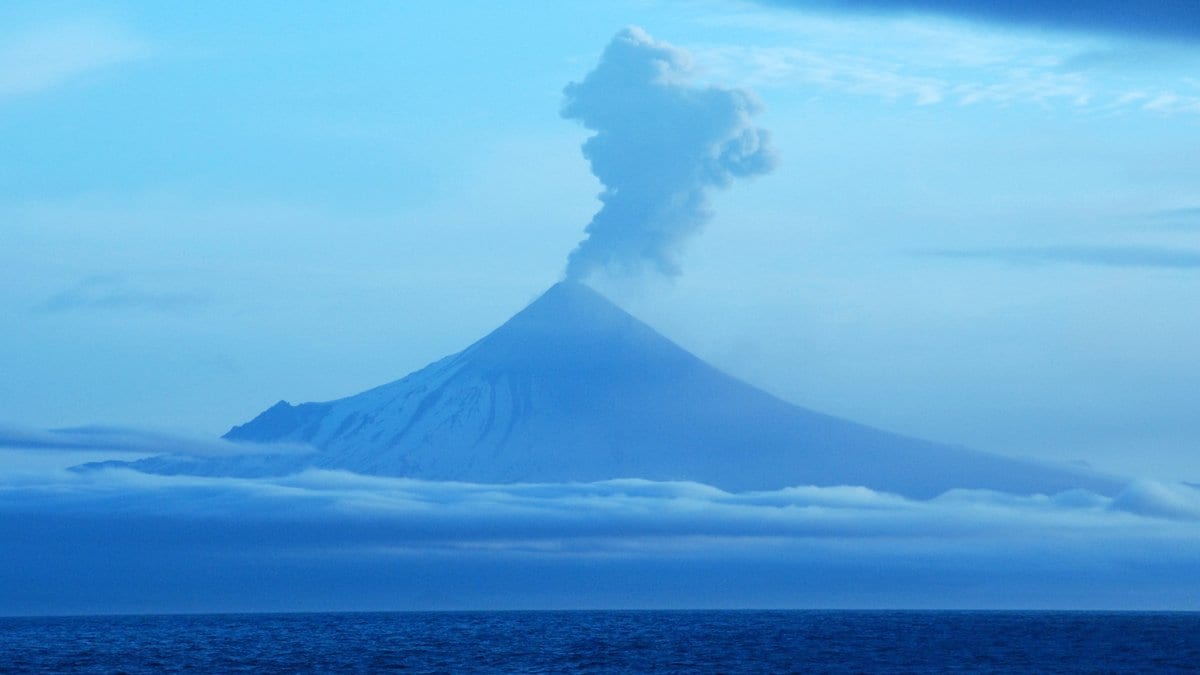
Early on Aug. 15, 2023, the analysts watching Shishaldin Volcano already knew an explosion was coming. Their notification had gone out hours before anything rose from the summit. Then a high deck of weather cloud slid over Unimak Island, and when the plume finally showed up in satellite images it did not look much like ash: a cold, water-rich cloud with a strong sulfur dioxide signal and almost no ash signature. The best height anyone on shift could put on it was 7.6 kilometers. It had reached 12.8 kilometers (42,000 feet), well inside the trans-Pacific flight levels. Nobody would know that for months.
That gap is now in the literature, written up by the people who left it. A chronology of Shishaldin's two most recent eruptions, published Nov. 21, 2026, in Bulletin of Volcanology, assembles the seismic, satellite, gas, lightning and webcam records of its 2019–2020 lava eruption and its 2023 explosive sequence. Matthew Loewen and seven colleagues wrote it: staff of the Alaska Volcano Observatory at the U.S. Geological Survey in Anchorage and the University of Alaska Fairbanks Geophysical Institute, with a co-author at Cornell University. The paper is peer reviewed and open access. It is also the observatory grading its own work, and no outside body has audited what AVO did in 2023.
What rising tremor could promise, and what it could not
The 2023 eruption lasted 117 days and produced 13 ash-producing bursts. The paper calls them paroxysms, literally "a sudden fit or rage," and their plumes reached from 5.2 to 14 kilometers. Each one was preceded by the same thing: tremor, a volcano's continuous shaking, climbing steadily for hours or days before anything left the summit. That climb was the forecast. AVO reports that nine of the 13 were called hours before significant ash emissions, and that after the first event every one was detected as it happened.
Both halves are narrower than they sound. Nine of 13 is the forecasting record; the real-time detection covers the 12 explosions after the first. Nor were the forecasts arithmetic. The authors write that seismic and sound monitoring gave useful indicators of a building burst, but that "no single amplitude threshold reliably marked the transition to ash emission." Analysts read the traces by hand, continuously, on shift rotations the observatory put in place by the fifth event. Over the season AVO went to Red, the highest of its four aviation color codes, nine separate times, "the most for any AVO-monitored eruption since Bogoslof" in 2016–2017.
The two the record marks against itself
The paper's own phrase for its worst moment is "the most obvious oversight": the delayed detection of event 1, on July 14, 2023. The automated local seismic alarms that woke AVO staff for every later explosion were not running. Regional alarms listening for the low rumble of a distant blast did fire, but with no local data nobody attributed them to Shishaldin. AVO and National Weather Service staff found the eruption about six hours later, during routine morning checks. Degraded monitoring data is the cause the authors put first. They offer a second, about themselves, and hedge it: "there was also the potential inherent assumption by AVO personnel that the eruption progression would follow the gradual onset pattern of the 2019–2020 eruption."
Event 7, the cloud of Aug. 15, 2023, failed differently. Its 12.8-kilometer height is retrospective, worked out afterwards from the satellite record; at the time the best estimate was 7.6 kilometers and the color code stayed at Orange. The paper does not soften what follows: "Had AVO realized the actual 12.8 km (42,000 ft.) asl ash height at the time, the Color Code would have been raised to Red." AVO's public summary of the eruption carries a third figure for that cloud, about 36,000 feet: three numbers, one agency, one plume.
AVO did raise Red for the eruption's biggest clouds. Three weeks after event 7, on Sept. 5, 2023, a Shishaldin plume reached exactly the same 12.8 kilometers, and the code had gone to Red more than an hour before it peaked. The eruption's tallest plume, 14 kilometers on Sept. 25, 2023, drew Red 12 minutes after its peak. Event 7 was a failure of measurement, not of policy.
Two aircraft met that cloud. At 11:25 a pilot near False Pass at 7.6 kilometers reported the smell of sulfur in the cockpit; almost 400 kilometers north, a flight at 9.8 kilometers reported a minute of St. Elmo's fire, static electricity glowing on the windshield. The authors are careful about what that shows: "Although not clearly related, event 7 resulted in the only 2 aviation encounters with a volcanic plume of the entire eruption and possibly could have been avoided had an accurate ash height and more elevated alert level been issued for this event."
Why the tallest plumes were the hardest to see
Event 7 was under-read because of the plume, not anyone's attention. The authors report that Shishaldin's highest plumes often lacked a clear ash signature in the satellite images AVO watches: the material thrown out was coarse, gravel-sized and bigger, and coarse grains do not register the way fine ash does, so a cloud dropping lapilli on a boat 40 kilometers downwind could read on screen as mostly gas. That morning a low weather cloud deck also muted the sulfur dioxide signal that might have flagged the plume another way.
Lightning was the other tell, and it was all or nothing. The authors write that volcanic lightning pinpointed the onset of four of the 13 explosions and was never detected on any global network for six others. Event 7's plume did make lightning — on a commercial network AVO could not see in real time.
One relationship does emerge across both eruptions: the taller the plume, the stronger the shaking and the more sulfur dioxide, since gas mass tracks erupted magma mass. It is loose. The abstract calls plume height "roughly correlated" with both; the discussion calls the correlation significant. The coefficients are 0.68 and 0.64, where 1 would be exact, over about 16 events and with no measure of statistical confidence given. Peak shaking sometimes led the ash and sometimes lagged it. It is not a dial an analyst reads off.
The two eruptions behaved like different volcanoes: months of lava down the flanks and three explosive bursts in 2019–2020, no lava outside the crater and thirteen bursts in 2023. The paper credits more magma arriving faster, consistent with the stronger gas output of 2023. The lesson the authors draw is the one that cost them six hours in July: the 2023 eruption "underscored the risks of relying too heavily on recent eruptive precedent."
Shishaldin is remote enough that the ground hazard stays small: False Pass, 38 kilometers away, had 397 residents at the 2020 census. One plume closed the Cold Bay airport for days while the runway was swept. The clouds are the exposure, and they rise into the trans-Pacific air routes. The chronology behind all of it is published as an open data release, the misses included.