A Hillside on Mauna Loa Holds 9,000 Years of Ash From Two Volcanoes

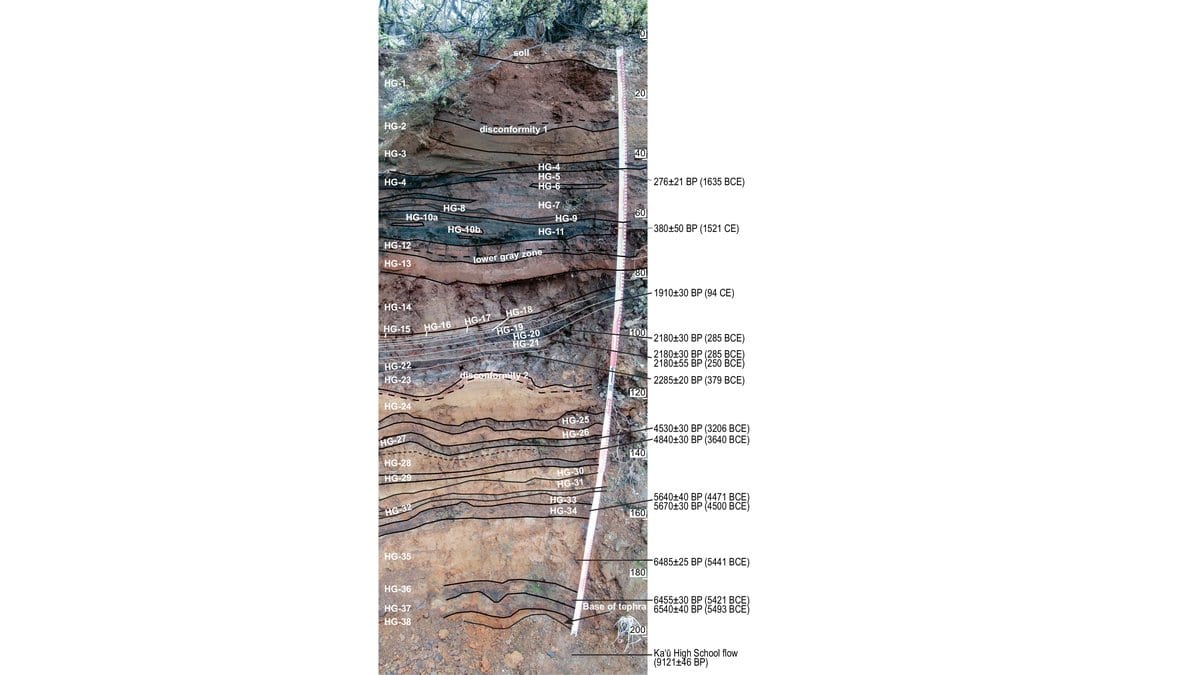
Midway up the southeastern flank of Mauna Loa, about where the forest gives out, a gulch called Hiʻonamoa cuts a two-meter face into the mountainside. None of it is lava. It is ash, bed on bed, some layers no thicker than a finger. Hawaii's volcanoes have a reputation for pouring rather than exploding. This wall is what the reputation leaves out.
Julie Chang and Frank Trusdell of the U.S. Geological Survey's Hawaiian Volcano Observatory worked the outcrop over five years, measuring every bed and picking charcoal out of it. Their description, published Sept. 3 in Bulletin of Volcanology, counts 38 tephra horizons in the wall, each a separate fall of volcanic ash.
Fifteen radiocarbon dates came back from 10 of those layers. The oldest is about 6,500 years old. One date landed out of stratigraphic order; the calibration software flagged it, and the authors set it aside.
Out of that come two averages, and they disagree. The blunt one divides the 38 layers into the roughly 9,000 years since the lava flow the section rests on: an ash fall every 240 years. The other averages the 11 intervals the dates allowed them to measure directly, and lands on 133 years. That second one, the authors write, is the best estimate.
Neither number is Mauna Loa's. The intervals were calculated, the paper says, "without regard to volcanic source," and the source here is demonstrably mixed. The outcrop sits about 20 km from Mauna Loa's summit and 35 km from Kīlauea's, in range of both. Glass grains from the section, analyzed by laser and released as a public USGS dataset, put two layers in Mauna Loa's chemical field and two others in Kīlauea's. What the averages describe is how often this one hillside was covered with ash, by whichever volcano.
An average also hides what the authors most want noticed. The real gaps between ash falls here are wildly uneven: decades in some stretches, most of a millennium in others. The paper gives that range twice and not the same way: the abstract and the results say 15 to 882 years, the conclusions 95 to 1,324. Nothing in the text reconciles the two. Both versions agree on the shape, though. Gaps that vary by more than an order of magnitude make an average with no rhythm behind it, and none of these numbers can say when the next fall comes.
That is worth holding onto beside the youngest date in the record, 1635 CE, which is not the same thing as the youngest eruption. Three ash layers sit above the bed containing that date, and none of them has been dated at all. Two are still fresh, with no soil developed on them, which is what a recent deposit looks like.
The record survives here, and almost nowhere else on this flank, for reasons the authors can name. The outcrop sits just below the trade wind inversion, a lid of warm air that keeps rising air from climbing higher, so ash settles around this height instead of clearing the summit. It sits at the tree line too: farther up, with no roots to hold it down, there is next to no ash left. Even so, the gulch erodes, and the authors note that any beds washed out of it would make the interval look longer than it was.
What the section hands volcanologists is a yardstick. Most of the layers are heavily altered, weathered toward clay, but even the oldest and dirtiest still hold a little fresh glass, enough to fingerprint chemically. That makes the outcrop a type section: a dated, described reference wall against which ash found elsewhere on the island can be matched. One bed here matches an ash of the same age 30 km east, probably from the same explosion. The glass compositions and field descriptions are published openly with the paper, so another team can check its own layers against them.
The hazard case sits in the thicknesses. “Since late 2024, Kīlauea’s ongoing eruption has produced less than a millimeter of ash at distances comparable to the gulch; several beds Chang and Trusdell sampled are centimeters thick. Something in the past was throwing far more ash, or the wind was carrying it better. Ash at that thickness grounds aircraft, hides lane markings, irritates lungs, and eats through fencing and water lines, whichever volcano sent it.
Chang and Trusdell call the recurrence calculation a first attempt, and it reads like one: a single outcrop, a minority of its layers dated, two averages ranked against each other, a repose range stated two ways. More sampling, they write, may yet turn up beds nobody has recognized. What the wall does support is a decades-in-the-making argument that Hawaii's shield volcanoes explode far more often than the textbook picture allows. A 2009 study of one Kīlauea ash put the rate an order of magnitude above the older estimate, and this section agrees with it. Turning that into a number meaningful for either volcano will take more hillsides.
Sources
- Bulletin of VolcanologyPeer-reviewed
- doi.org
- doi.org