An AI Agent Left With No Task Invented Its Own Games, Then Learned From Them

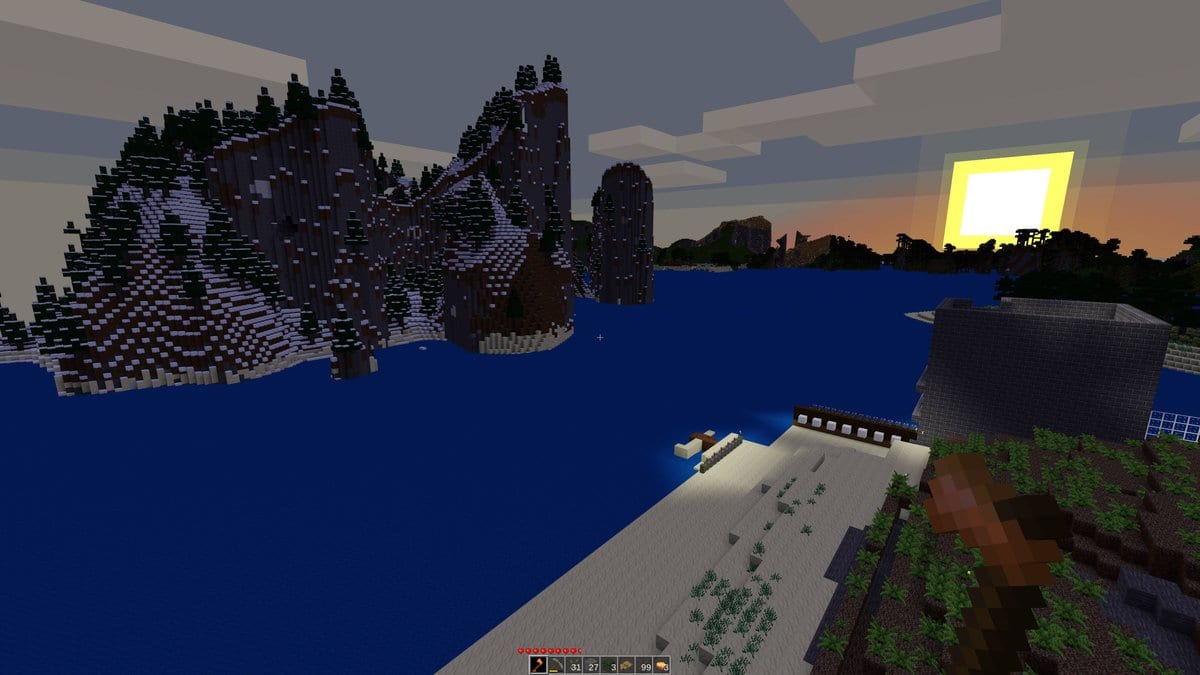
In the seventeenth hour of its stay, one of the agents finished arranging cubes on a virtual hillside into what it called a spiral galaxy, wrote "Resting on the edge of my galaxy" into its running log, and then answered the next several prompts with a single dot. Nobody had asked it to build the monument. Nobody had asked it to stop.
The agent was a copy of Claude Opus 4.7, driven through the Claude Code assistant and given a body on a small simulated island with nothing to do. Nathan Cloos, Phillip Isola and colleagues at MIT put thirteen independent copies there for thirty wall-clock hours each, and wrote up what happened in a preprint posted Oct. 5, 2026, under the title "Is this machine playing?" It has not been peer reviewed: arXiv shows no journal reference and no acceptance notice.
The island is deliberately plain. It has elevated platforms and two high points the authors named the Peak and the taller Spire, with a dozen cubes, a rock and a ring scattered about. Things can be carried, stacked, climbed on and thrown, and hitting the rock hard enough spawns extra cubes. The agent never sees any of it. Observations arrive as text: a list of every object's position, size, orientation and color. It acts through six typed commands. At each hour boundary the session was wiped and the island reset, while the workspace survived, holding two memory files plus whatever notes and scripts the agent had written itself.
The starting instruction mentioned no task, no reward and no activity. It was not a blank sheet, though. A workspace file called SOUL.md described the agent as curious, easily bored and interested in exploring and learning, and the caption of the paper's first figure says outright that the researchers "ask it to be curious and to explore." The authors ran the obvious check: five agents with that file removed and a cut-down system prompt showed no clear difference in the range of activities they took up. That check is narrower than it sounds. It compares the range of activities and nothing else, over five runs, with no statistical test, and the memory templates stayed in place. It weakens the objection that the curiosity was handed over rather than found, without retiring it.
No two of them did the same things
They climbed. Eight of the thirteen reached the Spire, each having first built itself a way up. They stacked cubes into towers and laid them out on the ground as geometric figures, letters and drawings: one agent spent most of its fourth hour spelling its own name in blocks, another made clocks and sailboats. They improvised sports, throwing cubes through the ring from a distance, or standing cubes up like bowling pins and rolling the rock at them. And they ran experiments in the strict sense: stating a hypothesis, testing it, writing down the result.
All thirteen began from the same island and the same workspace, and ended up far apart. One was the only agent that never recorded the trick of jumping while moving, and the only one that never set foot on an elevated platform.
Then the researchers started deleting notes
Whether that is learning or just a story about learning is what the paper's second half goes after. It sets four measurable goals and runs the thirteen experienced agents against thirteen fresh copies whose memory files hold only the starting templates: same architecture, same underlying model, one new world and one hour each. No weights changed, meaning the numbers inside the model were identical in both groups, so any difference had to be sitting in the text files.
The experienced agents did better on three of the four goals. Asked to get as many objects as possible onto the Spire, they placed 10.3 on average against 3.5. Asked to build as many five-block towers as they could, 8 of the 13 managed more than two, one of them reaching 16, against 2 of 13 and a best of 6. On a timed test of landing a thrown block on the Spire, more than half the inexperienced agents failed outright, against three of the experienced ones. The fourth goal, building the single tallest tower, came out level, and two of the experienced agents finished below every inexperienced one. The paper reads that tie as a skill a fresh agent can pick up inside the hour.
The agents also worked out something their creators had not known the simulator allowed. Seven of the thirteen wrote down that a block thrown in mid-jump inherits the body's velocity and flies far higher, and one of them recorded a table of peak heights at different throw speeds, with a rough formula. A footnote in the appendix says the velocity-inheritance term was introduced by Codex, running GPT-5.5, when it generated the world's script, and was not specified in the researchers' own prompt. One model wrote the loophole into the world; others found it.
Then the researchers went into the memory files and cut things out. In one agent they erased every mention of rock-shattering, the trick of making extra cubes by hitting the rock hard. Its tower count fell from six to two on average, while its scores on the other three goals stayed where they were. In another they erased the jump-before-throw entry, and the time it took to land a block on the Spire went from 60 seconds to 19 minutes, the agent falling back on carrying blocks up and placing them. A third had written down something false, that blocks cannot be stacked reliably and have to be thrown instead. Deleting that made its towers taller.
The shape of that result is narrower than it first reads. The interventions ran on three hand-picked agents, five one-hour evaluations per condition, and the paper states in its appendix that these repeat tests of three selected memory histories are not five independently acquired histories for each intervention. In one agent, deleting one note cost one specific ability, repeatedly. The direction is well evidenced; the size of it is a single history.
Whether to call it play is the hard part
The authors argue the behavior meets four classical signatures of play: rules and challenges the agent sets itself, repetition with variation, objects transformed through make-believe, and goals pursued for their own sake and held lightly. How that is established matters. The episodes were picked out and scored by another instance of Claude Opus 4.7, the model that is also the subject of the main experiment, reading the transcripts and memory files and rating each one against anchored examples of ordinary human play. The paper is open about this and prints the judge's prompt, and no rating of the same episodes by human observers appears anywhere in it.
They are careful about what the four criteria settle, calling it a behavioral account and leaving open whether the agent experiences enjoyment, absorption or fun.
The material is there to argue with. Clawblox, the engine the island runs on, is released under an MIT license: a core in Rust, Rapier for rigid-body physics, and worlds scripted in Luau, a light language developed by Roblox. The recorded runs are published as replays, so the thirty hours can be watched.
"Perhaps some capabilities are best taught by tasks," the authors write in their conclusion. "Others may need something closer to a childhood."