In Two Brains Recorded at Once, Cooperation Shows up in the Amygdala

The hard part of cooperating is not the wanting. Two people can both prefer the outcome where they help each other and still miss it, because neither can see what the other is about to do. Each has to guess, and act on the guess.
A paper published Oct. 19, 2026, in Nature Neuroscience follows that guess through two brains at once. Jun Ni, Yina Ma and colleagues at Beijing Normal University worked with neurosurgical teams at Beijing Tiantan Hospital and the Chinese PLA General Hospital. Their participants were pairs of epilepsy patients who already had electrodes inside their brains, implanted to find the source of seizures that drugs could not control. Each pair played a repeated prisoner's dilemma against the other, round after round, while both sets of electrodes recorded at the same time.
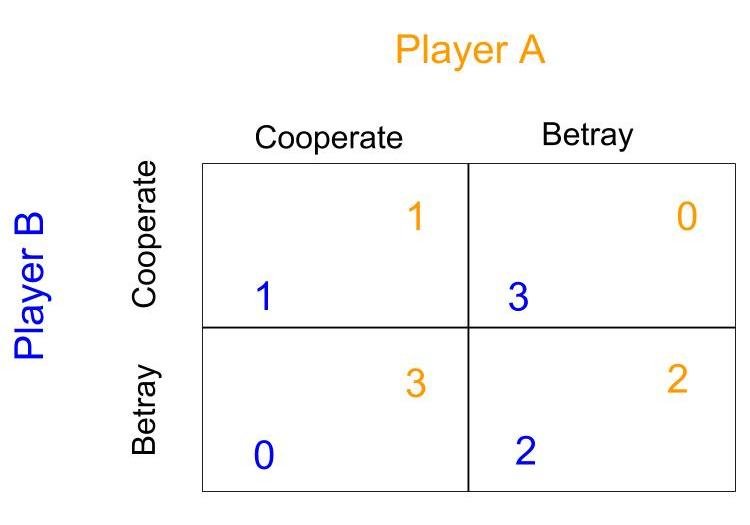
That game is the laboratory version of the problem. Each round, both players choose whether to cooperate. Mutual cooperation pays better than mutual refusal, but a player does best on any single round by refusing while the partner cooperates. Played once it rewards betrayal; played over and over against the same person, it becomes a question of reading them.
On the rounds where both players cooperated, the researchers report, the fine detail of activity in the two amygdalas grew more alike. Not louder, and not beating in time: alike in pattern, the spread of power across frequencies in one amygdala resembling the spread in the partner's. They call it interbrain representational alignment. It showed up during mutual cooperation and not during the other outcomes. A classifier given nothing but that alignment, tested on pairs it had never been trained on, could tell above chance whether a pair was about to cooperate.
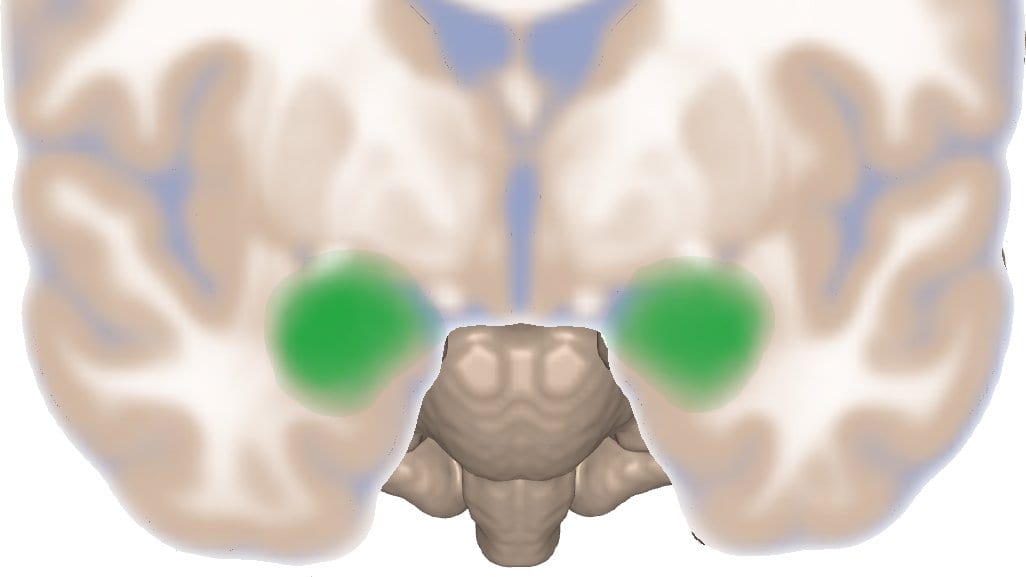
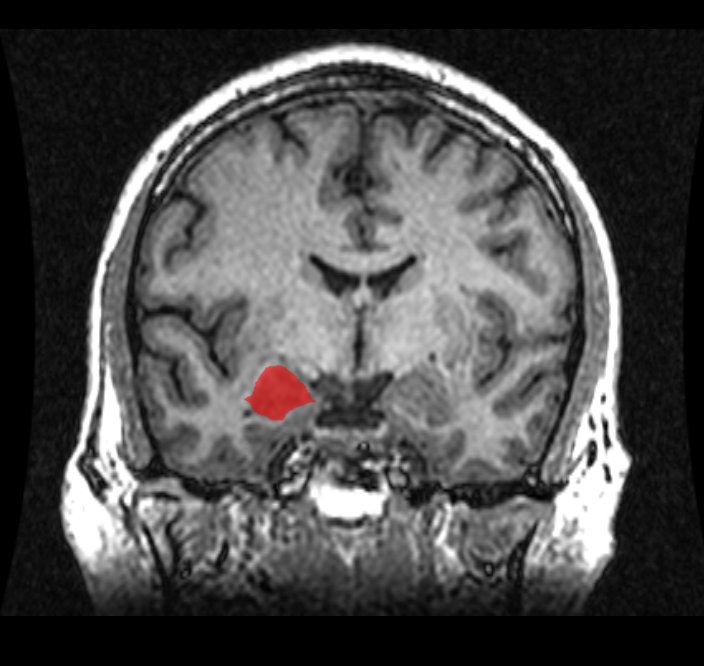
The amygdala is an odd place to find this. It is known for threat, vigilance and value, not for keeping track of what a partner intends. The team also recorded from the temporoparietal junction, a hub for social thinking, and found alignment there on cooperating and non-cooperating rounds alike. Only in the amygdala did the alignment separate the two.
The alignment arrived in two stages. The first came within about a third of a second of the round opening, carried by a dip in the slow theta rhythm, and it was sensitive to the pair's history together. The second ran from roughly half a second to a little past one second, marked by a dip in low-frequency activity together with a rise in fast gamma, which the authors tie to committing to the choice and acting on it.
Two people doing the same thing at the same moment will look alike for dull reasons, and much of the paper's extended analysis goes on those. There was none of it in the pause before a round opened, so this is not a standing resemblance between two people in the same situation. It held when trials were matched on how long each pair took to decide, which rules out two players simply choosing at the same speed, and through several changes to how the signals were measured.
The authors also propose a sequence. They fit a model to each player's choices to recover, for every round, that player's forward estimate of how likely the partner was to cooperate. A dip in the amygdala's slow, low-frequency activity tracked that estimate, and coupling between the region's theta rhythm and its fast gamma activity linked the partner estimate to the player's own decision. The authors call the chain a simulation-to-decision cascade. Their wording is deliberately narrow: the cascade is operationalized, meaning defined for the analysis as a forward estimate of the partner that guided the player's own choice. Nothing in the design switches the amygdala off to see whether cooperation fails, so the sequence is a model the data fit rather than a cause the experiment isolated.
The pairs also divided into two kinds of cooperator. The ones the authors call conditional cooperators leaned on tracking the partner, their cooperation following the estimate. The unconditional cooperators did not lean on it; what carried them was a disposition to tolerate uncertainty, which let them slide into alignment in anticipation rather than in response. Cooperation, on that reading, is not one trait done well or badly but at least two routes to the same outcome.
Recording two interacting human brains from the inside is not new, and the group that did it first is this one. The paradigm appeared in Nature Neuroscience in 2025, from a team sharing six authors with this paper, including its senior author, at the same three institutions. New here are the alignment measure, the game, the proposed cascade and the split between the two kinds of cooperator. It also means the closest comparable recordings in the world sit in the same laboratory.
Everyone in the study has drug-resistant epilepsy and was recorded in the hospital while clinicians looked for the origin of their seizures, which is the only circumstance in which anyone listens to a human amygdala directly. That makes the sample a patient sample, and small, as every study of this kind is. Processed data and the analysis code are posted in a public repository; the raw scans and recordings are restricted to protect patient privacy.
What the paper pushes on is the unit of measurement. Brain-to-brain recording outside the skull has been done for years, in classrooms and in laboratories; what is rare is listening to two amygdalas at once, from the inside. Measured across the pair, the quantity that moves is the resemblance between them.
Sources
- Nature NeurosciencePeer-reviewed
- www.nature.com