The Crystals in a Volcano's Black Pumice Grew Near the Surface, Not Deep Down

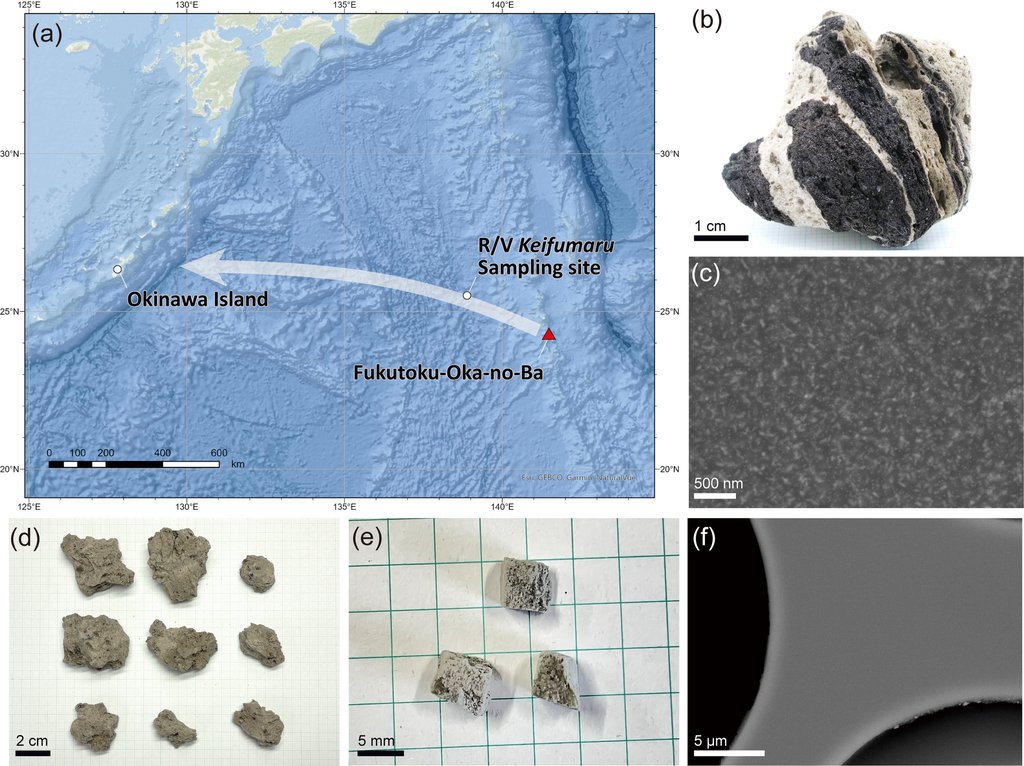
The pumice collected along the eastern coast of Okinawa Island on Nov. 2, 2021, was mostly gray. A few clasts were black, and some carried black lobes inside a gray matrix, the mark of two magmas that mingled once and then froze. All of it had floated there from Fukutoku-Oka-no-Ba, a submarine volcano in Japan's Izu-Bonin arc that erupted on Aug. 13, 2021.
Under an electron microscope the black glass is crowded with crystals, from magnetite about 10 nanometers across to clinopyroxene a few hundred nanometers long. Where they grew decides what they are. Deep in the magma reservoir, they could have stiffened the magma and given bubbles somewhere to form, and so helped drive the eruption; in the shallow conduit, they are a record of its later stages instead.
Taisei Ukita and Michihiko Nakamura of Tohoku University, with colleagues at the National Museum of Nature and Science in Tsukuba and at Hokkaido University, went at the question in a furnace. The gray pumice, which the paper treats as "lacking an abundant nanocrystal assemblage," became the starting material: four clasts, cut into millimeter cubes and reheated in sealed silica tubes with water vapor. Their results were published Nov. 28, 2026, in Bulletin of Volcanology.
The texture came back at shallow pressure, not at depth
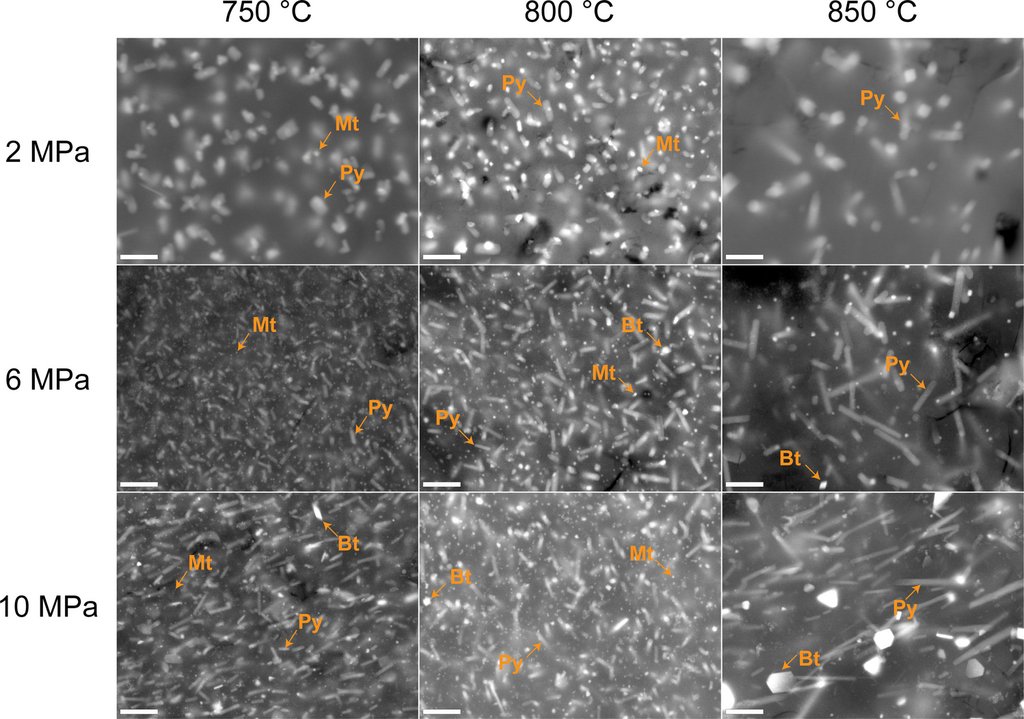
Across the low-pressure series the closest match was a 12-hour run at 800 °C and 6 MPa, which Ukita and colleagues report "most closely reproduced the groundmass texture of the natural black pumice" in both its minerals and its crystal count. In the natural clasts, crystals were counted by hand on electron images in eleven of the most crowded patches across five black pebbles, giving 7.9 × 10¹² to 1.6 × 10¹⁴ per square meter of glass. The run product averaged 5.7 × 10¹³, inside that range.
The other hypothesis got a single run, in a cold-seal pressure vessel at 200 MPa, against the roughly 250 MPa estimated for the reservoir beneath Fukutoku-Oka-no-Ba, FOB in the paper's shorthand. The vessel could not reach that pressure and the reservoir's estimated 930 °C at once, so the pressure was kept and the temperature dropped to 800 °C. Plenty crystallized, in crystals tens of micrometers long, but the count came to between 4.0 and 9.2 × 10⁹ per square meter, with about 2.9 × 10¹¹ in a zone of crystals grown during the quench that the authors do not treat as representative. Two to four orders of magnitude below the natural pumice — and no biotite at all.
That run is the conservative test rather than a weak one: less heat means more undercooling than the reservoir would supply, and undercooling is what makes crystals nucleate in great numbers.
A mica grew where it has no business being stable
The biotite is the part that reads as a depth gauge. Biotite, a common mica, is normally stable only above about 0.1 to 0.2 gigapascals, so finding it among the finest groundmass crystals usually means it grew where it is not truly stable. In the experiments the platy biotite crystals, about 100 nanometers across, appeared only at 6 MPa and above, and only over part of the temperature range: between 750 and 850 °C at 10 MPa, and from 800 °C up at 6 MPa. At 2 MPa they never appeared, and under the most oxidizing conditions tested they did not form within the 12-hour run. The hexagonal biotite plates in the natural black pumice therefore constrain both the pressure and how oxidizing the magma was.
Three hours was all the texture needed
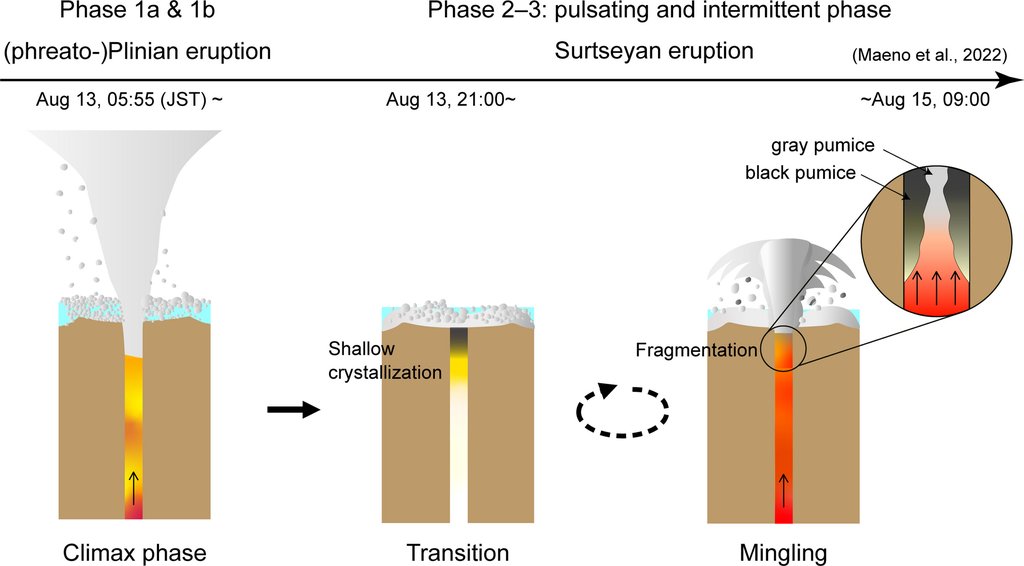
At 6 MPa and 800 °C the assemblage and the crystal count after three hours were much the same as after 12 and after 48, so this texture builds in hours. The eruption left time for it. A 2022 reconstruction by Maeno and colleagues puts about 15 hours of sustained, water-fed explosive activity at the start, after which the eruption settled into intermittent shallow-water bursts, with a lower discharge rate that would have left magma lingering, cooling and degassing in the conduit. The rafts agree: the pumice the Japan Meteorological Agency's vessel Keifumaru took from the raft's leading edge on Aug. 22, 2021, was gray, with no black or banded clasts identified, while black ones appear in the later Okinawa collections. Floating pumice is a buoyancy-selected sample and black clasts may have sunk, the authors note, so the contrast supports their reading without settling it.
Inside a banded clast the contact between black and gray glass is sharp, with no chemical blurring wider than half a micrometer; had the two magmas met at reservoir depth and risen together, diffusion should have smeared it over two to seven micrometers, the authors calculate.
That rearranges a 2023 account of the same eruption. Kenta Yoshida and colleagues, writing in Scientific Reports in May 2023, measured more oxidized iron in the brown, crystal-bearing glass than in the colorless glass and read it as a pulse of oxidizing fluid from hotter magma below, crystallizing the nanocrystals in the reservoir and triggering the explosion. The new paper questions the evidence as well as the conclusion: the X-ray spots were about 4.5 micrometers across, far larger than the magnetite crystals, so each measurement took in many of them, and the readings "do not necessarily support extrinsic magma oxidation by external fluids." The oxidation may have been intrinsic: a by-product of magnetite crystallizing, not its cause.
Both papers are peer-reviewed and open access, and the argument is not over. What stands behind the new reading is one laboratory, one volcano and a single high-pressure control run that nobody has yet repeated. The authors keep their own language conditional: the texture was "best reproduced at 800 °C and 6 MPa, suggesting a shallow conduit origin," and the dense assemblage, they conclude, did not predate the eruption but grew while magma sat at shallow depth in its later stages. On the trigger they are narrow: "In the 2021 FOB eruption, nanoscale crystallization in the shallow conduit did not trigger the onset of the explosive eruption in our model." Once formed, the crystals may still have stiffened the magma and shaped the phases that followed.
The result reaches beyond one volcano. If a dense population of nanocrystals is built in the conduit within hours, a dark clast picked off a fresh raft becomes a short-term record of what the conduit was doing, and the authors write that such crystals "may record shallow magma intrusion or slow magma ascent." At a submarine vent, with nothing to watch from the surface, floating pumice may be the most direct sample an observatory gets. The experimental data are archived on Zenodo. The general point is in the paper's conclusions: "These findings challenge previous interpretations attributing a crucial role to nanocrystals in triggering eruptions."
Sources
- Bulletin of VolcanologyPeer-reviewed
- Scientific Reports