Rock That Flexes Sooner Delays West Antarctica's Retreat by Decades

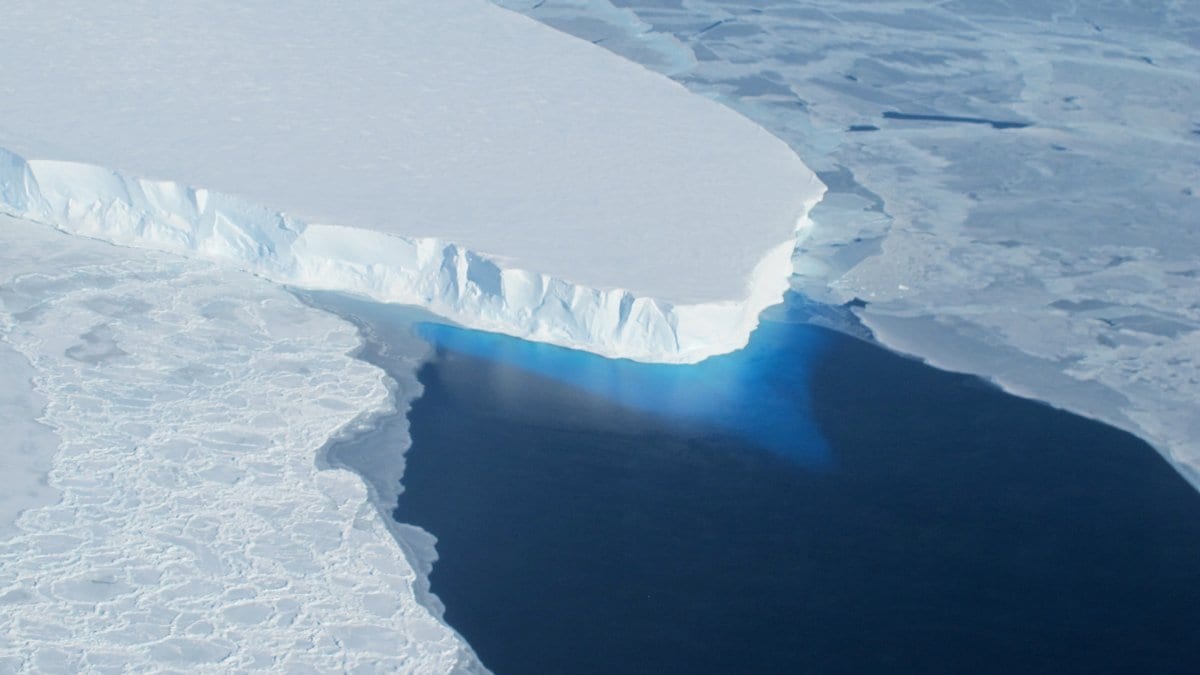
West Antarctica sits in a bowl. The bed under its largest glaciers slopes downward toward the interior, so when ice pulls back off a ridge, thicker ice follows it into the sea and the retreat feeds itself. One thing works against that. As the weight of ice comes off, the ground beneath rises, lifting the ice back toward shallower water and slowing the loss. How much protection that buys is not a glaciology question. It is a question about rock: How fast does hot mantle bend when a load comes off it?
Ice-sheet projections answer it with a description that rock laboratories set aside decades ago. In a paper published Nov. 25, 2026, in The Cryosphere, Allie N. Coonin of Brown University, with Natalya Gomez of McGill University and two colleagues, reports what happens when the laboratory answer goes in instead. In their runs, the grounding line, the place where ice starts to float, still retreats everywhere it did before. Where the change matters, it just gets there decades late.
The standard description gives the mantle two behaviors: an instant springy give that recovers, and a slow permanent flow that in most of the world takes thousands of years to matter. Squeeze real rock in a press and a third behavior appears between the two: a gradual bending, slow to arrive but recoverable, that acts over the decades and centuries modern ice loss occupies. The study puts that behavior, a creep law from Yamauchi and Takei, into a model where the ice sheet and global sea level evolve together, and runs it against the same model with the simple description.
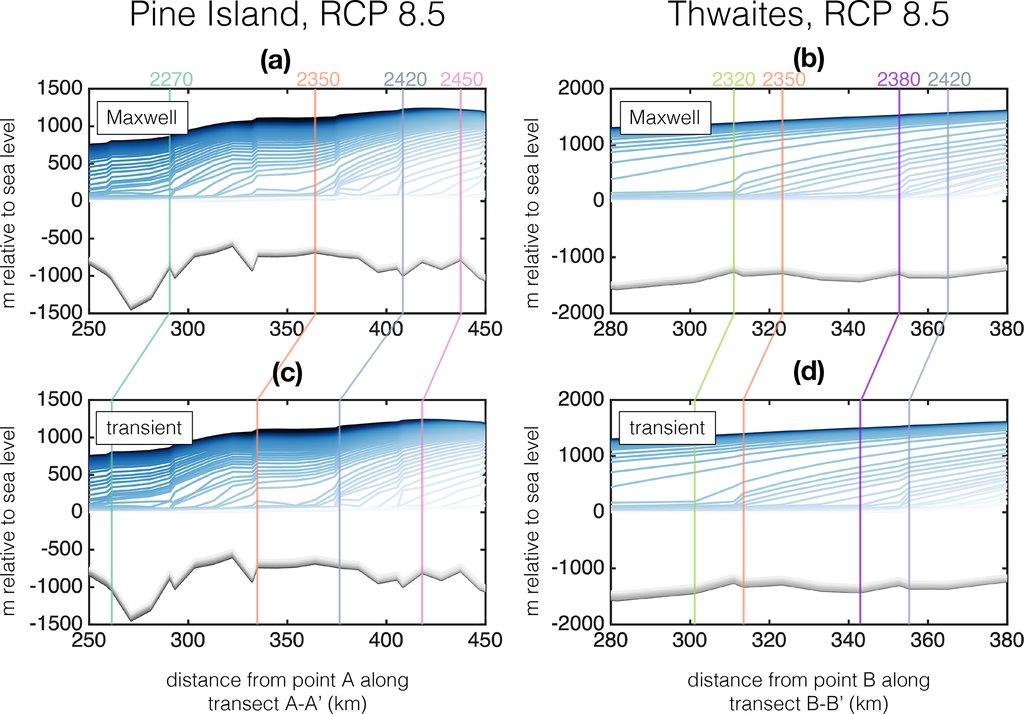
Under RCP 8.5, the highest of the three emissions pathways in the study, the two versions track each other until about 2300 and then separate. At every snapshot after that, the standard run's grounding line sits farther inland, by more than 30 kilometers, at both Pine Island and Thwaites glaciers. Under the two milder pathways, RCP 2.6 and RCP 4.5, Pine Island's grounding line finishes the simulation about 10 and 20 kilometers, respectively, short of where the standard model leaves it, the one place where the total distance shrinks and not just the schedule. At Thwaites, under those same two pathways, there is next to no difference.
The rebound was known. How fast it arrives was the question
That the bed rises and slows a retreat is not the new part. A 2018 paper in Science measured the uplift directly with GPS receivers anchored on rock around the Amundsen Sea and found it fast enough to stabilize the ice above. A 2025 study led by Luc Houriez found, with a different ice-sheet model, that bedrock uplift delays the retreat by decades at ridges upstream of Thwaites' present grounding line, a result that came from resolving the bed in finer detail, not from a different description of the rock. What Coonin and colleagues add is the comparison itself: not the first coupled model to carry recoverable creep, but the first to run it head to head against the simple description, with everything else held fixed, so the difference can only be the rock.
The mechanism shows up as speed. At 2300, in all three pathways, the ground at the two grounding lines rises 10 to 40 millimeters a year faster with the laboratory creep in the model than without it. Whether that extra lift buys anything depends on whether the rebound can keep pace with the melting. Where the ice goes fast enough, it cannot. Switch on the mechanism known as marine ice cliff instability — tall ice fronts failing under their own weight — under the highest pathway, and the two versions barely differ, because neither mantle can keep up. Under RCP 4.5 with the same cliff collapse, the gap instead opens to 50 to 70 kilometers at Thwaites. That is the largest offset in the paper and the shakiest: how ice cliffs break is still argued over, and the authors write that "these results should be viewed as a preliminary sensitivity test."
The saving is in the timing, not the total
Add the delays up and the water saved is thin. By 2500 the runs with laboratory creep deliver a few centimeters less sea-level rise from West Antarctica than the standard runs do, against a West Antarctic contribution of roughly 0.6 to 2.5 meters, and the authors call that reduction "small and likely within the uncertainty in dynamic ice sheet model projections." Early on it even runs the other way, as the faster-rebounding ground pushes seawater out of Antarctica's below-sea-level basins.
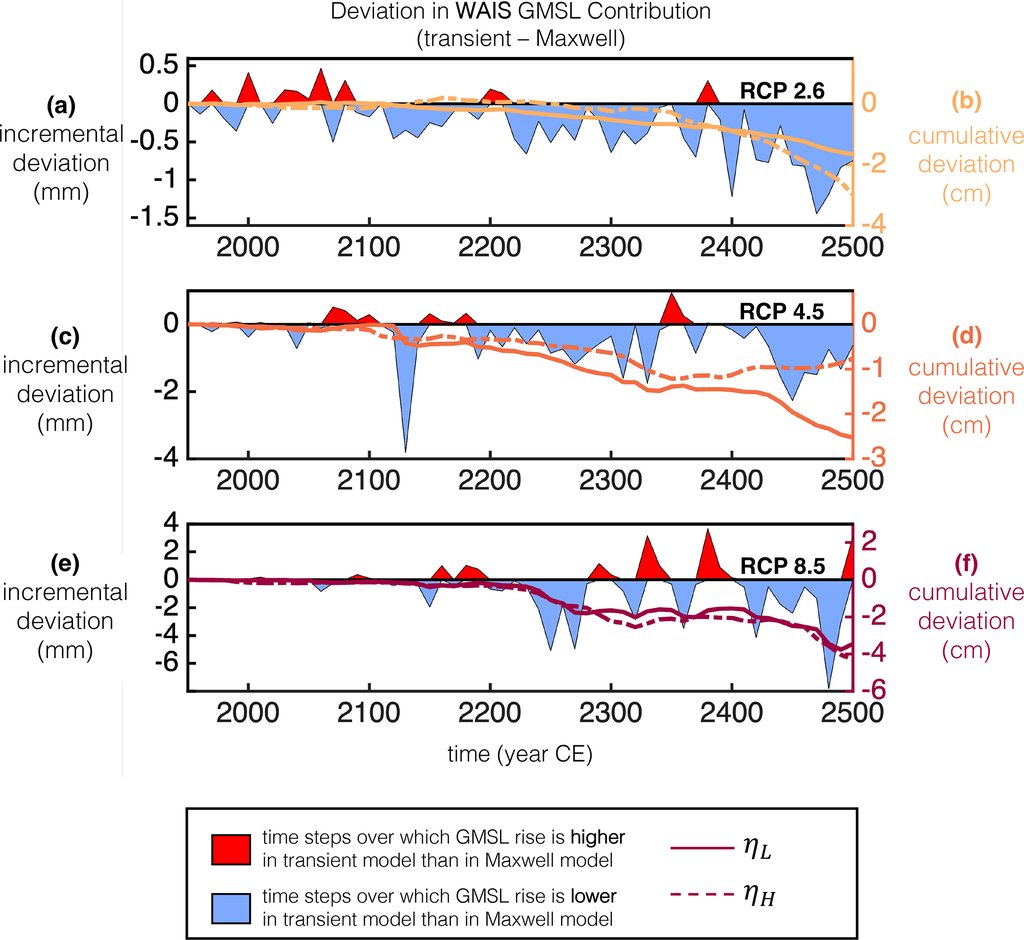
What the delay changes is the rate. Retreat never stops in any run, and over centuries the two versions converge. The authors' summary is that "drastic ice loss still occurs regardless of the assumed solid Earth rheology, but the pathway there varies". A later retreat is a slower one, and the pace of sea-level rise is what coastal adaptation is planned against. The rate of retreat also sets how fast fresh meltwater reaches the Southern Ocean, which other studies tie to expanding sea ice and to heat building under the ice shelves.
GPS could rule on the extra uplift
This is a result about models, not a measurement of Antarctica, and the paper is specific about which model. Ice flow comes from the PSU3D ice sheet and shelf model on a 10-kilometer grid, as fine as a continent-wide run can afford, handing its ice volumes to a gravity-consistent sea-level model every decade out to 2500. The mantle varies with depth only, not from place to place, and the softer of the two profiles used, the one thought to lie under West Antarctica, carries the headline runs; adding side-to-side variation is the authors' own next step. Ice outside Antarctica is held fixed by construction. And no number in the paper carries an error bar: Each is the difference between two runs. The model outputs and code are posted publicly, and the referee reports sit beside the paper.
The sharpest objection is the authors' own. The reason anyone thinks the mantle under West Antarctica is soft is that measured uplift says so. They write that it is unclear whether that softness is the rock's long-term property or is itself the creep this paper adds, already showing in today's data. If it is the second, part of the effect has been counted twice. Different laboratories' creep laws behave differently, so the choice carries into the answer. What makes the result testable is the rate: The paper's standard uplift rates are already about as large as the uplift observed around the Amundsen Sea, and the laboratory creep adds as much again on top. Only the standard rates are checked against observation, which leaves the faster prediction standing in front of instruments that can, given enough years, rule on it. If it holds, the schedule Antarctica keeps is partly set by rock physics.