More Plastic Falls on Swiss Lakes From the Air Than Sewage Plants Release

Switzerland puts a great deal of engineering between its households and its lakes. Wastewater runs through a treatment plant before it reaches a river, and the country knows roughly what comes out the far end. Above all that plumbing there is a second delivery route, with no valve anywhere on it, and it arrives with the rain.
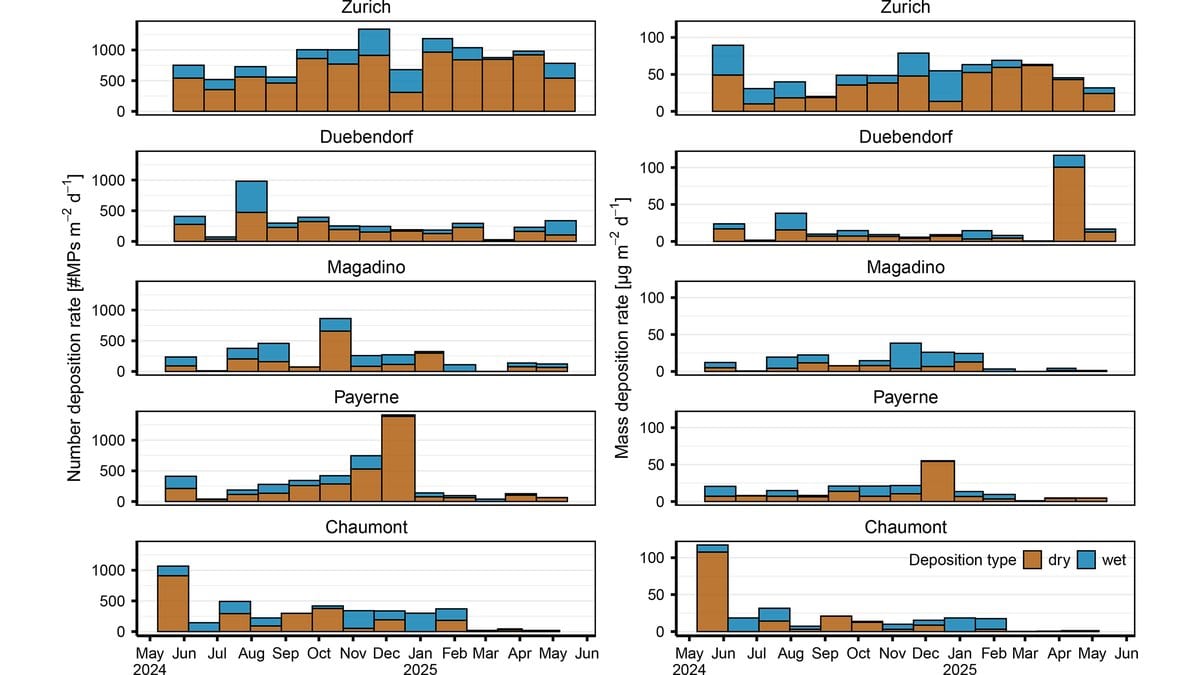
A team led by Narain M. Ashta at Empa, the Swiss federal materials laboratory, set out to weigh it. Working with the water research institute Eawag and the agricultural research center Agroscope, they collected rain and settled dust at five places for a year from May 2024: central Zurich, suburban Dübendorf, rural stations at Magadino and Payerne and the Chaumont ridge in the Jura mountains. Country-scale figures for how much plastic falls out of the air remain limited, and the team set out to establish a Swiss number produced by a method whose margin of error was known.
Their answer, published Aug. 20 in the open-access journal Atmospheric Chemistry and Physics, is that about 10 metric tons of microplastic a year lands on Swiss lakes and rivers straight out of the air.
The other way in already had a number. Guillaume Crosset-Perrotin and colleagues, an overlapping group working on the same federally funded project, sampled the sludge at 51 Swiss treatment plants and reported in ACS ES&T Water on July 13 that those plants together discharge about 4.7 metric tons of microplastic a year into surface waters. The sky, then, delivers roughly twice what the treatment plants do.
The two figures are not like for like, and the difference cuts in more than one direction. They cover different size ranges and were measured in different materials, and the wastewater number counts treated effluent only, not street runoff and not the storm overflows that skip a plant in heavy rain. Which route delivers more in total is not something either study settles. What the pair does show is that the route nobody has been counting is no rounding error beside the route everybody does.
That water figure is one slice of a national total. Scaling the sites up with land-use statistics, the team put the plastic settling on Switzerland at about 219 metric tons a year, and that figure carries three conditions wherever it goes. It counts only particles between 20 and 215 micrometers. It covers only the country below 2,000 meters. And it leaves out tire wear, which the same project is measuring separately and which is usually the largest single source of microplastic by mass, so the real total is higher, not lower.
It is, on top of that, a scale-up from a handful of collectors to a whole country, and the team is open about how wide the bounds are: the plastic arriving at the Zurich site averaged 53 micrograms per square meter per day, with a 95% confidence range of 17 to 107. Read the national figure as an order of size, not an audited total.
About 78 metric tons of the national total settles on farmland, a route into soil that needs nobody to spread anything, unlike the plastic that arrives with organic fertilizers.
Where it lands was the part the team had not expected. Zurich was the highest, but the other sites came out much alike, whether they sat in farmland on the Magadino plain or on the Chaumont ridge in the Jura. "The closer to densely populated areas, the higher the amounts we would have expected. But we do not see such a difference," said Christoph Hüglin of Empa, the study's senior author, in a statement released by the institute.
Comparisons across borders are shakier still. Deposition studies use different instruments and different size windows, Hüglin explained in the release, which makes many results hard to compare with one another. A Swiss figure set beside a foreign one is measuring the difference between laboratories as much as anything in the air.
What the study cannot say is what any of this does once it lands. It identifies particles by infrared light and converts them to a mass; harm to soil life, to fish, to crops or to people is measured nowhere in it. Hüglin's closing thought in the release is offered as an opinion, not a finding: plastic is a very good material for many uses, but on precautionary grounds littering should be avoided, plastics used only where they are needed and material cycles closed as far as possible.
For anyone writing water rules, the arithmetic is the point. Money and law have gone to the pipe, because a pipe can be metered, filtered and upgraded. The larger of the two falls on the open surface of the lake, and there is no outlet on it to fit anything to.