When New Forests Grow, the Ocean Takes Centuries to Finish Responding

Run a climate model long enough and you can do things to a planet that nobody can do to this one. A team in British Columbia began by stripping every forest off a simulated Earth, leaving nothing on land but grass, and let that bare world settle for 1,500 years. Then the researchers planted the trees back, not everywhere, but on every other square of a checkerboard laid across the land. The empty squares were the point. With half the land forested and half of it still grass, anything that happened over the grass had to have traveled there from somewhere else.
That checkerboard is a standard way of separating what a forest does to the ground beneath it from what it does everywhere else. What Pierre Etienne Banville, Alexander J. MacIsaac and Kirsten Zickfeld of Simon Fraser University added was the ocean. Their study, published Sept. 24 in Earth System Dynamics after open review with the referees named, ran the planting twice: once with a full ocean free to circulate and soak up heat and once with the sea surface held at fixed temperatures, as many land-focused climate studies do.
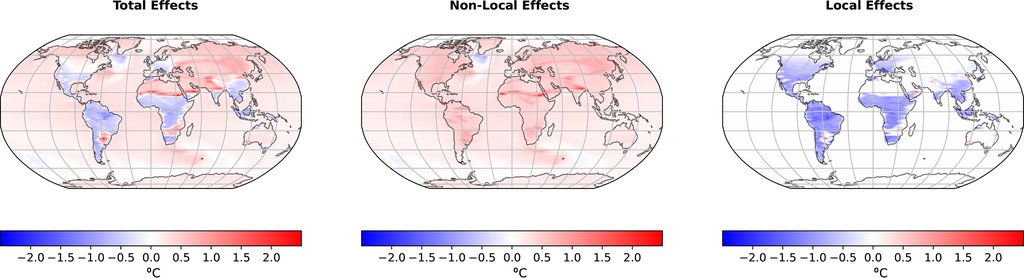
A forest is darker than grassland, so it reflects less sunlight and takes in more. In this model it also releases less water than the grass it replaced, which the authors point out is contrary to most models. Less evaporation means less of the heat leaving the surface as water vapor. Both processes warm the ground. What more than cancels them is the heat the forest passes straight up into the air above it, and the sum comes out cooler under the new trees, most strongly in the tropics, where the broadleaf trees carry the most leaves.
That heat does not stay over the forest. The warmed air drifts away from the planted squares, and warmer air holds more water vapor, which is itself a greenhouse gas. So the rest of the planet, including all the land left in grass, ends up warmer. No observation can capture this part, since there is no unplanted Earth to measure against; it exists only in models.
One thing was held still through all of it. Carbon dioxide stayed at pre-industrial levels in every run, on purpose, so that the physical effects of the trees were the only thing that could move. The cooling a forest buys by pulling carbon out of the air is not in this experiment, and no net temperature figure for reforestation appears anywhere in the study.
A separate group has answered the net question with a different model. Nora L. S. Fahrenbach and colleagues, running three real-world reforestation plans in a fully coupled Earth system model, reported in March 2026 in Communications Earth & Environment that reforestation "consistently provides net global cooling, ranging from −0.13 °C to −0.25 °C" by the end of this century, with the physical warming offsetting part of the carbon uptake, not erasing it. On the physics the two papers agree: cooling in the tropics, warming at higher latitudes where the land gets darker and effects that travel.
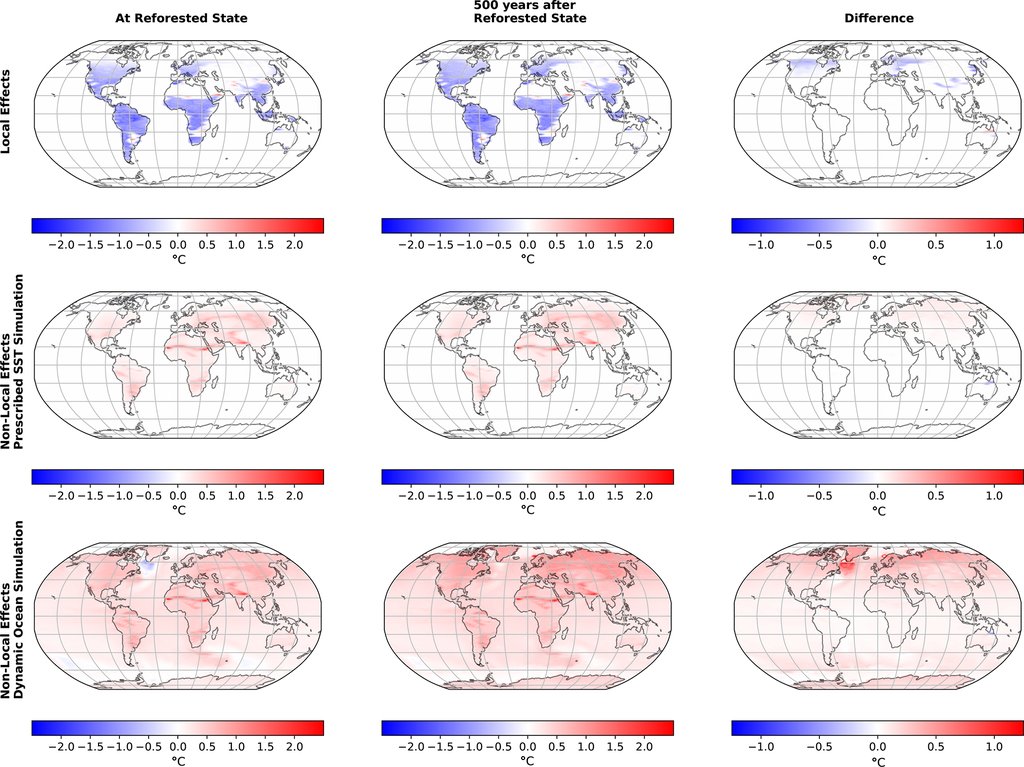
Back to the Simon Fraser runs. In the ones where the sea surface was held at fixed temperatures, the warming far from the forests was modest. With the ocean free to move, the same distant warming was of "much greater magnitude" and covered "a greater geographic area, particularly at high latitudes." The chain runs through the water. Warmer, wetter air over the sea raises the sea surface temperature, and a warmer sea evaporates more, putting more water vapor into the air everywhere. At high latitudes the added warmth melts sea ice, uncovering dark water that absorbs the sunlight the ice used to bounce away.
The authors note that the timing had not been looked at before, and it is the result they build the study on. That the effects travel at all was established earlier, by an independent group that reported in 2022 that global-scale forestation shifts both atmospheric and ocean circulation. By year 500 the forest had finished growing and the cooling under it had settled, and in the fixed-sea runs the distant warming had settled too. In the runs with a live ocean, however, the warming kept strengthening for another 500 years. The ocean is vast and slow to come into balance with the air above it, and heat pushed into the deep can surface again centuries later. What results is a committed warming, the phrase borrowed from the warming already locked in by the carbon dioxide people have emitted.
Reforesting half the world's land is not a policy; it is a lever pulled all the way over. The team ran the experiment again on a quarter of the grid squares, an extent they describe as closer to how much forest has historically been cleared, and got the same patterns at roughly half the size. The study utilized the University of Victoria Earth System Climate Model, which is relatively simple by design. It works on a coarse grid and treats the whole atmosphere as a single layer, so it carries neither clouds nor shifting winds. The researchers expect that clouds, once included, would weaken the distant warming in the tropics and strengthen it at high latitudes, cutting into the amplification they report.
What the team takes from this is an argument about time. Under the Bonn Challenge, 115 countries have committed to restore a billion hectares of land by 2040, and net-zero targets are written for dates that fall well before the ocean in this simulation finishes responding. Forestation brings real benefits for ecosystems and for the species living in them, they conclude, but "their use in net-zero policies should be carefully considered"; they would rather see a ton of emitted carbon dioxide balanced by a ton locked back underground. That is their interpretation of the model's implications, not something the simulation measured.
In the simulation, the trees stopped growing at year 500. The ocean was still answering at year 1,000.