Cells That Keep a Record of Which Genes They Switched On
Every single-cell RNA measurement is also an ending. To learn which genes a cell had switched on, you break it open and read what spills out, and from that moment the cell has no future against which to compare its past. Biologists have built a great deal on that bargain. It still leaves one question out of reach: what was this cell doing before anyone had a reason to watch it?
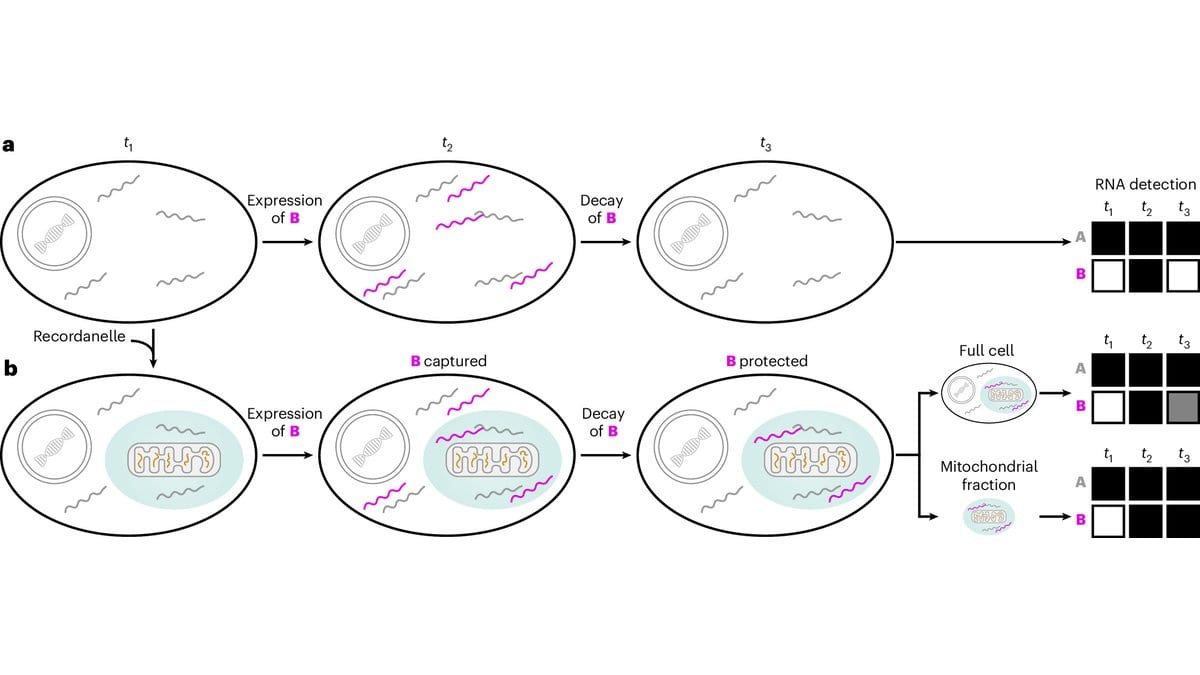
A group at ETH Zurich's Department of Biosystems Science and Engineering, in Basel, has come at it from the other side, by leaving the cell alive and giving it somewhere to keep a copy. Writing in Nature Biotechnology on Oct. 21, 2026, Christopher D. Reinkemeier, Marcos Manero-Carranza and colleagues describe what they call a recordanelle: a synthetic organelle made from a single protein. It collects messenger RNA, the working copies a cell makes of its active genes, and holds it beyond the reach of the enzymes that would otherwise take it apart.
The protein has three working parts. One end anchors the assembly to the outer surface of a mitochondrion. The middle is a sticky, shapeless stretch that makes the whole thing condense into a droplet with no membrane of its own. The far end grips the tail that mammalian messenger RNAs carry, which makes the catch general rather than aimed at a few chosen genes. The finished recorder is a single protein, small enough to deliver with the gene-delivery viruses laboratories already use. The paper, its code and its data are public.
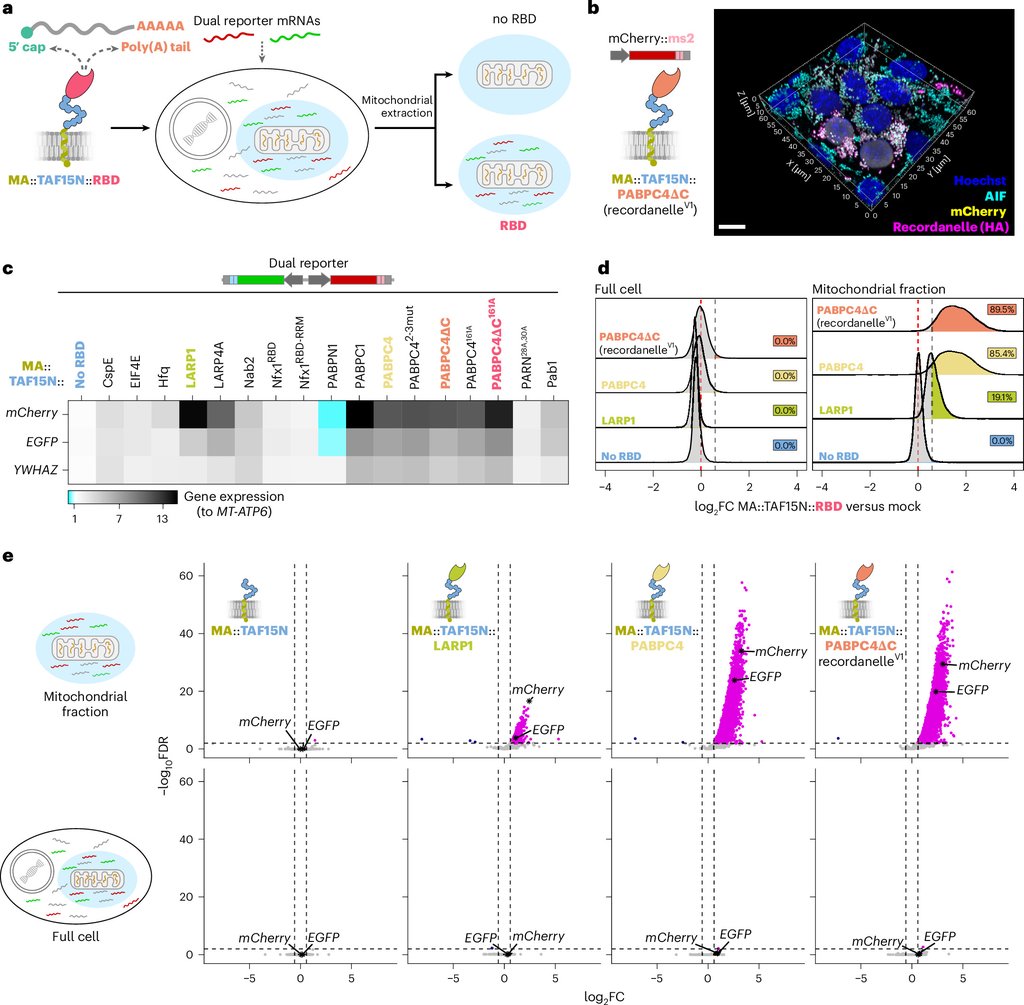
In cells carrying the best-performing version, 90% of the genes being expressed turned up enriched inside the organelle, at a deliberately strict statistical cutoff. The authors caution that this figure does not mean the recordanelles are bound to 90% of the RNA in the cell, only that this share of transcripts is represented in them.It is a sampling, taken broadly.
To find out whether the sampling survives, the team gave the cells a 20-hour pulse of interferon beta, an immune alarm signal, and then washed it out. Two days later the response in control cells had faded to nothing, indistinguishable from cells never given interferon. In recordanelle cells, every gene that had responded was still detectable. Sequencing cell by cell told the same story: the cluster of interferon-responding cells was still there two days after the signal ended, and only in samples carrying the working recorder. All of it was done in HEK293T cells, a human embryonic kidney line grown in dishes, and there is no animal work in the paper.
The record thins out as the cells divide
How long the archive lasts depends on what the cells are doing. In cultures left undisturbed, recording held for at least five days. In cultures that were split and kept growing, the signal was still readable three to four days after the stimulus and was gone from day five onward. Each division hands half the archive to each daughter and fills the space with whatever is being transcribed now, so growth is the clock running against this method.
What the recordanelle does not keep is an order of events. It samples continuously and cumulatively, so it can say that a gene was on somewhere inside the window, but not when inside it. Adding enzymes to encode temporal order or cell lineage is what the authors name as the next thing to build. The appeal is retrospective rather than chronological: pick a cell after the fact, and ask what it had been transcribing over the past few days.
A recorder that changes the cell it is recording would be worth little, and the group tested that harder than the claim demanded: viability, programmed cell death, the voltage across the mitochondrial membrane, oxygen use, the full set of proteins. Nothing moved substantially. Then the paper makes the case against itself. Recorders of this kind are perturbations by their nature, through the burden of an added gene, the occupied membrane and the RNA drawn out of the cell's own pool, and effects beyond the assays that were run cannot be excluded.
A second group published a different recorder in March
Storing a copy of a cell's RNA inside a living mammalian cell is not new, and this paper says so in its discussion. On March 26, 2026, Yu-Kai Chao, Michelle Wu, Qiyu Gong and Fei Chen described TimeVault in Science. Their device, built at the Broad Institute and Harvard, is a set of engineered particles that drift free in the cell and catch messenger RNA by the same tail. They report it stable in living cells for more than seven days, longer than the recordanelle's demonstrated window, and they used it on lung cancer cells that survive treatment aimed at the EGFR protein. Two further groups published related devices in 2026.
Reinkemeier and colleagues argue that their own design differs in kind: one protein rather than a manufactured particle, anchored to a membrane rather than drifting, sampling continuously across a window the experimenter chooses rather than, in their characterization of TimeVault, mostly being tested on 24-hour snapshots. That last comparison reflects the authors' interpretation of the TimeVault study rather than an established finding, and three of the eight authors, Reinkemeier, Manero-Carranza and senior author Randall J. Platt, have filed a Swiss patent application on the technology.
What the team wants to point it at
The use the group is reaching for is the one its own institution leads with. ETH Zurich published its account of the work on Oct. 26, 2026, and it names tumor cells that live through chemotherapy: cells nobody can pick out in advance, which can seed a relapse much later. The team wants to develop the system for animals and for cancer research, the release says. "If we can use our system in cancer research, we will be able to isolate persisting cells and look into their past," Reinkemeier says there, translated from the German. That is a plan rather than a result, and the cancer demonstration that does exist in the literature is TimeVault's.
What the recordanelle offers, if it holds up in cells less forgiving than a kidney line, is a cheaper commitment: you would not have to decide in advance which cells will matter, which genes to watch, or when to look. You would only have to ask within a few days.
Sources
- Nature BiotechnologyPeer-reviewed
- Science