A Mineral Famous for Seeding Ice Does It on Its Plainest Surface
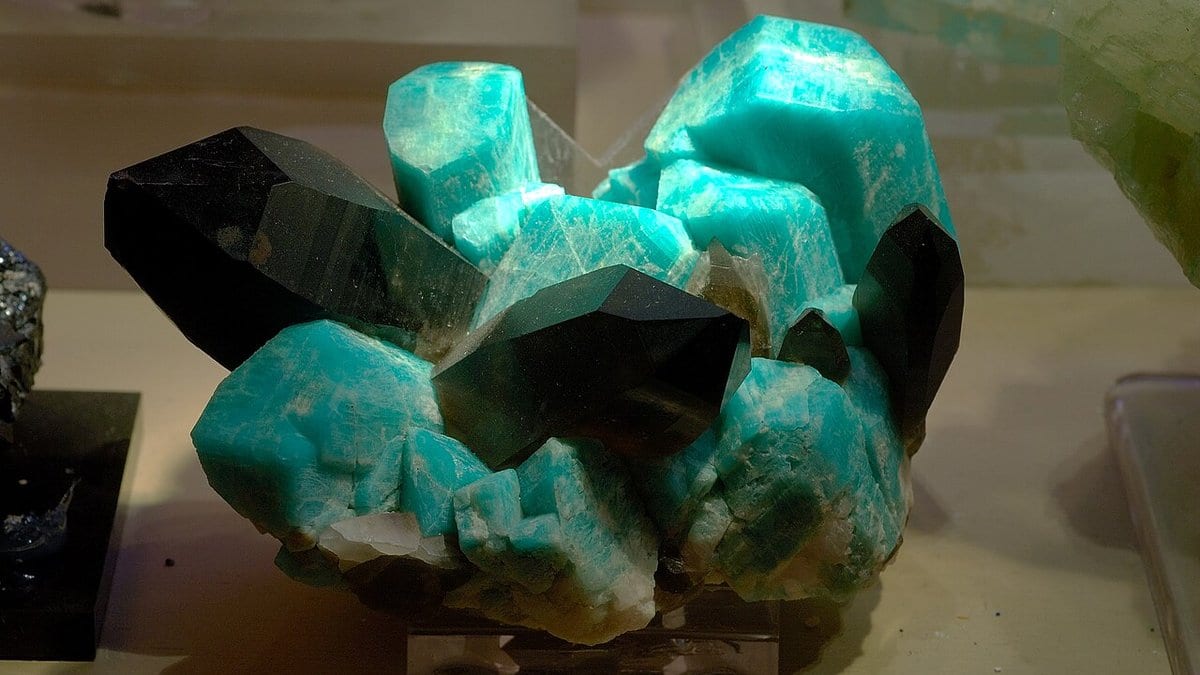
Left alone, pure water is remarkably reluctant to freeze. A clean droplet can be chilled to about −38 °C before it turns to ice by itself. Clouds do not wait that long, because the air is full of dust, and a speck of the right mineral gives water molecules something to build on. One mineral is unreasonably good at it: microcline, a potassium feldspar and one of the most common rock-forming minerals on Earth. Its near-twin sanidine has the same chemical formula and is far worse at it. For years nobody could say why.
The standard explanation is that ice does not use the whole grain, only a few privileged spots on it: cracks, pores, the edges of atomic steps. The field calls these active sites, and means something narrow by it: rare, distinct positions that start ice at low humidity and start it again in the same place next time. The evidence is good. Under an optical microscope, ice crystals grow back at the same features on a feldspar grain, all of them pointing the same way.
A study published on Aug. 25 in Nature Communications went looking for those spots at a scale no optical microscope can reach, and found that microcline does not need them. Florian Schneider of Bielefeld University, Tobias Dickbreder of the University of Vienna, and colleagues in Germany, Austria and Finland cleaved a microcline crystal inside an ultrahigh-vacuum chamber, cooled it to −128 °C, and let water vapor in through a fine valve while an atomic force microscope scanned the fresh surface. Ice clusters appeared within minutes. They were not confined to the step edges.
Those conditions are not a cloud, and the authors say so plainly. That temperature sits about 90 degrees below the range in which mixed-phase clouds turn to ice, and the water arrives as vapor in a vacuum rather than as a droplet on a speck of dust. The chamber was also held at two to five times the pressure at which ice and vapor balance, far above what larger-scale freezing experiments use, because a microscope sees only a tiny patch of surface and needs the odds raised to catch anything at all. The results, the paper says, "should not be interpreted as a direct representation of atmospheric ice nucleation"; they are a mechanistic framework meant to sit alongside work done closer to real conditions. What was measured is a mechanism on a crystal, not the freezing of a cloud.
The ice refused to pick the same spot twice
On microcline, ice did not wait for a flaw. Clusters formed at step edges, and they formed out on the bare terraces, the flat stretches in between. The team then repeated the cycle at six different places on the crystal, growing ice and letting it evaporate away, marking where each cluster had appeared. The positions moved. Across repeated cycles the scatter of starting points differed only marginally from random, and that is the observation doing the work: a rare privileged site would have been used twice.
Step edges were not idle. Directly at an edge, a cluster was still likelier to form than chance would predict, and that preference sharpened as the vapor pressure was lowered. The finding is narrower than "flaws do not matter," and more interesting: the plain face works as well, and on microcline it works at the lowest pressure at which anything forms at all.
The control mineral did what the textbook says
The control experiment is what makes that convincing. Sanidine has microcline's exact chemistry. The difference is that its aluminum atoms sit at random through the silicate framework instead of in an ordered pattern. Put through the same chamber, the same microscope and the same repeated cycles, sanidine behaved the way the textbook says it should: clusters were five times likelier to appear directly at a step edge than a random scatter would give, and they reached the open terrace only once the pressure was pushed well past the point where ice first formed. Microcline started making ice at roughly two-thirds the vapor pressure sanidine needed. Whatever the method might be doing to the result, it is not conjuring nucleation on flat ground; it produced none on the other mineral.
One caution is built into the paper's own title. "In the absence of active sites" does not mean a flawless surface. The authors write that they cannot rule out atomic defects, and expect the crystal to carry a great many; their argument is that a defect present everywhere is not the rare, repeatable site the old picture depends on.
A lattice match, offered as a first guess
As for why microcline is different, the paper offers a hypothesis and declines to oversell it. The ice grew tilted rather than lying flat, which points to the two crystal lattices locking together at an angle. Comparing geometries, the team found a microcline surface cell that matches an unusual face of hexagonal ice — the (10.4) plane, rarely considered in this context — to better than 5%. That match, they write, is "a first hypothesis, but it is not sufficient": sanidine's cell is almost the same and behaves differently.
The candidate difference is chemical. Both minerals finish their flat face in hydroxyl groups, the hooks that grab passing water molecules. On microcline twice as many of them sit on aluminum rather than silicon, in a regular repeating pattern; on sanidine they are fewer and placed at random. Aluminol groups, as the aluminum version is called, hold water more tightly. Simulations at the same temperature found ice clusters more stable on microcline, hydrogen-bonded to those surface groups. That supports the idea; it does not demonstrate it.
The explanation is not settled either. In a preprint revised in June, Zhou and Piaggi reached a different answer using machine-learning simulations: they also discard the old account, and name a different face of the mineral, the (110) surface, as the site that matters. That work has not been peer-reviewed, and Schneider's team cites the same line of research in its own introduction. Two groups now agree the textbook story is wrong and disagree about what replaces it.
What this work hands the field is narrower than a better cloud model: a reason to take unusual crystal faces seriously when judging whether a mineral will make ice. The paper's own atmospheric claim goes no further than "might be relevant". Bielefeld University's press release is bolder: it is headlined as a breakthrough, quotes the group's lead, Angelika Kühnle, saying the work "closes a key knowledge gap," and adds that a better understanding of mineral surfaces will help make climate models more accurate. Those are the university's words, not the paper's. The measurements, the simulations and the crystal structure are all posted, the last with the Cambridge Crystallographic Data Centre under deposition number 2532369, and the article is open access. The next group to disagree can start from the same numbers.
Sources
- Nature CommunicationsPeer-reviewed
- www.eurekalert.org