The Marsh Plants Survived an Extreme Storm. Their Wave Defense Is Weaker

The Delta Flume at Deltares in Delft is a concrete canal 300 meters long, and in February and March 2024 a Dutch team filled it with a salt marsh: blocks of turf cut from the Frisian coast, laid out with a small cliff at the seaward edge. Then they ran a month of storms at it, each day bigger than the last. The bed was expected to hold. The open question was the plants.
Tidal marshes are increasingly written into flood plans, and part of the reason they work is that they are high ground: a raised, root-bound slope takes a large share of the energy out of a wave before it ever reaches a dike. The standing stems take more of it. What nobody could say was whether those stems are still there after a severe storm, and that gap has kept marshes out of long-term flood planning.
The experiment, led by Victoria G. Mason of the Royal Netherlands Institute for Sea Research and Utrecht University with Tjeerd J. Bouma as senior author, is the first to put marsh plants under storms this size and report what broke. It appeared Oct. 8, 2026, in Communications Sustainability.
The largest storm put 4 meters of water over the marsh and drove offshore waves of about 2.0 meters at it. That is not a wall of surf breaking over the plants. The samples sat about 22 meters inside the marsh edge, deeply submerged, and what reached them was a surge near the bed, clocked at up to 1.93 meters a second. Earlier flume work on marsh plants had stopped at waves less than half as high.
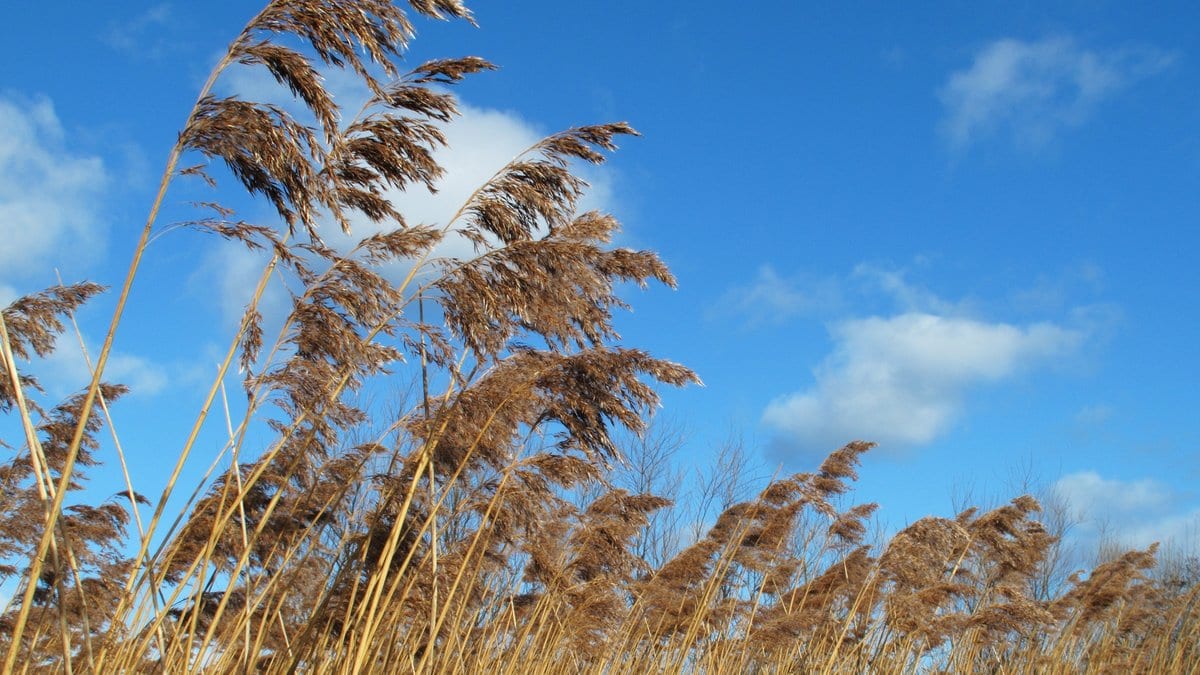
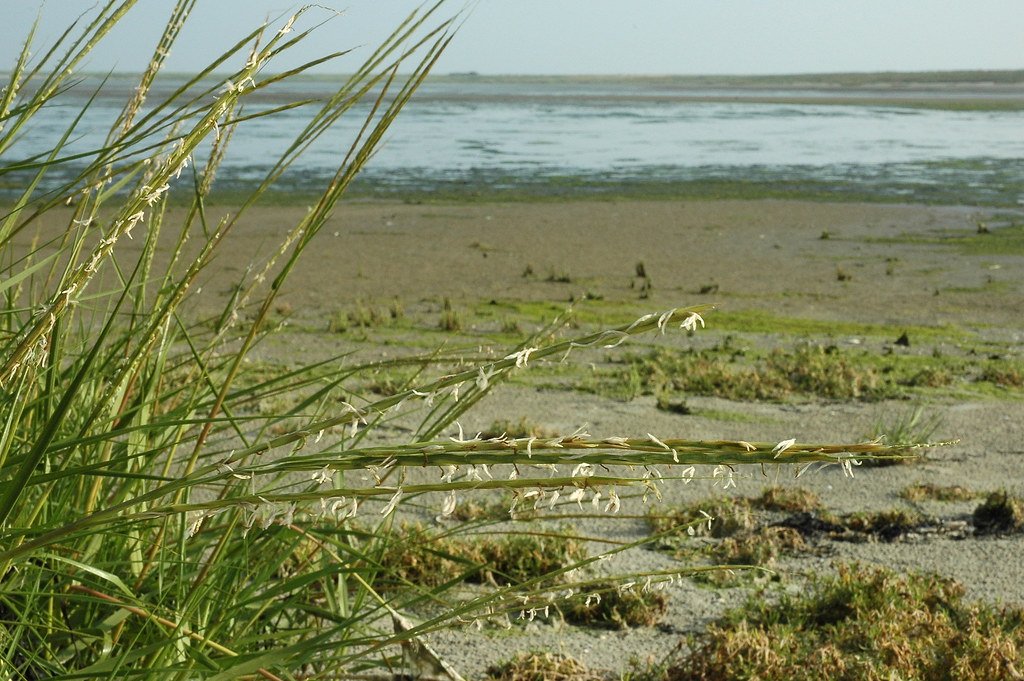
What went into that water were winter stems: Spartina anglica, Scirpus maritimus and Phragmites australis, harvested from the Western Scheldt estuary in the low-biomass winter state a storm season actually finds them in. They went in as potted cores set flush with the path, three per species, fresh every morning, so each sample met exactly one storm: cumulative damage was deliberately not part of the design. A core is not a stand, either. These stems had no neighbors to shelter them, and the marsh built around them was a different plant, Elymus athericus.
Losses were expected to be heavy. Across the storms they ran, the plants lost on average about 30% of their standing biomass, and never more than 66% on even the worst day. That biomass is a proxy: stem count times average stem height, diameter left out.
Canopy height took the brunt: in the two worst-hit species it fell by close to 60% on the most extreme day. Even so, at least 19 centimeters of canopy was left standing after every storm, for every species. Whole shoots were rarely pulled out, so the roots stayed in the sediment, which is what lets a marsh regrow in spring. Marsh-edge erosion may well be how marshes are lost, and a flume is not the place to test that.
The stems that could sway came through
Which plants broke was not the pattern the field expected. Serious breakage showed up in one species only, Scirpus maritimus, the stiffest of the three. Phragmites australis, the tallest, broke only in the most extreme storms, which runs against a standing expectation that tall stems snap sooner than short ones. The engineered mimics made the mechanism plain: long ones mounted on a flexible metal rod, so the whole stem could lean over, came through the worst storm with 10% broken, while every short mimic of the same thickness broke.
So the trait that matters is not stiffness by itself but whether a stem can sway, because bending with the water cuts the area the flow has to push against. A tall stem gets that from its length, a short one only from being soft. The stems left standing were consistently the more flexible ones. Shoot loss, though, was highest in Spartina anglica, the shortest and most flexible of the three, at 34% on the worst day; no species lost more than 15% on any other test day.
Surviving is not the same as protecting
This is where the easy reading goes wrong. Stiff stems are the good wave brakes: they stand up, and the water has to shove past them. Flexible stems lean out of the way and take less out of a wave, by up to 70% on measurements the paper cites. So a storm that selectively snaps the stiff stems leaves a canopy that is better at surviving the next storm and worse at blunting it. The first half of that is their model's projection, not a second storm they ran over the same plants.
A shortened canopy is not a useless one: in gentler conditions, stands with properties like these have been measured cutting waves by around 60%. Under that much water the stems were never the main defense anyway. Most of the work in a deep surge is done by the platform itself, the raised and root-bound slope, as long as its bed resists erosion.
The chart and the numbers underneath it
The paper's title promises "global prediction of marsh vegetation survival during extreme storms," and its last figure is the chart that promise rests on: expected biomass loss against stem stiffness. The discussion claims a good deal less for it, calling it a tool that can be used to "indicate potential biomass loss," working "within a range of uncertainty." Stiffness, the axis the chart is built on, is not a statistically significant predictor of biomass loss in their model (p = 0.42); it is kept in because the survivors were visibly the flexible ones. Flow speed near the bed is significant, but on its own explains little of the variation (R² = 0.09).
The word "global" in that chart comes from interpolation. Stiffness values for seven other species were taken from published papers; none of those plants was tested here. The storm intensities come from a global surge model at a once-in-a-thousand-year level. No plant from outside northwestern Europe went into the water, and the authors say the chart's accuracy depends on local measurements of the actual species.
All of it is one campaign at one facility, and it reverses the published prediction it was measured against: breakage came in well below what the standard calculation of the speed that snaps a stem predicted. The paper is peer-reviewed, and the flume measurements are posted openly.
What this hands a coastal planner is not a number for a particular marsh but a reason to want a mixed one. Stiff stems take the most out of a wave and are the ones that break; flexible stems survive and take less. Which species grow where is decided by salinity, climate and the tide, not by what a flood plan prefers.