Louder Than a Jet Engine: The Shrimp That Jams

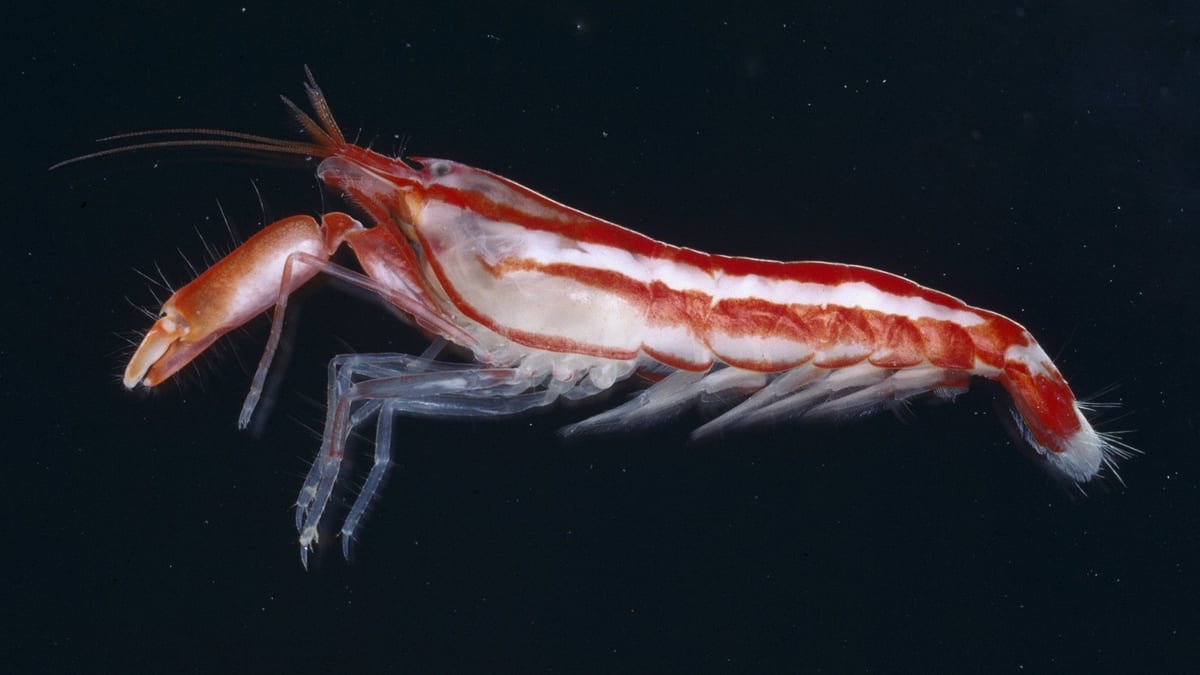
The pistol shrimp is one of the most extreme creatures on the planet. Despite its modest size of 3 to 5 centimeters, it shoots jets of water, creates blinding flashes of light, jams military sonar, sees faster than any vertebrate and yet can see almost nothing. The secretive life of this tiny marine animal is linked to remarkable biological mechanisms.
Where does the shrimp get the power to fire at 100 kph?
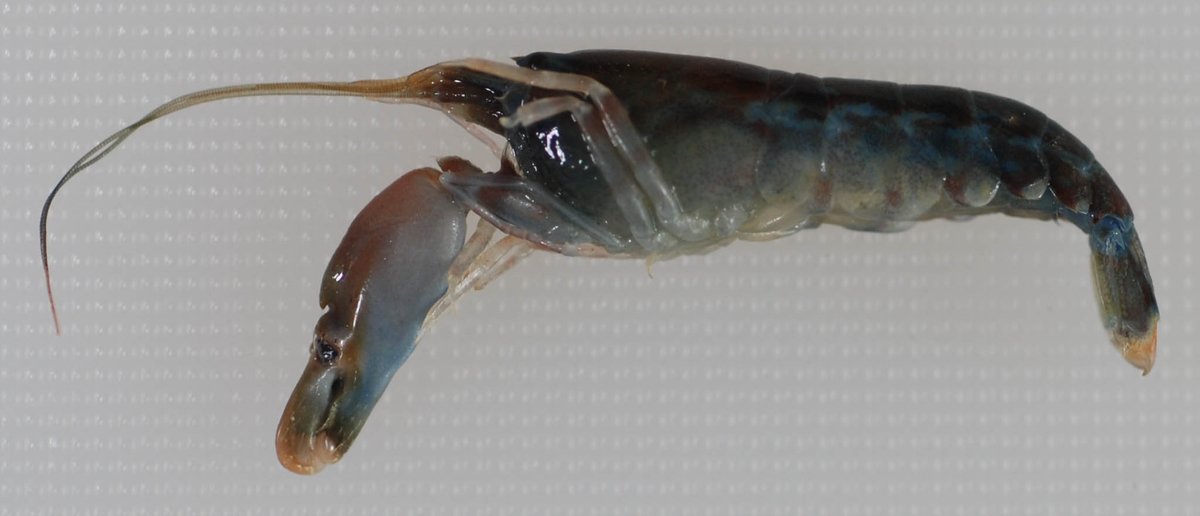
The most distinctive feature of the pistol shrimp is its asymmetrical claws. One looks normal, while the other grows to half the animal’s body length. It serves as more than just a tool for catching food; it is a spring-loaded mechanism with a trigger.
Nature has endowed the shrimp with unique biomechanics. As it prepares to fire, it spreads its large claw wide: the opening and closing muscles tense simultaneously, working against resistance and storing elastic energy, much like the taut string of a crossbow. At the moment of release, the movable finger snaps into action, and its massive piston slams into the corresponding socket at breakneck speed, forcing out a jet of water at a speed of about 100 kph. Such a sudden drop in pressure creates a cavitation bubble that produces a deafening click of up to 210 decibels upon collapsing. In terms of air pressure, this is comparable to the roar of a jet engine during takeoff; if a person were near such a sound source, their eardrums would burst instantly.
At the point where the bubble collapses, the water heats up to at least 5,000 K (about 4,700 °C) for a fraction of a second, which is comparable to the Sun’s surface temperature. The process is accompanied by a flash of light that physicists have dubbed “shrimpoluminescence,” for its likeness to sonoluminescence. This powerful shock wave instantly stuns or kills its prey: small fish, worms, and crabs. When thousands of these tiny duelists snap their claws simultaneously, their collective crackling is powerful enough to drown out even military sonar.
In fierce underwater battles, the pistol shrimp sometimes loses its giant, asymmetrical claw. At that moment, a remarkable process of regeneration and role reversal begins. Over time, a small, ordinary claw grows in place of the lost massive weapon. Meanwhile, the second claw, which was originally small and harmless, begins to grow rapidly and transforms into a new, devastating weapon.
Why does the gunman need a bodyguard?
Most pistol shrimp have very poor depth perception: their eyes are hidden beneath a carapace hood that protects them from their own shock waves and debris, and the world as a pistol shrimp sees it consists of blurry patches of light and shadow, without distinct shapes. As a result, many species live in a strict symbiotic relationship with gobies. The shrimp builds and cleans a branched burrow with several exits, while the goby stands guard at the entrance, acting as a living early-warning system. While the shrimp is outside, it constantly keeps its antennae pressed against the fish’s body; if the goby spots danger, it swishes its tail sharply or dives headfirst into the burrow, and the shrimp instantly follows.
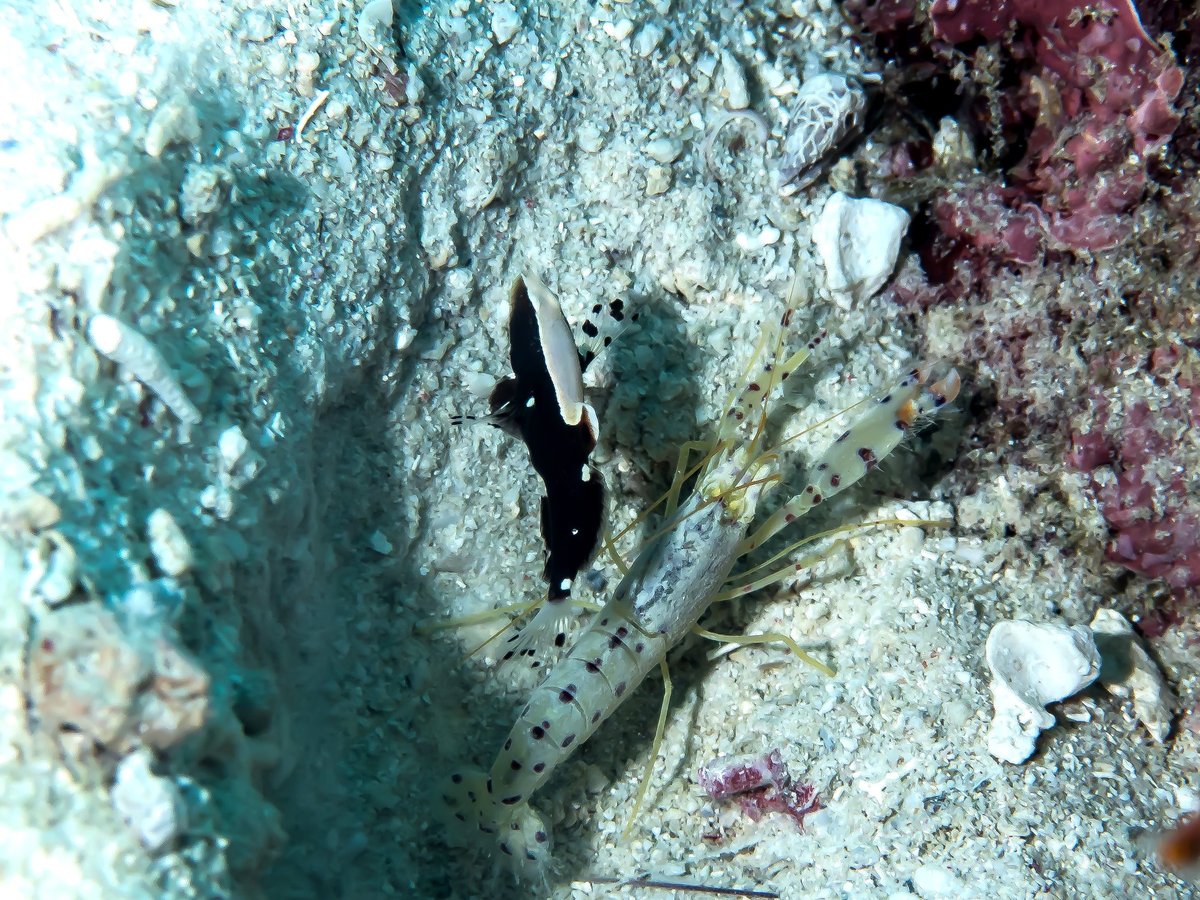
This symbiosis becomes vital during molting. After shedding its old shell, the shrimp becomes soft, and its formidable weapon turns to jelly for a few days. During this dangerous period, the defenseless shrimp relies entirely on its guardian.
The blind sniper: the paradox of eyesight
If the shrimp relies so heavily on the eyes of others, how did it earn the title of absolute record holder for visual speed? Behind this lies an astonishing biological paradox. Optics divides vision into two parameters: spatial resolution (clarity of detail) and temporal resolution (frame rate). When it comes to spatial vision, the shrimp is helpless; it cannot distinguish a rock from a fish based on shape alone. But in terms of visual speed (refresh rate), the snapping shrimp has claimed the title of absolute record holder among aquatic animals. Scientists measured the electrical impulses in the shrimp’s eyes: its vision refreshes at a rate of 160 times per second (160 hertz), and in some individuals, this rate reaches 200 hertz. For comparison, the human eye perceives about 60 hertz, and a pigeon’s eye is 143 hertz.
This eye functions as a highly efficient motion sensor. If a blurry, murky spot makes a sudden jerk, the shrimp’s brain instantly registers the change in light, and it either fires its cocked claw mechanism or hides in a burrow. There is a clear evolutionary rationale for this: the shrimp does not need to recognize the pattern on a predator’s shell; instead, it must instantly detect a sudden movement in murky water and react in time.
From British rock to coral reefs
There are more than 600 species of pistol shrimp in the world. Their colors are breathtaking, but one stands out in particular: in 2017, biologists discovered a specimen with a bright pink claw off the coast of Panama. They named it Synalpheus pinkfloydi, in honor of the legendary British rock band. This connection goes beyond color. Like the famous band that rocked stadiums, these crustaceans create a veritable barrage of sound underwater. However, this continuous crackling serves more than just hunting or territorial disputes; it also plays a crucial ecological role.
The “canary” of the coral reef
That very same crackling sound, which had been confusing submarine sonars, turned out to be a vital signal for the reef itself. The larvae of fish, crabs and corals are often carried out into the open ocean by currents. To find their way back, they navigate by the collective clicking of shrimp, using it as a lifesaving acoustic beacon. The larvae swim directly toward this sound and unerringly find their way to the refuge of the reef to settle. If a coral reef degrades due to pollution, the shrimp will leave, and new inhabitants will no longer be able to find their way home. Pistol shrimp are part of the acoustic system that keeps the reef alive. When the reef falls silent, it is the first sign that something has gone wrong.
Behind the deceptive tranquility of shallow-water reefs lies a tiny creature with remarkable characteristics: from generating extreme temperatures and forming friendships with fish to creating powerful acoustic fields. The pistol shrimp is not just a random inhabitant of the seafloor; it is a critical link upon which the navigation and survival of countless ocean species depend.
Sources
- Versluis, M., Schmitz, B., von der Heydt, A., Lohse, D. (2000). How Snapping Shrimp Snap: Through Cavitating Bubbles. Science 289, 2114–2117
- Lohse, D., Schmitz, B., Versluis, M. (2001). Snapping shrimp make flashing bubbles. Nature 413, 477–478
- Leutwyler, K. (2000). Snapping Shrimp. Scientific American, September 22, 2000
- Read, A. T., Govind, C. K. (1997). Claw Transformation and Regeneration in Adult Snapping Shrimp: Test of the Inhibition Hypothesis for Maintaining Bilateral Asymmetry. The Biological Bulletin 193, 401–409
- Karplus, I., Thompson, A. R. (2011). The Partnership between Gobiid Fishes and Burrowing Alpheid Shrimps. In: The Biology of Gobies
- Kingston, A. C. N., Chappell, D. R., Speiser, D. I. (2020). A snapping shrimp has the fastest vision of any aquatic animal. Biology Letters 16, 20200298
- Anker, A., Hultgren, K. M., De Grave, S. (2017). Synalpheus pinkfloydi sp. nov., a new pistol shrimp from the tropical eastern Pacific (Decapoda: Alpheidae). Zootaxa 4254(1)
- Vermeij, M. J. A., Marhaver, K. L., Huijbers, C. M., Nagelkerken, I., Simpson, S. D. (2010). Coral Larvae Move toward Reef Sounds. PLoS ONE 5(5), e10660