India's Rice Fields Release More Methane Than Earlier Estimates Showed

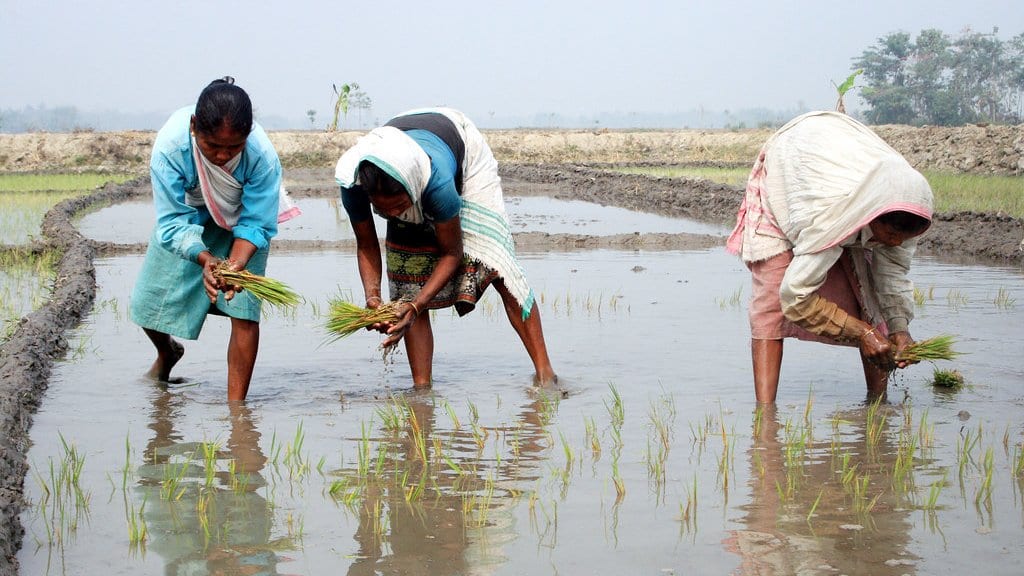
A rice paddy in the monsoon is a shallow pond with plants standing in it. The water is the reason the field matters to the climate. It shuts the air out of the soil, and the microbes living in the mud below switch to a kind of digestion that produces methane, which seeps up past the stems and into the sky. India grows rice on more than 40 million hectares of land, and how much methane rises off those fields has never been pinned down closely.
Closing that gap is the job of a paper published this week in Environmental Research Letters by Monu Yadav and Dhanyalekshmi Pillai, of the Indian Institute of Science Education and Research Bhopal, with colleagues at the International Rice Research Institute. They map the methane coming off India's rice at a scale of 10 meters, fine enough to pick out one field from its neighbor, and they do it season by season. The purpose is practical. How much methane a paddy gives off depends on how it is watered, so a map this fine can say which parts of the country, and which crop of the year, a change in watering would count for most.
The national figure comes out at 9.73 million metric tons of methane a year, give or take 2.03 million. That is well above what is on the books for India. Earlier published estimates run from about 3.6 to 6.5 million metric tons a year, the lower ones from national inventories built on standard emission factors, the highest from a global rice inventory published last year. The new range only just reaches down to the top of the old ones.
None of these numbers is a measurement of gas leaving a field. All of them, the new one included, are estimates: a count of rice fields carried through a model of what flooded soil does. What changed here is the count.
The rice map comes from two satellites in Europe's Copernicus program. Sentinel-1 carries radar. It bounces microwaves off the ground and reads what comes back, which is enough to tell a flooded, freshly planted paddy from dry land. It also works through the monsoon cloud that blinds a camera. Sentinel-2 is the camera, photographing the same ground in visible and infrared light as the crop grows and greens. Read together across a season, the two say where rice is standing in water, and when.
That rice map is the part of the work that gets checked hardest, against ground samples pixel by pixel and against India's agricultural census, and it holds up well on both. Those checks establish that the map has rice in the right places. They say nothing about how much methane comes off it.
The methane itself comes out of a model: a set of equations for how fast the mud in a flooded field makes the gas. What drives it is how warm the soil is, how long the water sits and how much plant matter is rotting in it. The model was run in 18 configurations, a way of measuring how much the answer depends on its own assumptions rather than on what the satellites saw.
The seasonal split is the part a policymaker can act on. The Kharif crop, the one planted with the monsoon and grown in fields that stay wet for months, accounts for 74.7% of India's annual rice methane. The summer crop supplies most of what is left, and the Rabi crop, grown through the dry winter, supplies very little.
That concentration is what makes the map worth having. The water is what produces the methane, not the rice; any drowned ground behaves the same way. So the lever is drainage: whether a paddy is held under water all season or allowed to dry out partway through, which lets air back into the soil and stops the process for a while. Draining takes coordination and labor, and it does not suit every field, so knowing where it would pay is worth something. The authors put the opportunity in the monsoon crop, and their map is fine enough to work at the level of districts inside it.
The study is peer-reviewed and open access, and it is the second half of a pair; the first covers India's natural wetlands, which release methane for the same reason with no one planting anything. It is also, so far, alone. The researchers describe their dataset as the first for India built from observations rather than averaged factors, mapped in place and across seasons, which also means there is nothing else at this detail to check it against. A figure roughly half again as high as the highest previous estimate will need that check.
The dataset is offered for three jobs: comparing against methane actually measured in the air over India, setting emission targets below the national level and testing whether a change in how fields are watered shows up as a change in emissions. Each of those depends on the map being right about particular fields in particular weeks, which is why so much of the paper is spent on getting the rice right.
Sources
- Environmental Research LettersPeer-reviewed