How an Invasive Beaver Turns a Sub-Antarctic Forest Into a Methane Source

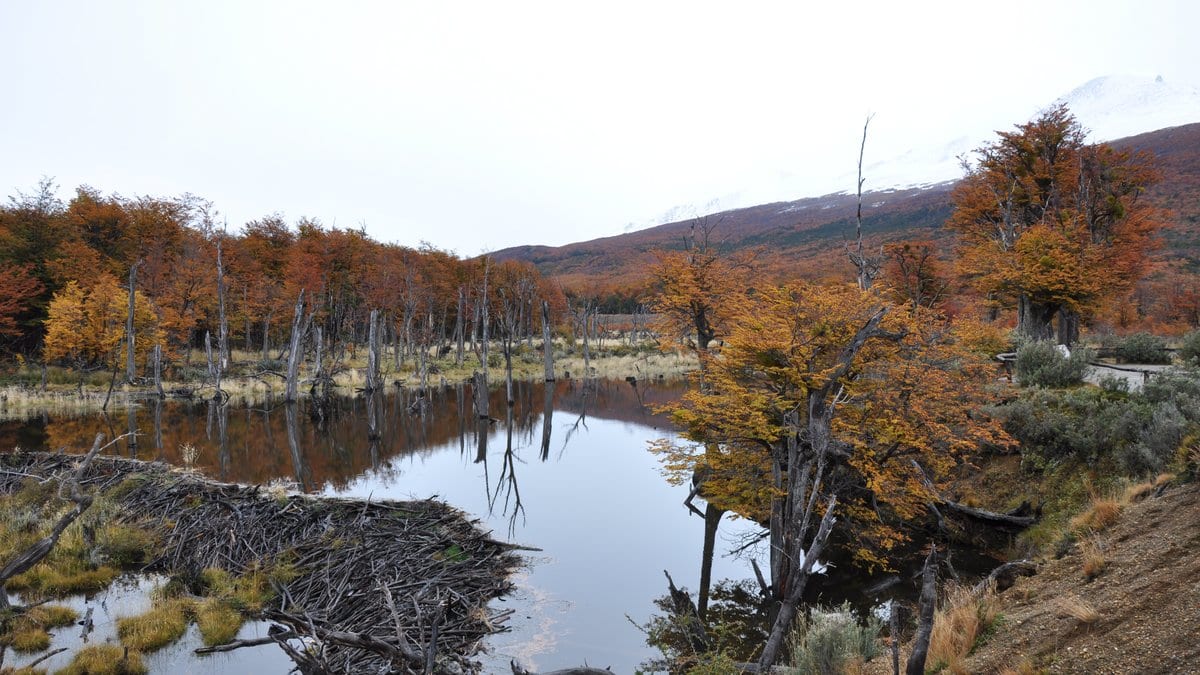
At the bottom of the world, on the islands of the Fuegian Archipelago, a rodent from another hemisphere has been reshaping the forest for the better part of a century. The North American beaver was brought to Tierra del Fuego in the 1940s to seed a fur trade. The trade never took hold; the beaver did. With no predators to check them, the animals spread across southern Chile and Argentina, and they brought their defining habit with them: they build dams. Each dam backs up a stream, floods the low ground along it, and drowns the slow-growing southern beech that had rooted there for generations.
What that flooding does to the air above it is the question a team led by Julio Alberto Salas-Rabaza of the Cape Horn International Center set out to answer. In a study published on July 29 in Environmental Research Letters, titled "Invasive North American beaver alters greenhouse gas fluxes in sub-Antarctic riparian forests," the researchers walked a single beaver-made wetland and the intact riparian forest beside it, and measured the greenhouse gases moving between ground and sky at both. Rather than sample one surface, they tallied the fluxes from three: the standing water, the soil, and the trunks of the trees themselves, which can channel gas up out of waterlogged roots. The point was to weigh, side by side, what a living forest and the wetland that replaced it each give off.
The clearest contrast was methane. Methane is a short-lived but potent warming gas, and it is the signature product of the airless, waterlogged mud that pools behind a beaver dam. The intact forest floor, well-drained and breathing, actually pulled a small amount of methane out of the air. The study puts it at about −5.8 kilograms per hectare each year, a net absorption. The flooded beaver ground did the opposite, releasing roughly 74 kilograms per hectare per year. Drowning the forest, in other words, converted a patch of ground that quietly consumed methane into one that steadily produces it.
Carbon dioxide told a more tangled story, and it is where the study asks for care. Measured as raw fluxes from those surfaces, the intact forest released far more carbon dioxide than the wetland did; respiration from living soil, roots and microbes runs high in a healthy forest. Add the methane in, and the total greenhouse gas leaving the intact forest came out about 125 tonnes of CO₂-equivalent per hectare per year higher than the wetland's. Taken alone, that number makes the drowned ground sound like the cleaner of the two, which is exactly the trap the authors are careful to step around.
The catch is that raw emissions are only half of a forest's carbon account. A living forest also takes up carbon, pulling it from the air through photosynthesis and locking it into wood and leaf, its gross primary production. The wetland, stripped of live trees, has almost none of that intake left. When the researchers fold the forest's uptake back into the ledger, the sign flips. The intact forest, they write, "likely functions as a net carbon sink," drawing down on the order of 15 tonnes of CO₂-equivalent per hectare each year. The beaver wetland, "devoid of live trees, remains a net source," giving off about 18 tonnes per hectare per year (17.94, in the paper's precise figure).
That word "likely" is doing real work, and it is worth keeping in view. The team did not directly measure the forest's photosynthetic uptake in this study; they inferred it, and they say so plainly, noting that their raw-flux difference "does not account for the substantial tree gross primary production." The sink-to-source flip is a well-reasoned inference drawn from measured emissions plus an estimated uptake, not a figure read straight off an instrument. The direction of the change is on firm ground: flooding a forest to make a methane-emitting wetland is a mechanism established across the wider beaver and wetland literature. The exact tipping point, from a roughly 15-tonne sink to a roughly 18-tonne source, is the qualified part.
Held at that honest resolution, the result is still striking. Beavers are what ecologists call ecosystem engineers, animals that remodel the physical world around them rather than merely living in it. In their native North America, that engineering is woven into how the landscape works, and beaver wetlands are often valued for the habitat and water they create. Dropped into a sub-Antarctic forest that evolved without them, the same behaviour reads very differently. Here it converts a carbon-absorbing forest into a carbon-emitting wetland, one drowned valley at a time, and the study frames the animal accordingly: a keystone species at home, a major invasive threat in the Fuegian forests it now occupies.
The measured plot is a single paired comparison, one wetland against one neighbouring forest, so the tonnes-per-hectare figures are best read as the size of the effect at this site rather than a regional budget. What travels beyond the plot is the mechanism and its direction. Tens of thousands of beavers now occupy the archipelago, and their dams have already remade large stretches of Fuegian riparian forest. If each flooded stand shifts the local carbon balance the way this one appears to, then an introduced rodent has quietly become a climate variable in a corner of the planet where no one thought to account for it. An invasive species can change not only what lives in a landscape but what that landscape does to the atmosphere above it.
Sources
- Environmental Research LettersPeer-reviewed