Germany's June Heat Wave Was Impossible in a Cooler Climate

In Kubschütz, a village in the Saxon Oberlausitz, the temperature on the night of June 27 never fell below 29.4 °C, the highest night-time minimum ever recorded in Germany. Earlier that day, at Möckern-Drewitz in Saxony-Anhalt, the thermometer had reached 41.8 °C, provisionally the highest temperature ever measured in the country.
Both readings fell inside a single spell of heat that ran from June 18 to 28 and that the Deutscher Wetterdienst, Germany's national weather service, has since put through an attribution study of its own. Never before had the service issued heat warnings for so many days in a row. Its conclusion, published in July: in a climate 1.3 °C cooler than today's, the event was statistically not possible.
The night-time figure is the one worth pausing on. Cooling after dark is what lets a body recover from a hot day, and during this heat wave the air in many places barely cooled at all; the Kubschütz minimum is the extreme end of that. The heat wave also arrived unusually early in the year.
For Germany as a whole, the study puts the hottest day of that heat wave 3.0 °C above what it would have been in a pre-industrial climate, with a range of 1.3 °C to 4.8 °C; averaged over the full week, the figure is 3.2 °C, ranging from 1.2 °C to 4.9 °C. These wide ranges reflect a common tension in climate attribution: observations and climate models do not land in the same place, with observations consistently showing the stronger trend.
An attribution study of this kind asks a what-if question: How much hotter was this event than the same weather pattern would have produced in a world that had not warmed? Addressing this question means running the observed record and climate models side by side to compare the two worlds statistically, which is why the output arrives as a spread rather than a single number. Saying an event is not possible in a cooler climate is a statement about that statistical model, not a claim that no such week could ever have occurred.
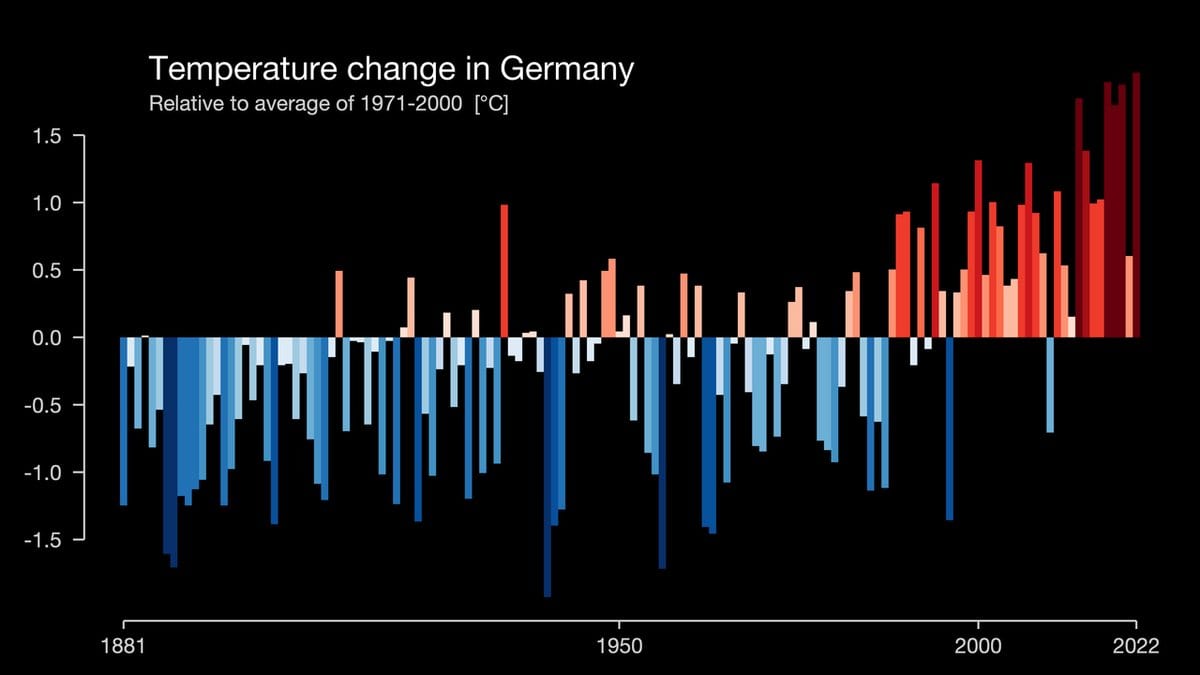
The heat wave sits inside a season the DWD closed out on Aug. 31, in a balance drawn from about 2,000 stations. Summer 2026 averaged 19.6 °C across the country, 3.3 °C above the 1961–1990 reference period. The service calls it one of the warmest summers since its nationwide records began in 1881, and goes no further: only 2003, at 19.7 °C, is likely to have been warmer, based on preliminary calculations.
That hedge is doing real work. The gap between the two summers is just 0.1 °C, and the figures behind it are provisional throughout: the last day of the season was taken from forecast data, not every station had reported by the press deadline, and the area means for rainfall and sunshine are rounded and can still move as late data arrives and is quality-checked. A ranking decided by such a narrow margin is not safe on numbers like that, which is why the service describes the season instead of placing it.
What the DWD does call unprecedented is how often the heat came. Nationwide, the service counted about 22 days at or above 30 °C. The southwest took the worst of it: Baden-Württemberg, Rhineland-Palatinate and Saarland are all heading for their warmest summers since 1881, and on the Upper Rhine, individual stations passed that mark on more than 50 days.
The other half of the season was dryness. Rainfall reached just under 72% of the long-term normal, and the deficit showed up in dried-out soils, historically low water on the Middle Rhine and forest and vegetation fires: the Hürtgenwald blaze in North Rhine-Westphalia was, by the state government's account, the largest there in decades. Sunshine ran to the other extreme, enough to put this summer among the sunniest on record.
Widespread drought did not rule out violent local weather. On Aug. 19, tornadoes were confirmed in Brandenburg and in a corridor running from the Westerwald across Hesse into western Thuringia.
Estimating the death toll of a single heat wave is a statistical exercise in its own right, and one was run here: the Robert Koch Institute attributed 6,020 deaths in Germany to the heat between June 25 and July 5, a figure the DWD carries in its attribution report.
The seasonal means will be replaced by quality-checked figures over the coming weeks, and whether 2026 ends a tenth of a degree short of 2003 or past it will be settled then. The June heat wave has already been through a different kind of check, and its verdict does not depend on where the season finally lands.