Engineered Crops Are Linked to a Slower Move North for American Farming

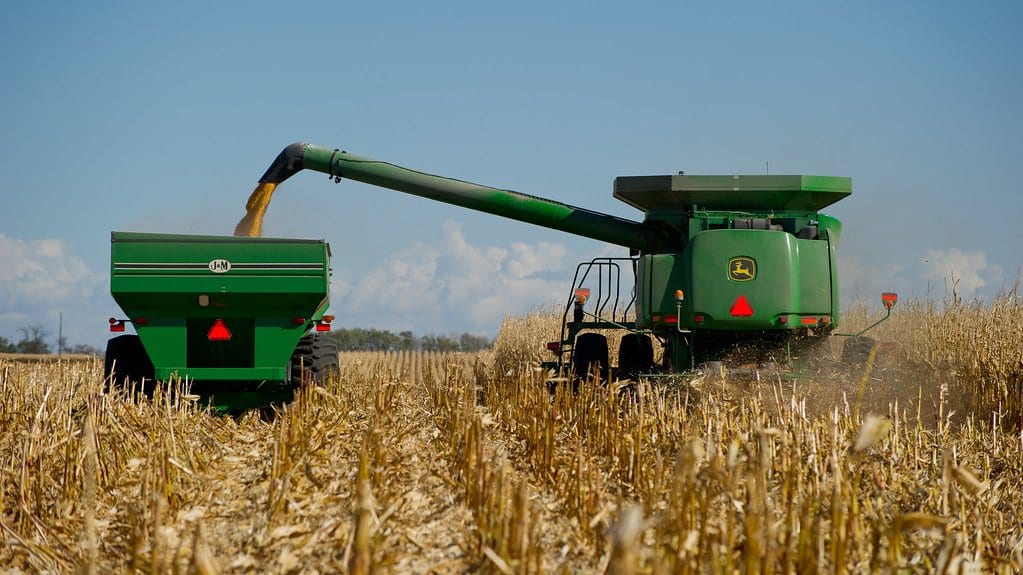
The map of what America grows has been sliding north. As the climate has warmed, corn and soybean have pushed farther toward the Dakotas, and the good years have moved with them. A paper published today in Nature Climate Change asks a different question about that drift: how much of it did not happen, and what the seeds farmers were already buying had to do with it.
The work comes from agricultural economists: Caroline Yifan Dong, Chengcheng J. Fei, Bruce A. McCarl and Xingguo Wang of Texas A&M University, with David Zilberman of the University of California, Berkeley. Their aim was to test whether engineered varieties have worked as a form of climate adaptation: not only as a way to grow more, but as a way to lose less when the weather turns bad. To get at it they pulled together four decades of public records: county yields and planted acres for corn, soybean and upland cotton, the USDA's tally of how fast engineered seed spread, historical climate data, soils, elevation and futures prices. The data and the code behind the analysis are posted publicly.
What they report is carefully worded. Adoption of engineered varieties is "broadly associated with yield benefits," the paper reports. For corn and soybean the association runs two ways at once: higher yields and steadier ones: year-to-year swings in corn yields were smaller where the seeds had spread. Some of the harm that heat and other climate stress do to a harvest appears offset, a "partial attenuation," and for upland cotton the effects are "more modest."
None of that is an experiment. Nobody handed engineered seed to one set of counties and withheld it from another. Farmers chose, and the counties that chose earliest differ from the rest in farm size, irrigation, spending on inputs and local practice. The comparison behind the study's largest claim, a United States in which engineered crops never arrived, is a scenario the team modeled, not a place anyone can visit. The corrections they use to separate the seeds from everything else that moved with them are statistical, and they are open about what is bundled inside the result: their own phrase is "GE development and associated forces," which takes in conventional breeding and the changes in farming practice that spread at the same time.
It matters what these seeds actually do. Almost all engineered acreage in the United States carries one of two traits: tolerance of weedkiller, so a field can be sprayed without killing the crop, or a bacterial protein that poisons the insects feeding on it. Neither is a heat trait or a drought trait. So if these varieties really did soften climate losses, the route runs through weeds and insects rather than through the plant's own endurance of heat. Warmer, longer seasons suit pests and weeds, and a crop that loses less to them loses less overall. The USDA's Economic Research Service puts those two traits on more than 90% of US corn, upland cotton and soybean acres today, from a standing start in 1996, the year engineered seed first went on sale for major field crops.
A long-standing finding cuts the other way, and it belongs beside this one. Reviewing the evidence on engineered crops in 2016, the National Academies of Sciences, Engineering, and Medicine concluded that "the nation-wide data on maize, cotton, or soybean in the United States do not show a significant signature of genetic-engineering technology on the rate of yield increase." That is a statement about the national trend line, how fast average yields climbed decade over decade. It is not the same measurement as a county-by-county association, and it says nothing about steadiness from year to year or about how a crop behaves in a bad-weather year, which is what the new work is about. Neither one settles the other.
The land-use result is the one that gives the study its reach. American cultivation has been moving north as the climate warms; that much is well established, and members of this team have worked on it before. What the new analysis adds is that where engineered crops were taken up, the northward drift is slower than the model says it would otherwise have been. Engineered crops "contribute to dampening the northward shift in US crop cultivation." Dampening, not stopping. The logic is ordinary enough: a crop that holds its yield where it is already grown has less reason to leave.
The research paper's own last line goes further than the rest of it. "These results demonstrate that GE crops have functioned not only as productivity-enhancing tools but also as key instruments of climate adaptation," the authors write: demonstrate, three sentences after the same summary said associated, implying and contribute to. The distance between those two registers is worth keeping in view, on a subject where confident claims travel fast in both directions. What the analysis puts on the table is four decades of American county records, a consistent direction in two of three crops and a modeled map of a country that chose differently.