Corn Harvests in Nebraska Got Steadier, and Irrigation Is the Main Reason

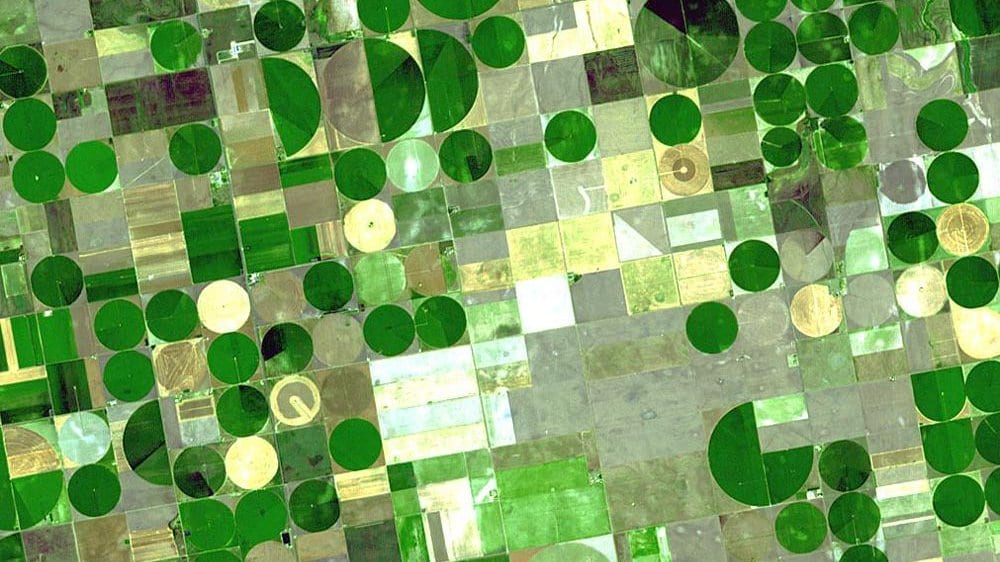
A farm in central Nebraska does not fail in an average year. What empties an account is the gap between one season and the next: the bad year that arrives after two good ones, when the loan was written for the good ones. Economists call that gap yield variability, and it is the quantity Mukta Dharmapurikar and Peter Huybers, of Harvard University, set out to trace through half a century of American corn. Their answer, published on Aug. 26, 2026, in Environmental Research Letters, runs against the expectation. The swings did not grow. They shrank.
Model-based studies broadly expect the opposite. As the world warms, they project harvests that swing harder from year to year, with consequences for price volatility and food security. Dharmapurikar and Huybers were not testing those projections against the future. They asked a narrower and more checkable question: what did the variability of Midwestern maize yields actually do over the decades in which the climate was already changing? Their paper is peer-reviewed and accepted, and it went online as the publisher's accepted manuscript, open access, ahead of its final typeset version.
The first thing they found is that the question has more than one answer, depending on how the swings are measured. Yields per acre rose enormously across the period, so a wobble of the same proportion arrives as a much larger wobble in bushels. Measure the raw spread, and variability appears to grow, largely because the crop did. The two researchers instead used a detrended coefficient of variation, which sizes each year's departure against the local trend rather than against a flat line. Read that way, variability fell in Nebraska from 1950 to 2009, and the decline shows up again in counties across Nebraska, Kansas and Colorado from 1970 onward. The sign of the trend depends on the metric, which is one reason arguments about agricultural volatility can run for years with real numbers on both sides.
Explaining the decline was the harder half. Using detailed annual yield and irrigation data, the pair fitted a fixed-effects model, which compares each county against its own history rather than against its neighbors, and found irrigation to be the primary driver of the fall in county-level variability. The result held when they controlled for the obvious rival explanation. Warmth accumulated over the growing season went into the model, along with the extreme heat that damages a crop, average rainfall and how much that rainfall itself varied from year to year. Nonlinear responses were allowed for as well, and irrigation still carried the trend. That is attribution by statistical design over observed history rather than by experiment, and it says irrigation explains more of the decline than weather does, not that weather played no part.
The mechanism needs no statistics to picture. Rain is the input that varies; a pump is not. A field that can be watered on demand loses the worst of a dry August, and decades of expanding irrigation across these states removed, field by field, the largest source of difference between one year and another.
A second result is stranger and more tentative. Where irrigation increased, yields on rainfed fields in the same county grew steadier as well. The authors report this as an association and suggest that irrigated fields confer benefits on their rainfed neighbors, which is an interpretation of a statistical pattern rather than a transfer anyone has measured directly.
The closing point is the one that should travel furthest. Steadiness of this kind is bought rather than given. It rests on water lifted out of the ground beneath Nebraska, Kansas and Colorado, and the authors state plainly that yield volatility would rise again if irrigation were reduced, by the depletion of aquifers, for instance.
That is where the finding meets the food-security argument it complicates. Swings in a few large producing regions are what move world grain prices, because a shortfall cannot be covered by a harvest that has not happened yet, and a year in which several major exporters stumble at once is felt in countries that grew none of the crop. If much of the past half-century's calm in American corn came from groundwater rather than from a gentler climate, then that calm has a physical volume behind it, and the volume is not unlimited.
It also changes what a pumping limit costs. A water district deciding how much groundwater its wells may lift is not only setting how much corn the county grows; on the evidence of this half-century, it is setting how steady that harvest will be. The projections of a wilder agricultural future are not refuted by this record. They are handed a condition: part of what has held American corn steady so far has to be pumped.
Sources
- Environmental Research LettersPeer-reviewed