Under Chile's Streetlights, a Cleared Patch of Shore Came Back More Slowly

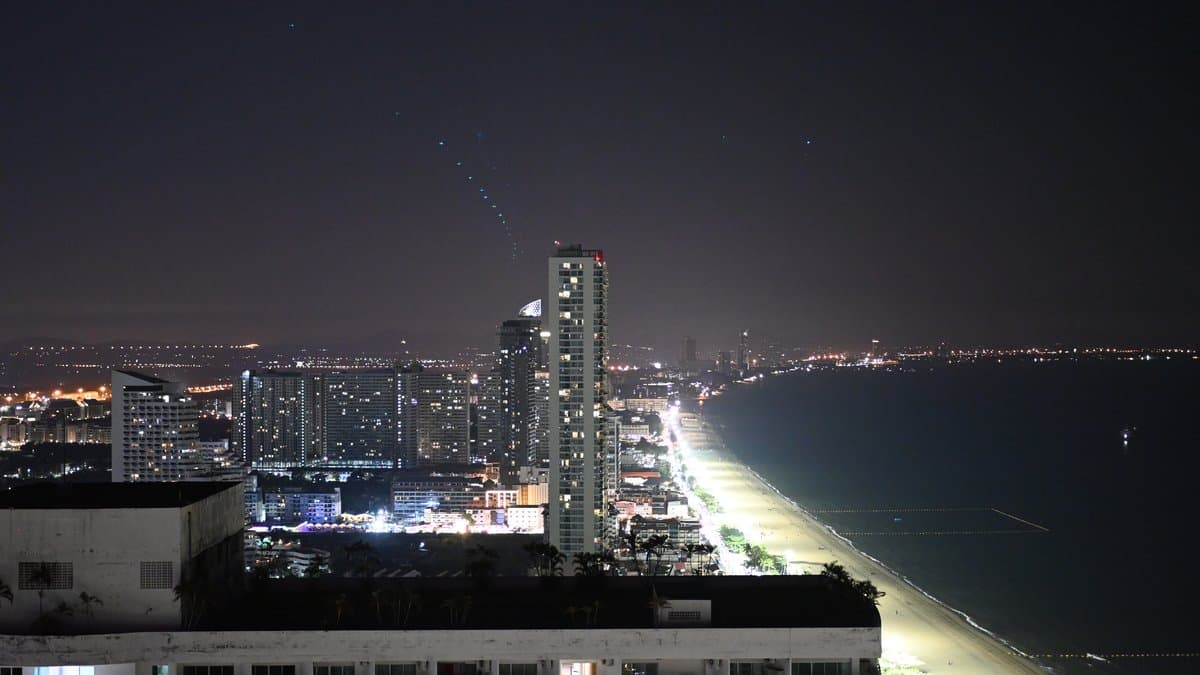
A streetlight on a seawall does not switch off at low tide. Below it the rock is alive with things that cannot move away: seaweeds, flat crusts, a slick of microbes and the small animals that graze on them. In the port cities of Chile, that band of shore (the strip between high and low tide) spends every night under a light nothing living there grew up with.
What the glow does to that band is what a team led by Moisés A. Aguilera, at Universidad Adolfo Ibáñez in Santiago, set out to measure. How steady light pollution works together with the physical setting of a city shore is still poorly understood, they write. Their answer, published online on Sept. 18, 2026, in Marine Pollution Bulletin, is that a great deal depends on what the shore is made of.
They worked two ways. First a survey of shores along northern and central Chile: eight natural rock platforms and eight concrete breakwaters of the kind built to take the swell off a port or a promenade. Then an experiment at a single place on that coast. There they scraped patches of rock clear of everything living, some under streetlights and some away from them, and went back to those patches for 573 days.
The survey found less seaweed where the nights were brighter, but only on the natural platforms. Both the quick-growing kinds and the tougher, fleshier ones were thinner there. The decline was not a straight line: more light did not simply mean less seaweed. On the breakwaters there was no change the team could detect, which is not the same as no change; a survey only sees what its design is strong enough to pick up.
The cleared patches split the same way. On the breakwaters, lit or unlit, bare rock mostly stayed bare rock: a film of microbes and flat crusts of algae. Few foundation species, the habitat-builders others live on, settled back in. On the natural platforms the patches did fill in, but under the streetlights the number of species came back more slowly than on the unlit rock.
A cleared patch is a disturbed patch whatever the lighting, so the team ran an analysis meant to separate the light from the scraping itself. Across both study sites, that left a small negative relationship between streetlight exposure and how abundant the foundation species were. Small is the authors' own word. They read it as light holding new arrivals back whatever the rock had been through.
What they will not do is call the light the cause of the slower regrowth. The experiment had a single site for each combination of habitat and lighting: one lit rock platform, one unlit, one lit breakwater, one unlit. The authors write that the different recovery paths, while consistent with the effects of night light, "cannot be unequivocally attributed to light pollution." The contrast on the shore is real and it was measured; what produced it is not settled by this experiment.
That night lighting can change which things settle on a shore is not in doubt. In 2015, Thomas W. Davies, then at the University of Exeter, and colleagues lit panels at sea with white LED lamps. The brightness matched what the marine life there already meets. Colonization changed for a good share of the species they followed: some were held back, some encouraged. That was a different ocean and a different group, which is what makes the direction of the Chilean result unsurprising.
Aguilera's group has already sketched one route from a streetlight to thinner seaweed. In work published in April 2026 in Environmental Pollution, from the same coastline, they found the film of microbes growing thicker on lit natural rock. The grazing animals that eat that film were both more numerous and more active at night. On lit breakwaters the film grew too, but grazer numbers did not move, which the team put down to the dark gaps between the boulders. That is the same laboratory, so it offers an explanation rather than a confirmation.
The paper's own closing point is about repair rather than blame. Bringing a damaged city shore back, the authors write, means helping the habitat-builders get established early. It also means easing the light, alongside the other pressures a city puts on the same rock. This is one coastline, surveyed once, and cleared in one place. Coastal lighting is a condition of shorelines everywhere; the measurement is Chilean.
Sources
- Marine Pollution BulletinPeer-reviewed
- doi.org
- doi.org