Off Gran Canaria, Ocean Plastic Peaks 500 Meters Down

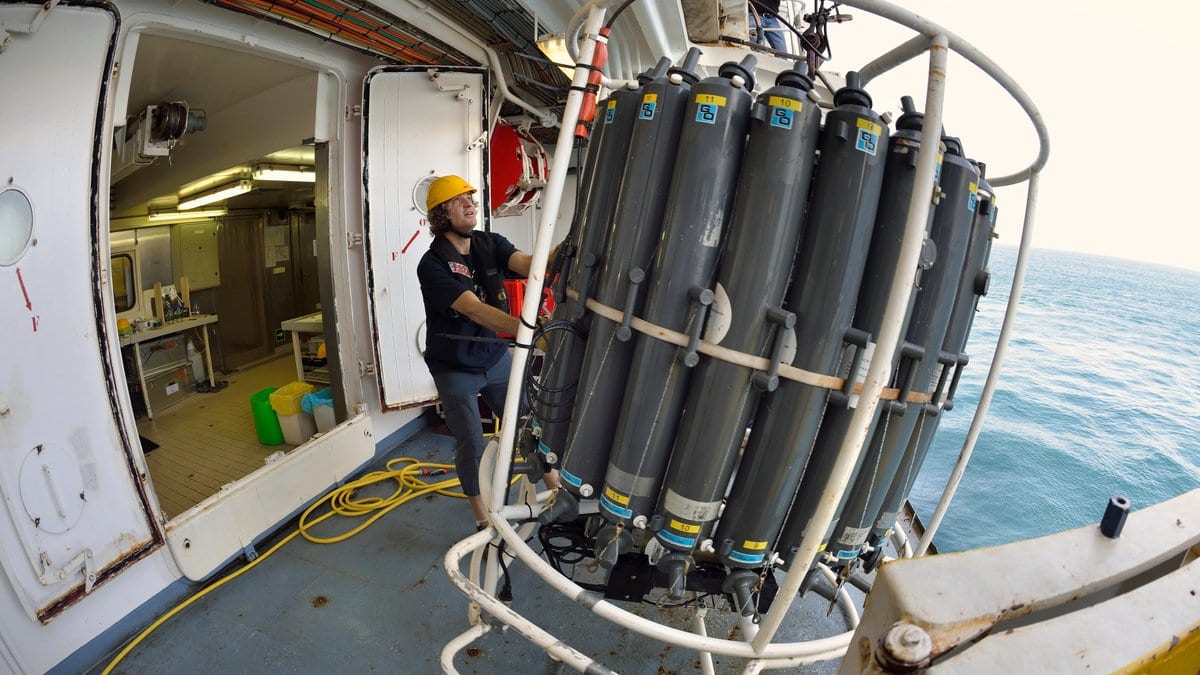
In March 2024, the German research vessel Maria S. Merian held station over deep water south of Gran Canaria and began lowering sample bottles. The deepest one closed at 2,720 meters, in water that is dark, cold and a long way from the nearest shopping bag. Mohamed Rida Abelouah of Ibnou Zohr University in Agadir, Morocco, and colleagues in Morocco and Tunisia have now reported what came back up. All 33 samples had plastic in them.
What makes the result worth reading is not that plastic was down there, but the shape of the column. The profile they describe in Marine Pollution Bulletin rises and falls instead of thinning out with depth. Abundance peaked at 500 meters, at 39.3 particles per liter. It fell to its lowest at 2,000 meters, at 2.0 per liter. Then came a second signal in the deepest water sampled, between 2,500 meters and the bottom of the profile. Those counts come from bottles of seawater rather than a net towed through it, with the particles identified by infrared and Raman spectroscopy, two techniques that read a material's chemical fingerprint. That distinction matters more than it sounds.
A towed net catches what cannot slip through its mesh, and fine fibers slip through. A separate 2026 survey around the Balearic Islands, run from Spain's Centro Oceanográfico de Baleares, compared a surface net tow with bottles filled just below it in the same waters. Fiber counts rose by six orders of magnitude between the two. That team concluded that nets underestimate fiber contamination in the ocean. So a bottle-and-spectroscopy count is not a larger version of a net count. It is a different measurement, and the Canary numbers describe what this method saw in this water column rather than how that water ranks against anywhere else.
The pattern lines up with the physical state of the water itself. Abundance rose with temperature (r = +0.77) and with salinity (r = +0.66), and fell as potential density rose (r = -0.76). Potential density is just how heavy a parcel of seawater is. The subsurface maximum sits at the upper boundary of the North Atlantic Central Water, one of the great layered bodies of water that stack on top of one another in this part of the Atlantic.
Oxygen was the obvious suspect, and it did not work out. That peak coincides with the top of the regional oxygen minimum zone, a mid-depth layer where dissolved oxygen runs low, which makes a link tempting to assume. The team tested it, and the association came back weak and inconsistent in direction, at a rank correlation of -0.06. That is about as close to no relationship as a number gets. They conclude that water-mass structure, not oxygen levels, is the principal physical correlate of how microplastic is spread down the column.
The deep particles were also a narrower set of things. With depth, the mixture converged toward fine, dark, fibrous polyethylene terephthalate. PET is the plastic of drink bottles and polyester clothing. From 1,500 meters to the bottom of the profile, every particle identified was PET, all of it finer than half a millimeter. That band rests on the one full-depth station, and the authors flag the limit themselves, writing that the deep-water structure there "should be interpreted as indicative rather than basin-wide representative."
The surfaces of the particles carried a record of their own. Electron microscopy with chemical analysis showed them weathered and biofouled, coated in the growth that long exposure to seawater brings. The surfaces also bore mineral residues of Saharan dust and biogenic carbonate, the calcium-rich remains of marine organisms. The authors read that combination as consistent with a Saharan dust and biogenic origin.
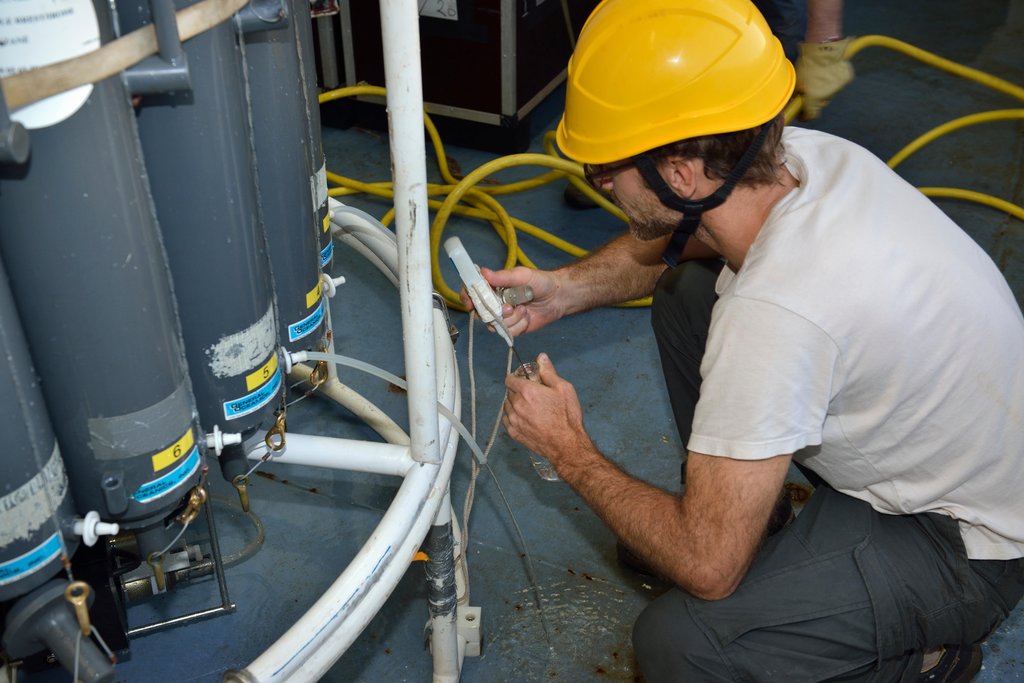
How a plastic fiber ends up that deep is the question this leaves open, and the paper does not claim to answer it. Mineral and biological coatings are known to change how fast a particle sinks, so that is where an answer would be looked for. Where fibers gather in mid-water has largely been a matter for ocean models that sort plastic by shape, and a measured column is a different kind of evidence.
Abelouah and colleagues go as far as calling the deep Canary Basin a potential accumulation zone, one that delivers an aged signature of PET fiber into the deepest water. "Potential" is their word, and it is the right one. The paper is peer-reviewed and appeared online Oct. 3, 2026, ahead of print. What it establishes is narrow and solid. In this column, by this method, microplastic turned up at every depth sampled. Its abundance went with the water's temperature, salinity and density, not with its oxygen. And at the bottom, it was all one kind.
Sources
- Marine Pollution BulletinPeer-reviewed