Why One Lightning Strike Starts a Fire and the Next One Does Not

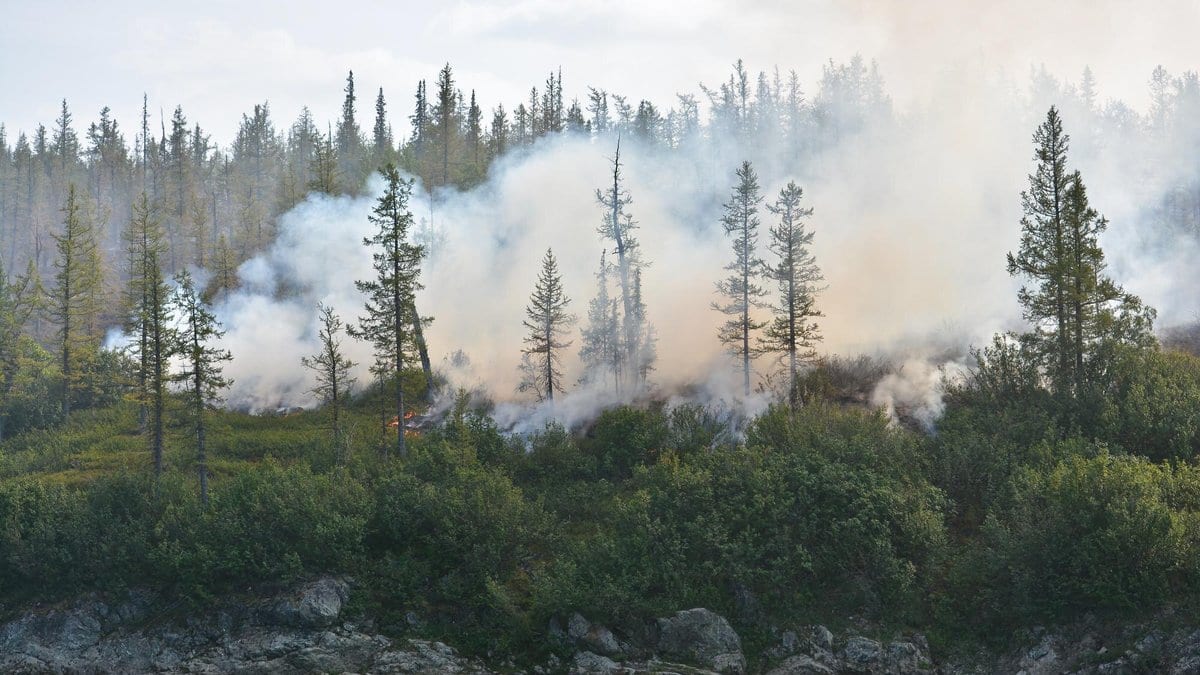
Two bolts come down out of the same storm, a few kilometers apart, into the same stretch of spruce. One leaves a scorched trunk and nothing else. The other leaves a fire that is still burning three weeks later. Walk the ground afterward and the two strikes look much the same.
A study published online Oct. 21, 2026, in Environmental Research Letters puts the difference mostly in the weather of the previous week. Brittany Engle and Cornelius Senf of the Technical University of Munich, with three colleagues, assembled 5,251 pairs of lightning from the boreal forest. The boreal is the belt of spruce, pine and birch that rings the top of the world. In each pair, one strike was linked to a wildfire and the other started nothing.
The question matters because climate change is expected to shift both sides of the problem at once: how readily the boreal burns, and how much lightning reaches it. That is the paper's own starting point, and it notes that the mechanics of lightning-ignited fire remain unclear, which makes prediction at this scale hard.
The design is a contrast rather than a tally. Counting fires tells you little in a biome where most of the forest floor is flammable for most of the summer. Asking what was different about the strikes that started one tells you more, and the authors describe their approach as a quasi-experimental design of ignition and non-ignition pairs. To each pair they attached temperature, rainfall and relative humidity, plus four properties of the bolt itself. One of those was polarity, the direction of the current. They also attached net primary productivity, a measure of how fast the forest was growing. Three models were fitted: the full boreal, open forests and closed forests.
Temperature gave the clearest signal. A one-standard-deviation increase, which the paper puts at about 3.3 °C, raised ignition probability by 44–69%. That is a relative increase rather than a level: a strike's odds of starting a fire rise by that proportion, and it is not the case that 44–69% of strikes start fires. The range comes out of the modeling across the three forest types, and no single figure in it belongs to any one of them. Rain and humidity pushed the other way: more total precipitation and higher relative humidity both lowered ignition probability.
The timing has two halves, and both are worth holding. Temperature and precipitation were most predictive 3–8 days before the lightning arrived. The effect then lasted up to 7–11 days after it.
The trailing window sounds backward until you picture what a lightning fire in the north actually does. A bolt can leave the litter and the thick layer of half-rotted needles beneath it smoldering out of sight, sometimes for days, before a flame reaches the surface and the fire is noticed at all. The following week's weather therefore still bears on whether a strike ever becomes a fire anyone records.
None of which makes the lightning beside the point. Positive polarity was also associated with a higher chance of ignition. The authors' conclusion is that wildfire ignition in the global boreal is driven primarily by short-term fire weather rather than by lightning characteristics alone. Weather dominates. The bolt still counts.
What that implies for a warming north, the authors decline to collapse into a single number. They write that a projected rise in temperatures is expected to push ignition probability up across the boreal, though this may be partly offset by an increase in total precipitation. Both hedges are theirs. The offsetting quantity is total rainfall rather than humidity, which the study handles as a predictor in its own right.
One detail belongs in the open: the lightning observations come from a commercial detection network, and one of the five authors works for that company, an affiliation declared on the paper.
The paper is peer reviewed and accepted, with the copy-edited version of record still to come, and it is open access under a Creative Commons license. Its reach is the boreal and nothing wider. What is new in it is not the idea that the previous week's dryness matters; operational fire-danger systems already build that in. It is that the same short list of drivers holds up consistently across the whole northern belt, from Scandinavia through Siberia to Canada, in a design that leans as much on the strikes that started nothing as on the ones that did.
Sources
- Environmental Research LettersPeer-reviewed