In Climate Simulations, Arctic Summer Warmth Has Already Outgrown Its Natural Swings

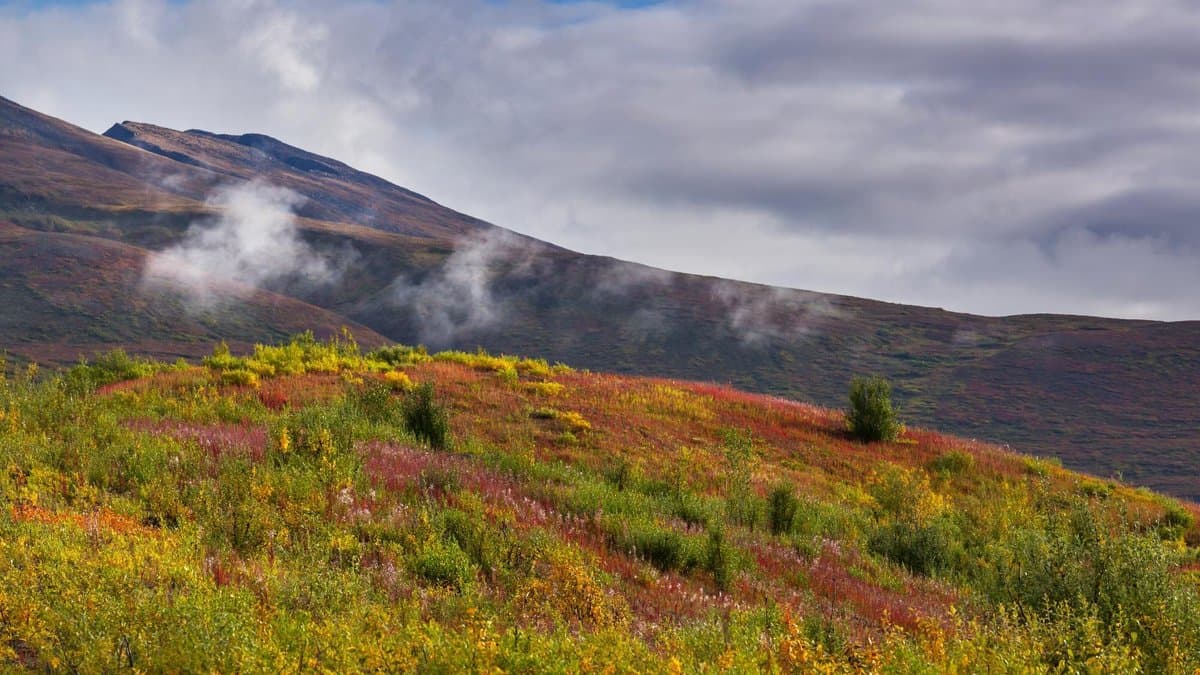
On the north side of Alaska's Brooks Range, spruce are moving into ground that used to be tundra. Observations show the treeline there advancing quickly, and the warming behind it is not in doubt. The harder question is whether that warmth is still something the Arctic's own weather could have produced by itself. A study published Sept. 11 in Environmental Research Letters put that question to a climate model, and the answer came back in two parts.
Daniel M Hueholt of Colorado College and co-authors at Colorado State University and Boston University set out to describe how the climate's natural swings and its long-term warming act together on Arctic warmth. Their paper covers the past and the future together, and its purpose is practical. Any projection of how Arctic ecosystems will change has to hold both at once, and the authors offer their method as a way to do that.
What they tracked is a measure a gardener would recognize. Growing degree days are the yearly sum of daily temperatures above 5 °C, a running tally of the usable warmth a place gets. Existing fieldwork, which these authors cite rather than carry out themselves, has identified rising growing degree days as a key driver of Arctic greening.
Their tool is the Community Earth System Model 2 Large Ensemble: the same model run many times over, each run starting from slightly different conditions. Every run therefore gets its own sequence of cold decades and warm ones, so the spread across them shows what the climate's ups and downs can do unaided. Measured against this spread, many simulated Arctic ecoregions, areas grouped by their plant life, have already entered a state in which the warming trend dominates. Many is the researcher's own word, as is simulated: the crossing they describe happened in the model.
The Brooks Range is where they look closest. Sorting the runs into cases where the crossing arrives early and cases where it arrives late, they find it is associated with sea surface temperatures in the Pacific and the Arctic. That is a link between two things inside the model, not a cause, and not a statement about Alaska.
The second part of the answer rests on a different comparison, and it has not happened. Set against a separate run of the model without industrial emissions, Arctic summers with no match anywhere in that older world begin around the middle of this century, and then spread across much of the far north. This timing belongs to the single emissions path these runs follow. Another path would move it.
Warmer and greener are not the same thing, even in the Brooks Range. A 2021 study in Ecography mapped roughly 12,400 km of northern Alaska's treelines and found them standing in air a few degrees warmer than the growing-season average long thought to halt tree growth. Colin T. Maher and colleagues concluded that cold air is not what holds the treeline in place there, and noted that many treelines worldwide are not advancing at all as the climate warms. Soil temperature and frozen ground appear to matter as much.
The Arctic result, then, is a statement about a simulation: one peer-reviewed study, one model, with no measurement standing behind the crossing itself. To check that the picture held up, the team set one half of the runs against the other half, which handles smoke and other airborne particles differently, and they grant in the same breath that the model's far-northern climate carries biases. What the work offers the next group making a projection is not a date for any one place. It is a way to keep the forced warming and the natural swings in one frame, given that the swings can hide a trend for a decade or expose it early.
Sources
- Peer-reviewedEnvironmental Research Letters
- Ecography