The Arctic's Coldest Months Are Becoming Its Biggest Carbon Problem

For most of the year the far North does its climate work in the dark. Long after the growing season ends and the last flux of summer photosynthesis fades, the soil beneath the snow keeps breathing: microbes chewing through old organic matter, exhaling carbon dioxide into air already well below freezing. That quiet winter respiration used to be an afterthought in the Arctic carbon budget. It is turning into the headline.
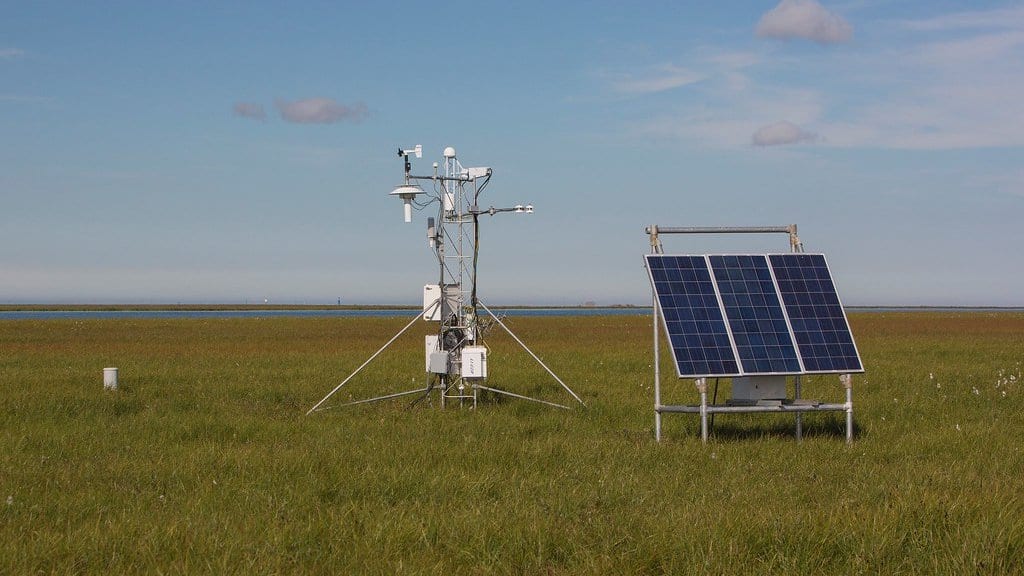
That is the picture emerging from a new report in Environmental Research Letters, led by Grant Falvo and colleagues across a consortium of North American and European research groups, published on 7 July 2026. Drawing on 31 long-term eddy-covariance towers (the instrumented masts that measure the two-way exchange of gases between land and atmosphere), the team documented what the Arctic-Boreal region actually did during the 2024–2025 winter, one of the warmest that region has on record and the second such winter in a row.
The finding is not subtle. At tundra and boreal-forest sites, monthly average CO2 emissions ran significantly above their long-term norms through the cold months. Warm winters, in other words, do not simply make the Arctic less cold. They wake up the soil.
Why winter is the hinge
To understand why that matters, it helps to know where the Arctic keeps its carbon. Permafrost soils hold roughly twice as much carbon as the atmosphere does: a vast, frozen archive of plant and animal matter that never fully decomposed because it stayed too cold. As long as the ground stays frozen, that carbon stays locked away. When it thaws, or even when unfrozen pockets linger longer into the winter, microbes get back to work and release it.
The study captures that mechanism in the act. When air temperatures stay elevated through the winter, snow insulates soils that are warmer than they should be, and respiration continues where it would normally slow to a crawl. The extra CO2 those sites vented was the measurable signature of that process: the permafrost-carbon feedback, the self-reinforcing loop in which warming releases carbon that drives further warming, showing up not as a projection but as a number on a tower.
There is a genuine complication, and the researchers are clear about it. The same sites that leaked carbon in winter also pulled down more CO2 than average during the summers of 2024 and 2025. Longer, warmer growing seasons mean more photosynthesis, and greener tundra and forests are hungrier for carbon. The Arctic's books are being rewritten on both sides of the ledger at once, and whether the region ends up a net source or a net sink over a full year depends on which effect wins, a question the network is built to keep answering season by season.
What the towers did not see in methane
These are carbon and methane towers. The team tracked methane fluxes alongside CO2, but the methane anomalies were not statistically significant. This is a carbon-dioxide story. The warm winter did not, on this evidence, trigger a detectable surge in methane, the more potent greenhouse gas that often dominates Arctic tipping-point anxieties. Reading a methane spike into these results would go beyond what the data support.
Watching the feedback in near-real-time
Perhaps the quietest innovation here is also the most consequential for how science tracks the Arctic. Historically, flux data from remote high-latitude towers might take a year or more to be cleaned, calibrated, and published, long enough that a record-warm winter would be old news before its carbon consequences were tallied. The networks behind this report deliver data with a median latency of about 14 days.
Two weeks. That is close enough to real time that a warm anomaly and its carbon response can be observed almost as they happen, rather than reconstructed in hindsight. The authors make a point of advocating for wider adoption of this automated, publicly accessible model, a monitoring system fast enough to catch a feedback loop mid-turn.
That speed changes the kind of question scientists can ask. Instead of confirming, years later, that a warm winter released carbon, they can watch an unusual season develop and see the ecosystem's answer within the same year. Over the long baseline these towers are building, back-to-back record winters stop being isolated events and start becoming a trend line, one the instruments are now quick enough to read as it is drawn.
Sources
- Environmental Research LettersPeer-reviewed