The Aral Sea's Dry Bed Turned Into a Carbon Bomb. Rewetting It Could Defuse the Rest

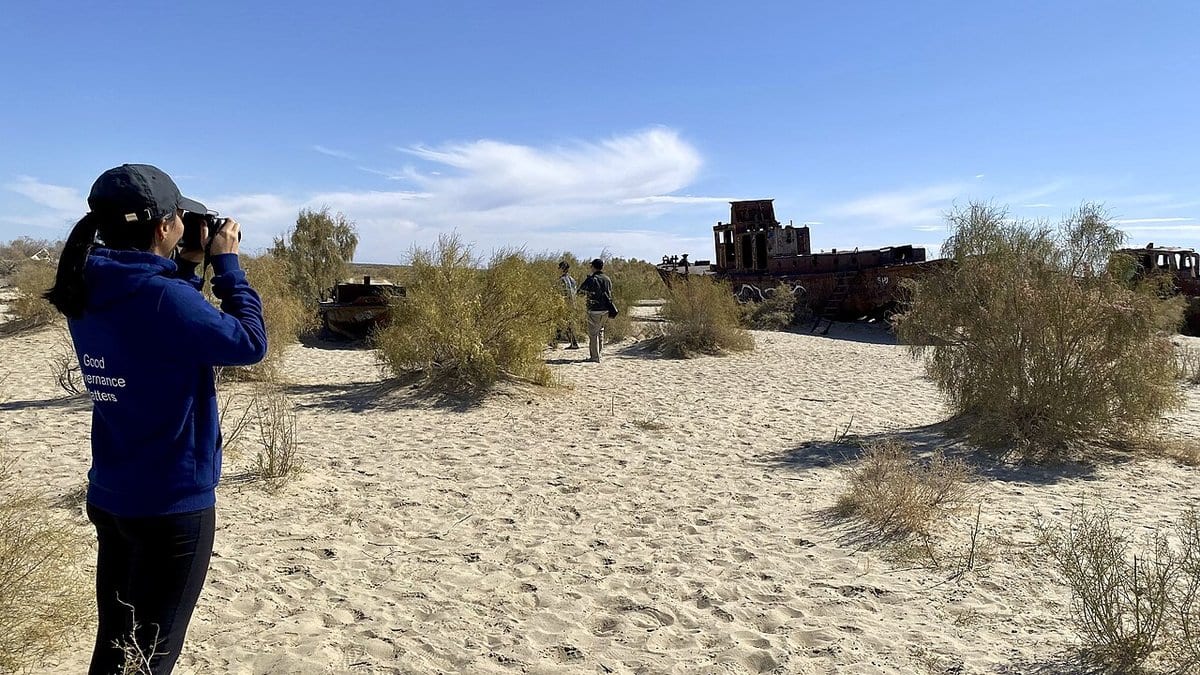
For decades the Aral Sea has stood as a monument to what human engineering can undo. Once the fourth-largest lake on Earth, it began shrinking in the 1960s when Soviet planners diverted the rivers feeding it to irrigate cotton across Central Asia. What was left behind is a desert of cracked salt and fine dust, dotted with the rusting hulls of fishing boats grounded miles from any water. The human and ecological toll of that collapse has been documented for years. What a team of researchers has now added is a quieter, invisible loss: carbon.
Their finding, published in Science, reframes the dry lakebed as something few people had thought to measure. Lake and sea sediments are, in effect, long-term carbon vaults. Over centuries, dead algae, plants and other organic matter sink to the bottom and are buried under water, where the lack of oxygen slows their decay to a crawl. Expose that mud to the open air, and the process runs in reverse. "When these systems dry out, this carbon storage function can be reversed," the researchers explain: the sediments meet the atmosphere, microbes go to work on the organic matter, and carbon that had been sealed away for generations escapes as CO2.
Rafael Marcé and Núria Catalán of the Centre for Advanced Studies of Blanes, part of Spain's national research council (CEAB-CSIC), led the effort to put a number on that escape. Reconstructing how much of the Aral's bed has been laid bare since 1960 and how its buried carbon has decomposed, they arrived at roughly 748 million tonnes of CO2 released across Central Asia's altered carbon balance. For scale, that is close to three years of the total greenhouse-gas output of a country the size of Spain, emitted not from smokestacks but from bare ground.
The more striking half of the paper looks forward rather than back. Not all of the carbon has burned off yet. The team estimates that about 605 million tonnes of it still sits in the exposed sediments, slowly decomposing and waiting to be released. That is where the physics that created the problem also points to a way out. Re-flooding the basin, even partly, would put the sediments back under water, cut off their oxygen supply, and halt the decay. The carbon would stay where it is instead of continuing to vent.
That is not a hypothetical restoration. The northern portion of the Aral, on the Kazakh side, has already been partly revived behind a dam, and the study treats reflooding as a concrete lever rather than a thought experiment. The researchers model a scenario in which roughly US$9.7 billion in water-management improvements restores about half of the sea's 1960 surface area. That investment, they calculate, would prevent the release of some 323 million tonnes of CO2-equivalent, carbon that could be certified and sold as credits on voluntary markets.
The economics follow from there. Depending on carbon prices, the avoided emissions could translate into somewhere between US$3.6 billion and US$18 billion in tradable carbon credits, according to the CEAB-CSIC team. A dying sea, in other words, might partly finance its own recovery, with the climate benefit acting as collateral for the water works that make it possible.
Some caution is warranted. The headline figures are estimates built on reconstructions of how much sediment dried out and how fast its carbon decomposes, and reflooding a basin the size of the Aral is an immense hydrological and political undertaking spanning several countries. The carbon-credit values, in particular, hinge on volatile market prices and on the accounting standards that would govern such a project. The study makes the case that the opportunity is real and quantifiable; realizing it is a far larger question of money, water rights and cooperation across Central Asia.
Still, the reframing matters. Drained lakebeds are usually filed under regional tragedy, their damage assumed to be local and already done. This work counts the Aral as a global carbon source that is still emitting, and shows that the same lever which could restore an ecosystem could also keep hundreds of millions of tonnes of CO2 out of the air. It suggests that in at least one place, ecological repair and climate mitigation are not competing goals but the same one.
Sources
- SciencePeer-reviewed
- www.ceab.csic.es