The Gulf's Worsening Haze Answers to El Nino, a Satellite Record Shows

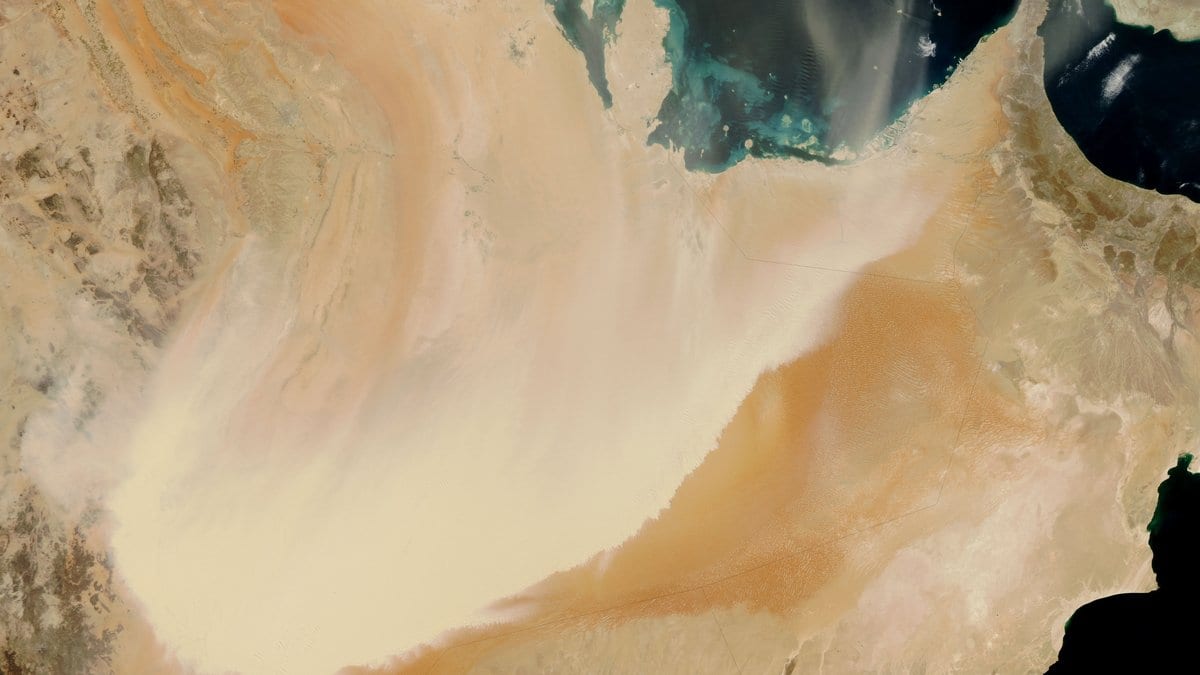
Over the Arabian Peninsula, the haze that dims the sky is often not smog in the familiar sense. It is dust, lifted off deserts and carried on the wind, and it is one of the harsher air-quality burdens anywhere on Earth. Sorting how much of that fine particulate load is trending upward, and why, has been difficult in a region where ground monitors are sparse. So a team turned to the long view from orbit.
A study accepted 22 July 2026 in Environmental Research Letters assembles 26 years of satellite observations, spanning 1998 to 2023, to chart how PM2.5, the fine airborne particles small enough to lodge deep in the lungs, has behaved across the peninsula. Led by Juan Felipe Mendez Espinosa and colleagues, with Ibrahim Hoteit among the authors, the work maps not just where the pollution sits but how it has shifted over more than two decades.
The record shows a clear break. Through the first stretch, from 1998 to about 2007, PM2.5 stayed relatively low. After that came a pronounced climb. Geographically, the burden is far from even: concentrations run highest over eastern Saudi Arabia and the Arabian Gulf, while the northwestern reaches of the peninsula stay persistently cleaner. The rise, the authors find, is consistent with a substantial contribution from increasing dust, with a smaller additional push from human-made sources such as industry and traffic. In other words, the trend is dust-led, though not dust alone.
The more novel part of the study is what sits behind the dust. The researchers link the swings in PM2.5 to the El Nino-Southern Oscillation, the vast see-saw of warm and cool phases in the tropical Pacific that reshapes weather worldwide. ENSO emerges as the dominant climate influence on the region's fine-particle pollution. La Nina years, in particular, line up with dirtier air: they coincide with a weakened subtropical westerly jet, suppressed rainfall, and heightened regional aridity. Drier ground and slack winds aloft make it easier to loft dust and keep it aloft, and the peninsula's air quality worsens accordingly.
That connection is the study's real argument. If a climate pattern centered thousands of miles away in the Pacific helps set how much dust hangs over the Gulf in a given year, then air quality in the region cannot be treated as a purely local, solely human problem. It is partly a climate phenomenon. The authors draw the practical conclusion that managing air quality here calls for climate-aware approaches, planning that anticipates the dustier conditions a La Nina is likely to bring rather than reacting after the haze arrives.
The study lands a useful point: over a landscape where dust is a defining feature of the air, the amount of it people breathe is bound up with the planet's largest climate cycle. Watching the Pacific, it turns out, may offer a hint of how thick the haze over the Gulf will be.
Sources
- Environmental Research LettersPeer-reviewed