Fresh Carbon Grown in a Jar Reads Four Centuries Too Old

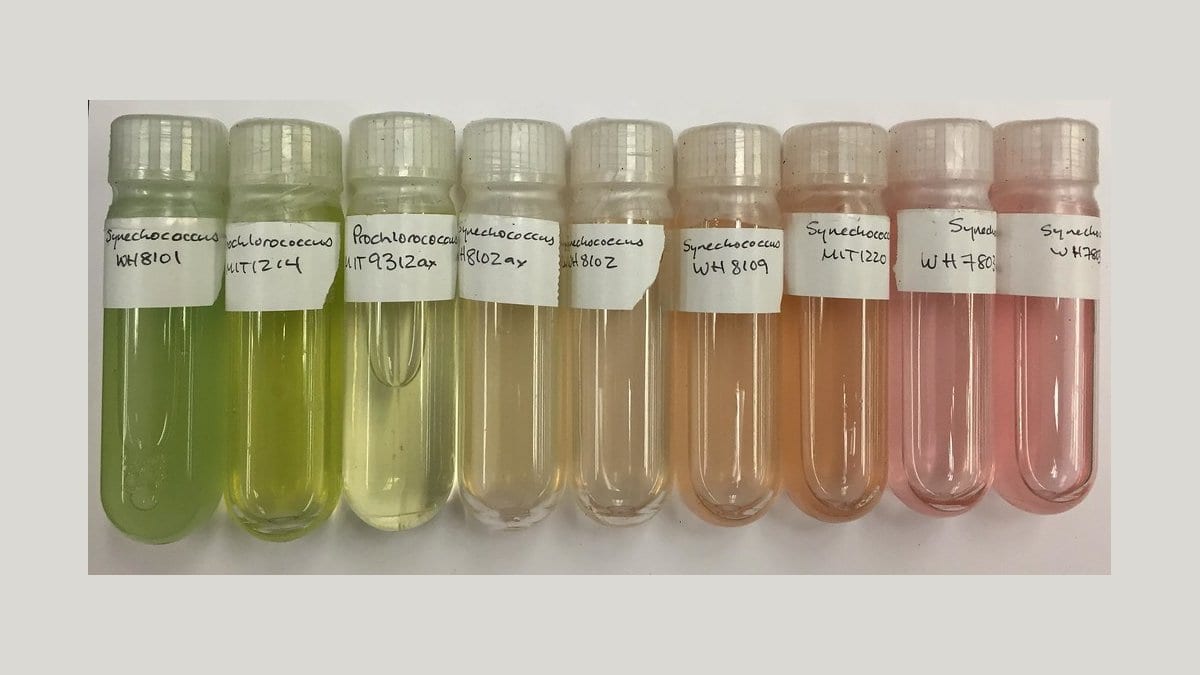
For two years, a sealed culture of marine microbes fed itself in a Chinese laboratory: a cyanobacterium and the bacteria that live alongside it, recycling their own nutrients, with nothing added and nothing taken out. Nothing inside could be older than the experiment. Yet when the carbon that built up in it was measured by radiocarbon, the method archaeologists use on bone and charcoal, it came back looking centuries older than it was.
The measurement comes from Hanshuang Zhao, Zenghu Zhang and colleagues at the Qingdao Institute of Bioenergy and Bioprocess Technology, part of the Chinese Academy of Sciences. Zhao and Zhang share first authorship; the senior author is Yongyu Zhang. They published the work on Aug. 29, 2026, in Nature Communications, peer-reviewed and posted early as an accelerated preview, which means the text can still change before the final version of record appears.
The culture itself was Synechococcus, one of the smallest and most abundant photosynthetic cells in the sea, grown with the community of bacteria that normally live with it. Over two years the algae leaked organic matter, the bacteria worked it over with their enzymes, and what survived that repeated reworking was a residue of inert particles. About 26% of the particulate organic carbon the culture produced resisted being broken back down, accumulating instead as a stable pool.
That much was not new. In 2024, working with the same model system, the same group reported in Global Change Biology that sustained algae-bacteria interaction builds recalcitrant carbon in the ocean. What the new paper adds is what happened when they dated the residue.
Radiocarbon dating runs on a slow leak. Living things take up carbon-14, a rare radioactive form of carbon made high in the atmosphere, for as long as they are alive; once they stop, it decays away with a half-life of about 5,700 years. Less carbon-14 in a sample means more time has passed since the carbon was fixed. That is how a piece of driftwood, or a particle sinking through the ocean, gets an age.
The particles out of the culture carried an apparent age offset of more than 400 years. That is not an age. None of the carbon was more than two years old, and the researchers knew when it was made; what the number records is the gap between how old the material looks on the radiocarbon scale and how old it actually is.
The most probable explanation has nothing to do with the carbon sitting around. Coal, oil and gas are so old that the carbon-14 in them decayed away long ago, so burning them adds carbon dioxide with no carbon-14 in it and dilutes what the air holds. Algae fixing that air build the dilution into their tissue on day one, and the particles they leave behind inherit it. The researchers suggest this aged signature likely results from the assimilation of fossil-fuel-depleted CO2. While the size of the offset reflects the specific carbon-14-depleted air within the culture vessel, the finding demonstrates a crucial chemical pathway.
That matters because old-looking particulate carbon turns up in the real ocean, and an old radiocarbon age there is typically interpreted as a long ocean residence time: carbon that has been circulating or sitting for centuries. The experiment shows the two can come apart. The team offers these findings as a conceptual caution about how marine ages are inferred, rather than a direct correction to existing ocean measurements.
A closed vessel holding one genus of cyanobacteria differs from the complex dynamics of open water, where the air is not enclosed, light and nutrients swing with the seasons and something is always eating. Carrying these results over will require replicating the measurements on organic particles collected directly at sea. For now, these laboratory findings provide a vital first step, leaving oceanographers with a crucial question to ask before reading a radiocarbon age off a marine sample.
Sources
- Nature CommunicationsPeer-reviewed