Most of Accra's Schoolchildren Are Over WHO Air Guidelines Once You Count the Whole Day

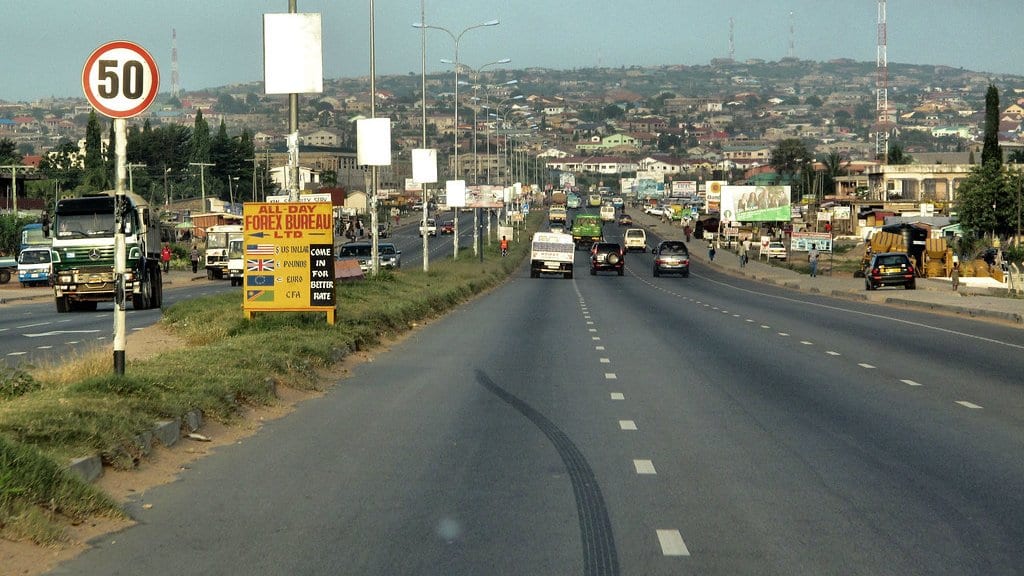
A child in Accra keeps two addresses. One is home. The other is a schoolyard, which may sit in a very different part of the city. Traffic fumes and traffic noise do not respect that split: both vary street by street, and what you measure at one address tells you only so much about the other.
Yet very little has been published about what children in the region's cities breathe and hear at both places at once. A study in Environmental Research Letters now puts numbers to that question for Accra. Rachel Hulme, Sierra N. Clark and colleagues at the University of Ghana, the University of Massachusetts Amherst and Imperial College London enrolled 1,034 children aged 8 to 12 from schools across the city, most of them public, and set out to estimate the air and the sound at each child's two addresses.
Nobody put a monitor on a child. Accra has very few permanent air-quality stations, as do most cities of its size in the region, so the team worked by land-use regression. Measurement campaigns across the city feed a statistical model. It learns how pollutant concentrations track with the things a map can show (road density, traffic, land cover, distance to known sources) and then estimates an annual average for any address it is handed. The researchers handed it the geocoded homes and schools of the 919 children whose records linked cleanly, and asked it for fine particles, nitrogen dioxide, black carbon and environmental noise.
Then came the arithmetic a child actually lives. Each setting was weighted by the hours spent in it, and the two were combined into one time-weighted exposure. At the median home, the model put fine particulate matter at 33.8 micrograms per cubic meter of air; at school it ran slightly lower. Added across the day, the total for most children came out above the relevant WHO guideline. These are modeled annual averages at an address, not readings from a device a child carried; they describe the block a child lives on, not the child.
Home and school proved related but not interchangeable. Fine-particle levels at a child's two addresses correlated at 0.56, with noise a little weaker and nitrogen dioxide weaker still. The relationships are moderate, which is what makes measuring both addresses worth the effort. Knowing where a child sleeps gives you a fair idea of the air in that child's classroom, and a fair idea is all a study of one setting can offer.
Noise came from the same modeled basis, and the two settings were judged against two different yardsticks. The median home stood at 66.3 decibels on the day-evening-night average, above the level WHO recommends for road-traffic noise. The median school stood at 62.4 decibels across the school day, above Ghana's own standard for areas with educational facilities.
One part of the study asked the children themselves. Among those whose modeled home noise fell between 65 and 70 decibels, 35% said they were highly annoyed by road-traffic noise, the single point in this work where a child's own account sits beside the model's.
The burden is not spread evenly across the city. On average, children at public schools and children living in lower-income areas were exposed to more air pollution and more noise than their counterparts at fee-paying schools or in wealthier neighborhoods. The soundscape divided along the same line: nature-based sounds turned up more often in the higher-income areas.
The study is a cross-sectional exposure assessment, focusing on the external air and sound environments rather than tracking direct biological markers inside the children's bodies. It describes the conditions at these homes and schools without claiming specific health outcomes or physical changes. The authors frame the results as carrying implications for children's health, development and learning, a reason the numbers matter rather than a finding about the children measured.
Published as a peer-reviewed and open-access study, this research provides Accra with an estimate where there was none: address-level figures for both of the places its schoolchildren spend their days, and a measure of how unevenly the two are distributed across the city.
Sources
- Environmental Research LettersPeer-reviewed