Tire Rubber in a Place With No Roads: Nanoplastics Turn up in Antarctic Soil

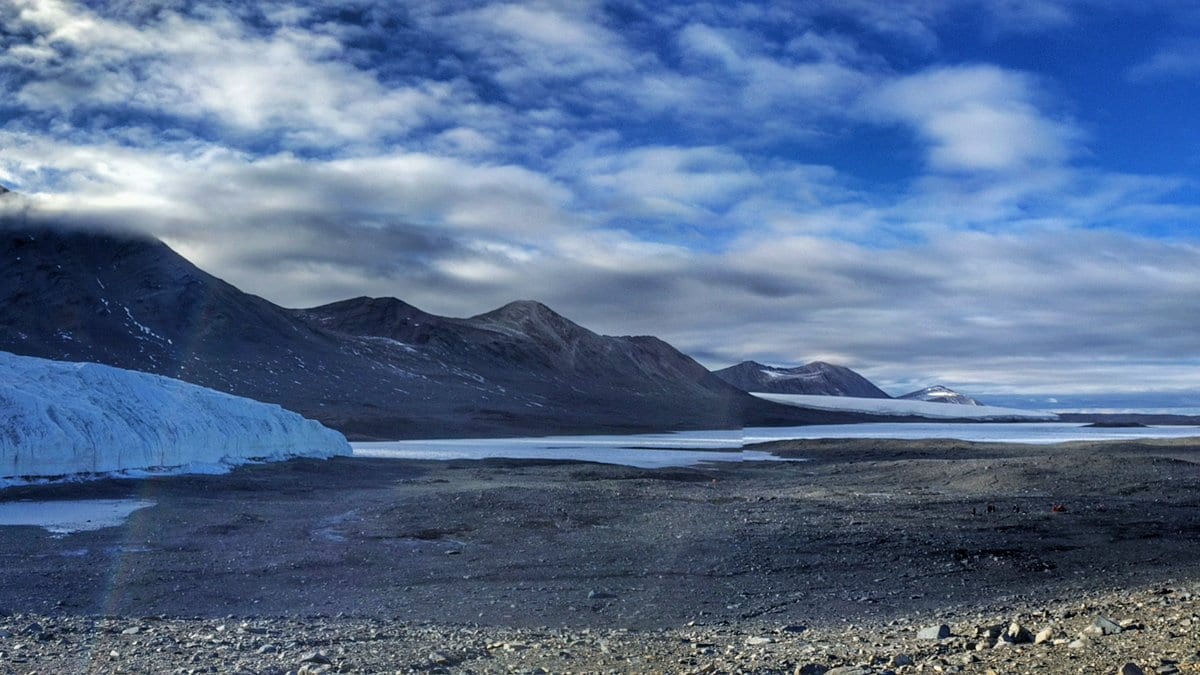
There is a corner of Antarctica where it does not snow enough to bury anything. The McMurdo Dry Valleys are a polar desert of bare gravel and frozen ground, kept ice-free by winds that strip away what little moisture arrives. Almost nothing grows. There are no roads, no towns and no permanent residents. If you set out to choose the patch of soil on Earth least likely to contain plastic, you would choose this one. So the list of things a team of European scientists pulled out of it deserves a second look: polypropylene, polyethylene, PET, polystyrene, PVC, and the rubber worn off vehicle tires.
The samples were collected between Jan. 8 and 28, 2023, in the Taylor and Wright valleys, and the analysis was published on July 4, 2026, in the peer-reviewed journal Scientific Reports by 12 researchers led from Lancaster University, with co-authors in Norway, Italy, Germany and Bosnia and Herzegovina. Their paper reports the first detection of nanoplastics in Antarctic soil: particles smaller than a micrometer, well below the size range most microplastic surveys can see. Across 13 topsoil sites, nanoplastics registered above the method's polymer-specific detection limits at 54 percent of them. The highest concentration was 295 nanograms per gram of soil. The median across the sites where anything was detected was 26.6 nanograms per gram, roughly a tenth of that peak, and both numbers matter: this is a landscape with a faint plastic signal, not a contaminated one.
Getting to a number like that required an instrument that does not look at plastic so much as cook it. Thermal desorption proton transfer reaction mass spectrometry heats a soil sample until the polymers in it come apart, then reads the fragments as a chemical fingerprint and works backward to the parent plastic. That is what makes sub-micrometer particles reachable in a soil matrix, and it is why this counts as a first: the standard techniques for microplastics identify particles by imaging them, and below about a micrometer there is nothing left to image usefully. The trade-off is that nothing is ever seen. The method returns mass per polymer class, not counts, shapes or sizes, and the sample is destroyed in the reading. Quantifying against something as chemically messy as soil carries uncertainty that the paper's abstract does not put a bound on.
Size is not a detail here. Microplastics are, roughly, anything under 5 millimeters, which lumps a bottle cap fragment together with something a bacterium could swallow. Below one micrometer, particles start behaving less like litter and more like a chemical: they can cross biological membranes, enter cells and move through tissue in ways that a visible fleck of polyethylene cannot. That is the fraction almost no environmental survey has been able to count, and it is the fraction this instrument was built to reach.
The other half of the result is vertical. At four sites the team also sampled below 20 centimeters, and found nanoplastics at two of the four, at a median of 1.95 nanograms per gram. That is a much fainter trace than the surface carries, and four sites is a thin basis for any conclusion. It does suggest something the surface figures alone would not: that this soil is not simply receiving plastic and holding it at the top. Some of it is working its way down.
So where did it come from? The team ran the samples' likely histories backward through FLEXPART, a Lagrangian particle dispersion model used to trace how air masses and the things they carry move around the planet. The modeling suggested seasonal deposition patterns, with inputs from both local sources and long-range atmospheric transport. Two routes, then, not one. Local means human activity in Antarctica itself: research stations, field camps, clothing, equipment, vehicles, all of which shed plastic. Long-range means the rest of the world, arriving on the wind.
The paper's own verb is suggested, and the authors are careful about the distinction. "At present, it is unclear whether ultrafine nanoplastic particles have arisen through direct long-range atmospheric transport from afar, or through the weathering of larger plastic debris found in marine areas along the Antarctic coastline," said Crispin Halsall of Lancaster University, a co-author, in the university's announcement of the work.
Which brings the tire particles back into view. Tire wear is among the largest sources of microplastic released anywhere in the world, and unlike a bottle or a bag it is generated as a fine dust at the moment of use, on every road, continuously. It is also light enough to be lifted and carried a long way. The Dry Valleys have no road network. The distance to the nearest research stations does not appear in the paper's abstract; the science news site Phys.org, quoting the full text, puts it at roughly 100 to 120 kilometers. Either way, nobody is driving in the Taylor Valley.
None of this is quite as surprising as it sounds, which is itself the point. Nanoplastics have been reported in Antarctic snow before; a 2022 study by a group including Dušan Materić, a co-author on this paper, found them there. In 2025, a survey published in Nature found nanoplastics distributed through the water column across the North Atlantic. Remote does not mean untouched, and it has not for some time. What the Dry Valleys result adds is soil, a compartment that stores rather than circulates, in a place with essentially no local plastic economy. The concentrations are low enough to serve as something the field currently lacks: a baseline. Future measurements from the same valleys can be compared against these, which is a slow, unglamorous kind of usefulness.
This is one field season, 13 surface sites and four deep ones, from a single stretch of January. It establishes that nanoplastics are present in Dry Valley soil and roughly at what level; it does not survey Antarctic soil, and it cannot say how the amount is changing. The paper does not separate the local contribution from the imported one, and the modeling was never going to: back-trajectories describe where air came from, not what was in it. The authors end by calling for work on the fate, transport and ecological impacts of plastic in polar regions. Nobody yet knows what a few tens of nanograms per gram do to the microbes and invertebrates that scratch a living in this soil. Until someone looks, that question stays open.
Sources
- Scientific ReportsPeer-reviewed
- www.lancaster.ac.uk