How a Brainless Slime Mold Became an Engineering Consultant

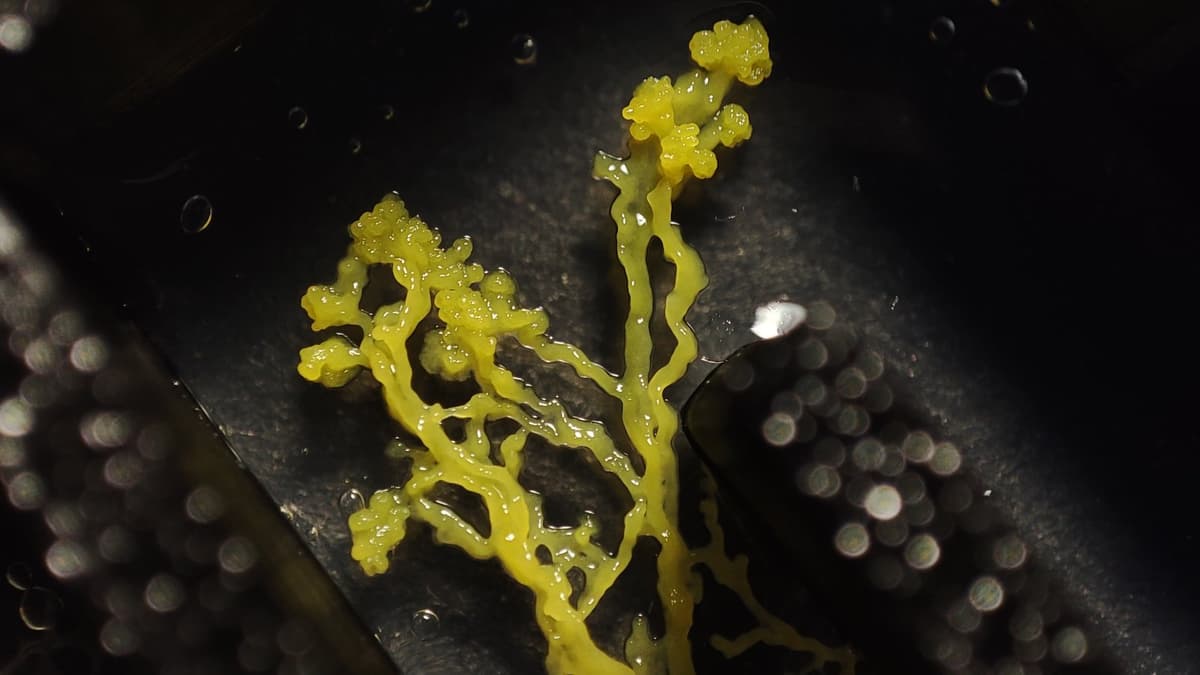
Imagine this: You are the CEO of a logistics company. You face the following challenge: to optimize delivery routes in real time, minimize infrastructure costs and respond instantly to the availability of new resources. However, you don't have a data center, GPS navigation or even a team of analysts. Moreover, you don't even have a brain.
For any startup, this is a recipe for inevitable bankruptcy. But not for slime mold. This gigantic cell solves the most complex optimization problems without a single neuron, inspiring engineers to devise elegant solutions to robot coordination problems.
The shortest path without neurons
The year 2000. Biologist Toshiyuki Nakagaki places a slime mold in a plastic maze. He takes the growing edge of a large plasmodium, the vegetative stage of the slime mold's life cycle. After breaking it into pieces, he scatters them throughout the maze. At two strategic points, the entrance and the exit, he places small agar blocks with oat flakes. A few hours later, the fragments of the slime mold fuse together to form a single, pulsating organism. At first, it completely fills all the corridors of the maze. Then the branches in the dead ends and along the long detours gradually begin to degrade until only a single connection remains: the shortest route between the two food sources. No navigation system. No overhead view of the maze.
26 hours versus decades
This finding has intrigued more than just biologists. In 2007, a group consisting of Atsushi Tero, Ryo Kobayashi and the previously mentioned Nakagaki of Hokkaido University described this behavior mathematically, as a model of an adaptive transportation network.
Three years later, the same group, joined by colleagues at Oxford, conducted an experiment using real geographic data. On a damp surface, the researchers arranged oat flakes in a pattern that mirrored the layout of major cities around Tokyo. In the center, at the point corresponding to the Japanese capital itself, they placed a slime mold. After 26 hours, a pattern began to appear on the damp surface. When researchers placed a map of the Tokyo subway, one of the most complex and efficient transportation systems in the world, next to it, the resemblance was striking. A single-celled organism without a brain replicated a topology that took humans decades to design.
Let's look at this problem from an engineer's perspective. We need to connect cities with roads in such a way that the route between any two of them is as short as possible, construction costs are as low as possible and the network continues to function even if one section breaks down. These are three requirements that pull in different directions. Short routes mean direct roads without detours. Reliability requires redundant paths, which means extra costs. To strike a balance between these conditions, engineers typically need months of work, numerous iterations and significant computing power.
The slime mold has neither iterations nor computing power. It doesn't have a logistics department that spends months weighing the trade-off between network speed and reliability. There is only a reaction to what is happening here and now.
How does a slime mold, which has no brain, “think” with its body?
The slime mold consists of a network of tubes that contract rhythmically, similar to our blood vessels or intestines. When the edge of the slime mold comes into contact with food, a signaling molecule is released at that spot, which increases the amplitude of the tube walls' contractions. Strong contractions accelerate the internal flow; the flow, in turn, carries the signal farther. This creates a feedback loop: the signal amplifies the flow, and the flow helps the signal propagate. Where the current is stronger, the tubes become thicker; where it is weaker, they become thinner.
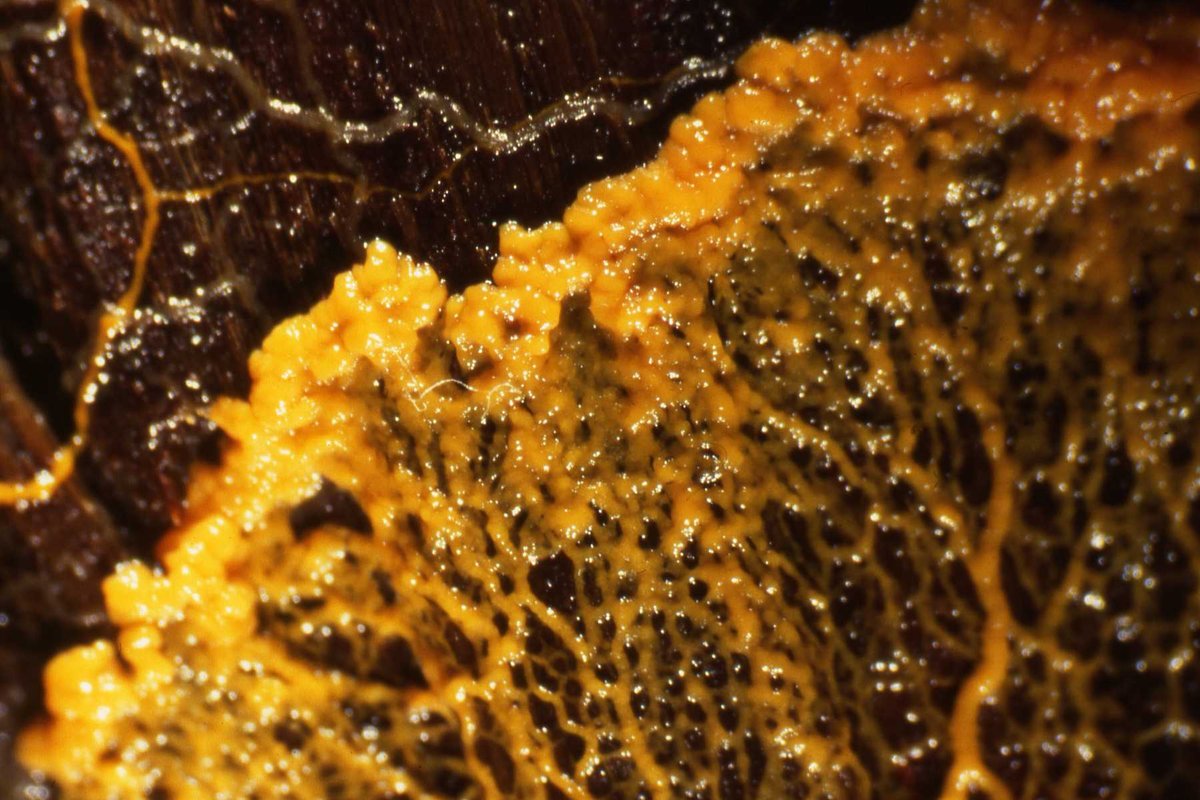
The slime mold reorganizes its body into a shape that allows it to transport nutrients as quickly as possible. For the mold, the maze isn't an IQ test; it is simply a means of survival. Thanks to this unique mechanism for finding food, the slime mold has become a source of inspiration for engineering, computer science and robotics. To better understand how the biological principles described above can be applied in practice, let’s look at a specific example.
From a rotten tree stump to robot logistics
In complex logistics environments such as ports, factories and distribution centers, multi-robot systems have proven to be a practical solution.
Fleets of mobile robots must work together to solve navigation problems, distribute tasks and share resources in a rapidly changing environment. Without central control, coordination between them breaks down. Therefore, decentralized information exchange in ports is particularly important.
In 2025, Dieisson Martinelli, André Schneider de Oliveira and Vivian Cremer Kalempa proposed an algorithm for decentralized mesh networks in multi-robot systems in a paper published in Scientific Reports. The experiment described, involving three agents in a virtual port, demonstrated that the principle of local bond strengthening, borrowed from the slime mold, allows agents to coordinate effectively even under conditions of signal instability.
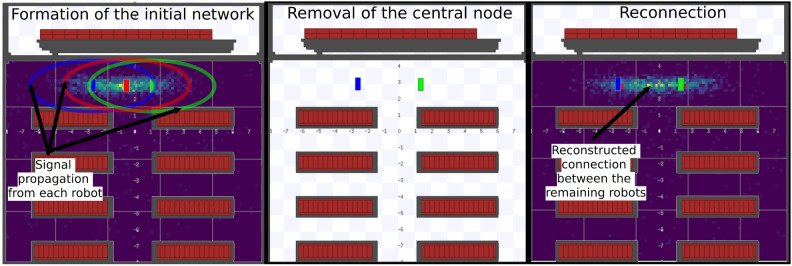
The approach is based on a mechanism in which each agent continuously transmits a signal. In the computational model, this signal acts as “food”: the stronger and more stable the connection, the more firmly this trace is established, much like how the most active channel in a slime mold becomes thicker. If the signal is lost, for example, if the agent has driven away or been blocked by a container, the trail gradually fades on its own, without the need for manual termination. When a stable connection is established between agents, a temporary channel for data exchange is opened.
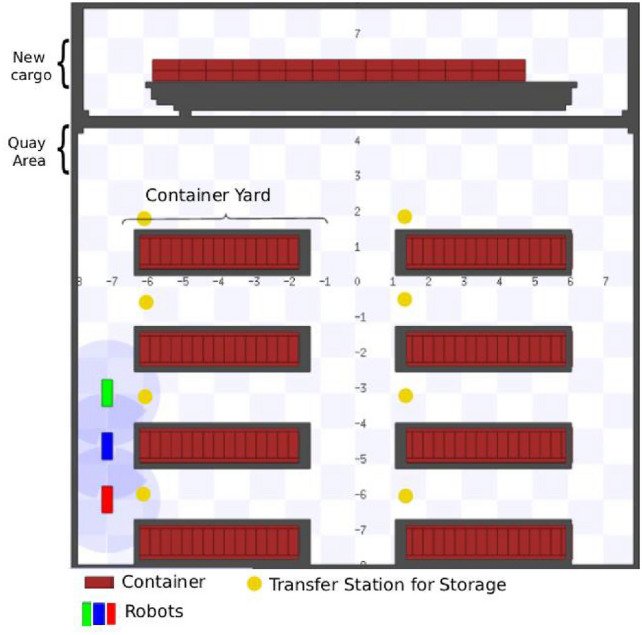
At this stage, which is limited to computer simulation, this channel provides a solution to a key problem in multi-robot systems: uneven load distribution. Using a new communication system based on the principles of slime mold, the robots exchange information and redistribute uncompleted tasks the moment they make contact. In this specific simulation model, this resulted in a 17.87% reduction in the total operation time.
The researchers also tested the approach's resilience to failures: if a robot that served as a link between two others suddenly went offline, the remaining robots reestablished a connection with each other almost instantly. When a new agent entered the coverage area of an already established network, it connected to it in an average of 0.092 seconds, demonstrating that this approach scales easily as the number of machines increases.
So far, these results have been obtained only through computer simulations. The researchers explicitly state that the next step is to test the approach on real robots, where actual signal delays, interference and hardware limitations will come into play. However, the very idea of borrowing the principles of simplicity and locality from nature seems like a promising direction for robotics operating in unpredictable conditions.
Evolution figured this out before we did
The slime mold has no data center, no GPS and no engineering degree. It never set out to design a subway system or coordinate a swarm of robots. But the mechanism that evolution developed for finding food in decaying wood has become a source of inspiration for solving 21st-century engineering challenges.
Sources
- Nakagaki, Yamada & Tóth (2000). Maze-solving by an amoeboid organism. Nature 407, 470
- Tero, Kobayashi & Nakagaki (2007). A mathematical model for adaptive transport network in path finding by true slime mold. Journal of Theoretical Biology 244(4), 553–564
- Tero et al. (2010). Rules for Biologically Inspired Adaptive Network Design. Science 327, 439–442
- Alim, Andrew, Pringle & Brenner (2017). Mechanism of signal propagation in Physarum polycephalum. PNAS 114(20), 5136–5141
- Martinelli, de Oliveira & Kalempa (2025). Bioinspired algorithm based on Physarum polycephalum for the formation of decentralized mesh networks in multi-robot systems. Scientific Reports 16, 3457