A Fly-Brain Circuit, Rebuilt in Software, Learns a Smell in One Pass

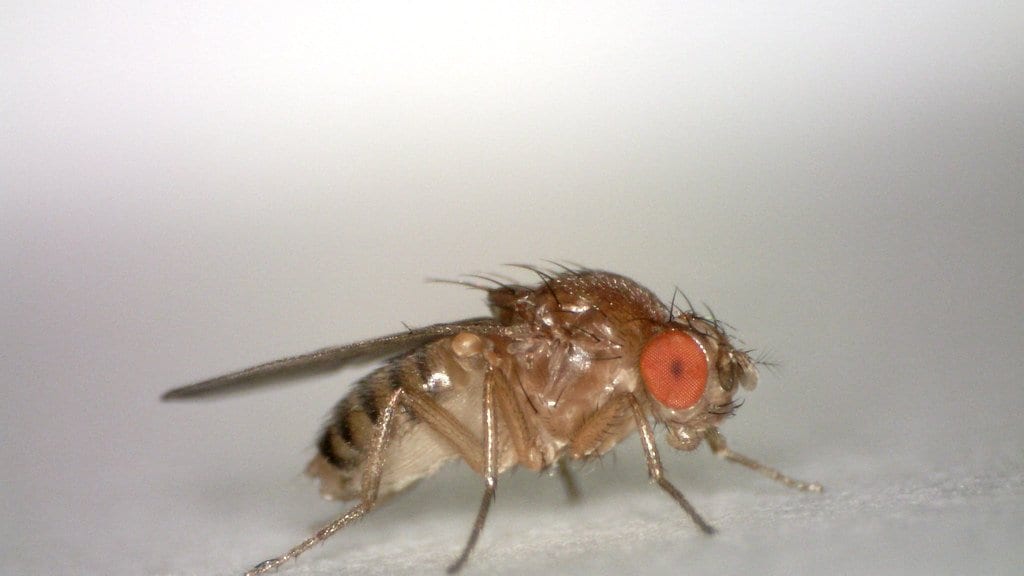
A fruit fly can find the one overripe banana in a kitchen using a brain smaller than a poppy seed. It gets no training set and no chance to rehearse. Its solution looks unfashionable next to modern machine learning: rather than tune millions of connections, the fly scatters each scent across a layer of cells so thinly that any two smells barely overlap.
Kevin Max and Yang Shen, both at Japan's Okinawa Institute of Science and Technology, have rebuilt that circuit as a spiking neural network they call Spi-Fly. Their paper, published open access on Aug. 24 in Neuromorphic Computing and Engineering, makes a narrower claim than the phrase "artificial nose" suggests, and a more interesting one.
The design has three layers. Signals from odor sensors are projected randomly and sparsely onto a middle layer of about a thousand neurons, so that each scent switches on only a scatter of them. That scatter is the barcode. Output neurons learn to recognize it through an associative rule, roughly the mechanism a fly uses to attach a memory to a smell. Nothing travels backward through the network, and that absence is the whole design.
Backpropagation through time, the standard way to train a spiking network, has to hold the whole history of an input in memory while it works out which connection to blame for an error. Its cost grows with the length of the recording and with the size of the network. Spi-Fly's grows only with the network, and it learns online, one sample at a time, which is what a sensor in a duct or a pocket actually receives.
The results say something more specific than that it works. On a public set of gas-sensor recordings, Spi-Fly reached 88.8% accuracy after a single pass over the training data, where a network trained by backpropagation managed 56.3%. Give that network ten passes and it climbs to 95.0%. An ordinary support-vector machine, fed all the data offline at once, scores 90.0% on the same recordings, better than Spi-Fly. On a second, synthetic dataset the gap is wider: a simple Bayesian classifier reaches 93.9% where Spi-Fly manages 58.9%.
Spi-Fly is therefore not the most accurate classifier in its own paper, and the paper does not pretend otherwise. It wins inside one regime, and that regime is where a portable device lives: one pass over the data, learning as samples arrive, weights squeezed down to a few bits.
Then comes the result that carries the work. Trained on odor classes one after another instead of all at once, the backpropagation network "suffers strongly from catastrophic forgetting, performing only barely above chance level," the authors report. A standard remedy for forgetting did not significantly improve it. Spi-Fly showed "no significant loss in performance compared to training on the full datasets." That means it holds its own level, not that it matches what a backpropagation network reaches when allowed to see the whole dataset repeatedly.
Low precision is the other half of the argument. The team quantized the weights after every update and pushed the comparison down to four-bit weights, where Spi-Fly degrades less than backpropagation does. The reason is almost comic: its learning rule only ever increases a weight, so it never has to spend a bit on a minus sign.
None of this ran on a chip. Every Spi-Fly result in the paper is a software simulation, and no power draw was measured. The hardware appears as a plan: "In future work, we plan to implement Spi-Fly on our neuromorphic olfactory sensing system to test its performance under real-life conditions," the authors write. The chip pictured with the institute's announcement comes from an earlier project of Max's with groups in Eindhoven and Kiel, and it has never run this network. What the paper establishes is compatibility with that class of hardware, not a saving anyone has measured.
The capability is not new either. A team led by Huo has reported an olfactory processor doing few-shot, class-incremental learning on the chip itself, and Imam and Cleland ran a neuromorphic olfactory circuit on Intel's Loihi. Both sit in Spi-Fly's own reference list. What is new is the recipe: the fly's sparse code married to an associative memory rule, and how little the combination minds being quantized.
A second caveat comes from that same list. The gas-sensor data is a well-worn set from UC San Diego, and Dennler and colleagues showed in Nature Machine Intelligence that it suffers from sensor drift and a measurement order that was never randomized, leaving it "of limited use for odour identification benchmarks." Max and Shen cite that critique themselves, which is the right instinct, and it also means the headline accuracy figure rests on contested ground.
The paper is open under a CC-BY license and the simulation code is public, so anyone can rerun the comparison rather than take it on trust. Max names where he would like it to end up: "Detecting explosives; assessing allergen levels; ensuring food safety; identifying drugs — there's a huge range of applications for scent classification." He and collaborators in Eindhoven and Kiel are building the odor-sensing hardware, and folding Spi-Fly into it is the stated next step, the point at which the energy argument gets a number attached to it.