How an AI That Reads Faint Muscle Signals Gave a Man With ALS His Grip Back

The hardest part was never the motor. It was the listening.
When a person's hand still works, the brain sends a clean order down the nerves and the muscles snap to it. Amyotrophic lateral sclerosis breaks that chain: the motor neurons that carry the command die off, the muscles weaken and waste, and the signal that reaches the skin becomes a whisper buried in static. The intent is still there. A man may want, very precisely, to close his fingers around a cup. What the world receives is almost nothing.
A team led by Gordon Cheng at the Technical University of Munich set out to answer that whisper. In a study published on 23 June in Nature Machine Intelligence, John Nassour, Cheng and their colleagues describe a soft hand exoskeleton (a textile glove, not a rigid robotic claw) that gave a man with severe ALS-driven hand paralysis back the ability to grasp objects on purpose and feed himself again. The result rests on a single patient, which is exactly why the way the device was built matters as much as the fact that it worked.
A glove designed around one hand
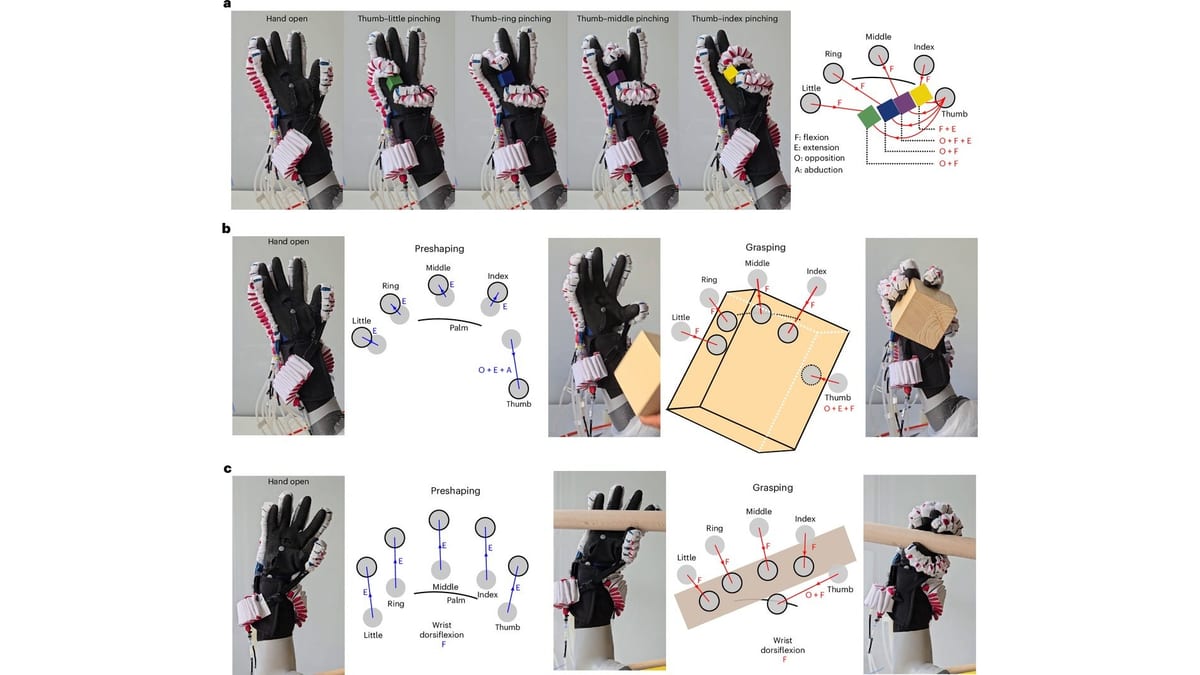
Most assistive gloves bend the fingers. That alone does not return a useful hand, because the thing that makes a human grip dexterous is the thumb: its ability to swing across the palm and press against the fingers in opposition. The Munich glove adds a motorized thumb that is both opposable and abductable: it can move toward the other fingers and out to the side, the two motions that turn a closing fist into an actual grasp. The device also supports wrist dorsiflexion, lifting the wrist into the position from which a real grip is launched.
The team did not design this in a lab and then hand it over. They used a co-creation approach, building and revising the glove around the specific needs of the patient who would wear it, adding articulations where his hand needed them. The hardware is the visible half of the story. The half that makes it intelligent is what happens before the motors ever move.
Reading a signal that is almost not there
The glove decides what to do by reading surface electromyography (sEMG), the electrical activity that muscles give off, picked up by electrodes resting on the skin. In a healthy arm those signals are strong and easy to interpret. In a hand wrecked by ALS they are weak, noisy and unreliable, the kind of input a naive system would either ignore or misread.
So the researchers built a grasp predictor: a machine-learning model trained to infer, from those faint signals plus motion data from the hand, which grasp the wearer intends. Against a reference group of 15 people with healthy hands, the predictor hit 97% sensitivity. It correctly recognized the intended grasp in nearly every attempt. Crucially, the system does not stop at a single guess. A layer of machine-learning error correction compensates for the gaps and noise in a degraded signal, catching the cases where the raw reading would have led the glove astray. The combination is what lets the device act on intent rather than on a preset routine: the wearer thinks of closing his hand, and the glove closes the way he meant it to.
For the man with ALS, the difference was concrete. With the exoskeleton on, he could intentionally grasp everyday objects, scored a 5 on the Box-and-Blocks Test (a standard measure of manual dexterity in which a person moves blocks one at a time over a partition), and regained the ability to feed himself. Going from no functional grasp to feeding yourself is not a benchmark number. It is a person getting a piece of his independence back.
What six stroke patients showed, and what they didn't
To probe whether the approach reaches beyond one nervous-system disease, the team also tried it on six people who had hand impairment after a stroke. The pattern there is the honest, interesting result: the glove helped the most severely impaired patients the most, and offered less to those whose impairment was milder.
That makes sense once you see what the device is for. Someone with a milder deficit still has some working signal and some residual control of their own, and an external glove that takes over the grasp can get in the way as much as it helps. Someone with almost nothing left has the most to gain from a system that can read a whisper and turn it into a grip. The finding is a useful corrective to the temptation to read an assistive device as universally good: it is targeted, and it is most valuable precisely where conventional rehabilitation has the least to offer.
The scale here is small. This is not a clinical trial. The grasp-restoration outcome belongs to one man with ALS; the six stroke patients form a small validation cohort, not six separate cures; the 15 healthy controls calibrated the predictor. You can read the full study, methods and figures via its DOI: 10.1038/s42256-026-01263-3. The work is peer-reviewed, which is real weight. But a single small study, however carefully done, is a beginning. No independent group has yet reproduced it, and how the device performs across many patients, over months of daily use, in homes rather than labs, is unknown.
A line of research, advancing
Soft exoskeletons for paralyzed hands are not new. Researchers, including groups in Germany, have been working the problem for years. What this study pushes forward is the combination: a genuinely dexterous textile glove with an opposable thumb, an AI that decodes badly damaged muscle signals at high accuracy, error correction that holds up against real-world noise, and validation in people with severe impairment rather than only in healthy volunteers. Each of those pieces existed somewhere; bringing them together to let one man feed himself is the advance.
The honest framing is also the more hopeful one. The point is not that hand paralysis from ALS or stroke has been solved. The point is that an AI good enough to read a signal most systems would throw away can sit between a damaged nervous system and a working hand. For at least one person, it closed the gap. Whether it holds up at scale is the next question, and the right one to ask.
Sources
- Nature Machine IntelligencePeer-reviewed
- Nature Machine IntelligencePeer-reviewed
Medical Disclaimer: This content is provided for general informational and educational purposes only. It is not medical advice and should not be used as a substitute for professional medical advice, diagnosis, or treatment. Always consult a qualified healthcare professional regarding any medical condition, concern, symptom, or treatment decision.