The Slowest Part of a Quantum Computer May Be the Ordinary Software Reading Its Errors

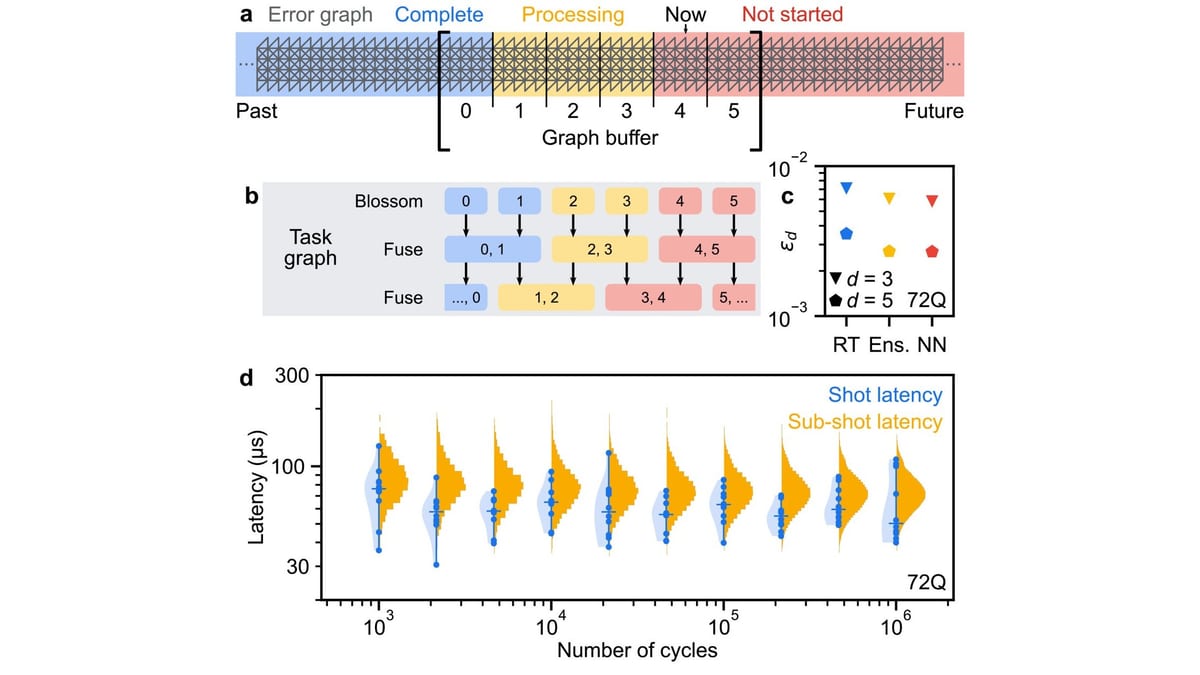
Every quantum computer that corrects its own errors is running a race against itself. The hardware measures its qubits over and over, thousands of times a second, and each round produces a small package of data describing where something might have gone wrong. A classical computer has to read each package and work out what actually happened. Fall behind, and the packages queue up, and the queue grows faster than it can be cleared.
The field has a name for this: the backlog problem. It is a scheduling problem, not a physics one. Nothing about superposition or entanglement makes it hard. It is hard for roughly the reason a checkout line is hard, and it puts a mundane software throughput limit squarely in the path of one of the most heavily funded projects in physics.
A preprint posted to arXiv on July 30 goes after that limit from an unglamorous direction. Ran Miao, Rui Luo, Xiaohan Shan and Xiaoming Sun describe a system they call QAdapt, a small neural network that sits in front of a conventional decoder and cleans up part of the signal before the decoder ever sees it. Sun is a professor at the Institute of Computing Technology of the Chinese Academy of Sciences and directs its laboratory for quantum computation and theoretical computer science. Their paper is titled QAdapt: A Noise-Adaptive Neural Pre-Decoding Framework for Quantum Error Correction.
What the decoder is reading
The data stream is called the syndrome. In a surface code, the arrangement most large quantum-computing efforts have settled on, one logical qubit is spread across many physical ones, and extra measurement qubits woven between them get checked every cycle. Those checks never reveal the stored information, since reading it would destroy it. They reveal only whether something inconsistent has happened nearby. From a long stream of such inconsistencies, the decoder infers the most likely pattern of underlying errors and says what correction to apply.
Two things make that inference expensive. The stream never stops while the computation runs, and the errors are correlated in space and in time, so a single physical flip can leave marks across several cycles and several neighbouring checks. Read each mark in isolation and you get the wrong answer.
Splitting the job
A pre-decoder divides the labour. Rather than hand the whole stream to one algorithm, a first stage picks off the easy local structure, the recurring patterns that can be matched cheaply, and passes what is left to the conventional global decoder. QAdapt's first stage learns local spatiotemporal correlations in the syndrome and forwards the residual syndrome onward. The global decoder still runs. It simply has less to chew on.
What the authors treat as their contribution is what happens after that. Noise on real hardware is not the tidy, uniform noise a decoder is usually trained on. It is stronger in some places than others, and it shifts over hours and days as the machine drifts. A network trained once on simulated noise slowly goes stale. Retraining it on the new conditions invites a second failure, familiar to anyone who trains neural networks, in which the model learns the new regime and forgets the old one. QAdapt adapts sequentially while trying to mitigate that forgetting.
The numbers, and what they are measured against
Two headline figures appear in the abstract, and each needs its qualifiers travelling with it.
Across 110 synthetic out-of-distribution noise configurations for rotated surface-code memory circuits, the system consistently reduced the logical error rate relative to a neural pre-decoding baseline. On Google's publicly released Willow benchmark data, with no fine-tuning for that machine, it reports reductions of up to 5.79% in logical error rate and up to 9.32% in backend decoding latency on the residual syndrome.
Three qualifiers do most of the work in that sentence. "Up to" governs both numbers, meaning neither figure describes a typical or average improvement. The latency number is not decoding time; it is the time the conventional global decoder spends on what remains after pre-decoding, and it does not net out the computational cost of running QAdapt itself. Finally, the comparison is against a different neural pre-decoding baseline rather than against a conventional decoder running alone, or against the leading learned decoders in the field. Anyone reading this as beating a production decoder is reading something the paper does not claim.
The one external anchor
The sturdiest thing in the paper is the dataset. The Willow data is not a private benchmark and not a vendor claim made about this work. It is Google Quantum AI's own experimental data, released publicly on Zenodo alongside the group's below-threshold surface-code result in Nature, covering surface-code memory experiments at several code distances with tens of thousands of shots each. These authors did not generate it and cannot tune to it, and they report using it without target-domain fine-tuning. That is checkable, and it is the item's real strength.
It is also the entirety of the external evidence. The other 110 evaluation settings are the authors' own synthetic constructions. Nobody outside the group has reproduced the result, and the arXiv record carries no code or data availability statement.
None of this is a breakthrough in quantum computing, and the paper does not present it as one. QAdapt is a classical machine-learning component in front of a classical decoder, aimed at a classical bottleneck. Whether single-digit reductions matter depends on where they land, since error correction stacks layer on layer and a saving low down is passed upward through everything above it. The preprint went up on July 30 and has not been peer-reviewed. For now it is a plausible engineering increment reported by the people who built it, and it should sit there until someone outside the group runs it.
Sources
- arXivPreprint