Singapore's Newest Server Rack Runs on Living Neurons, and Someone Has to Feed It

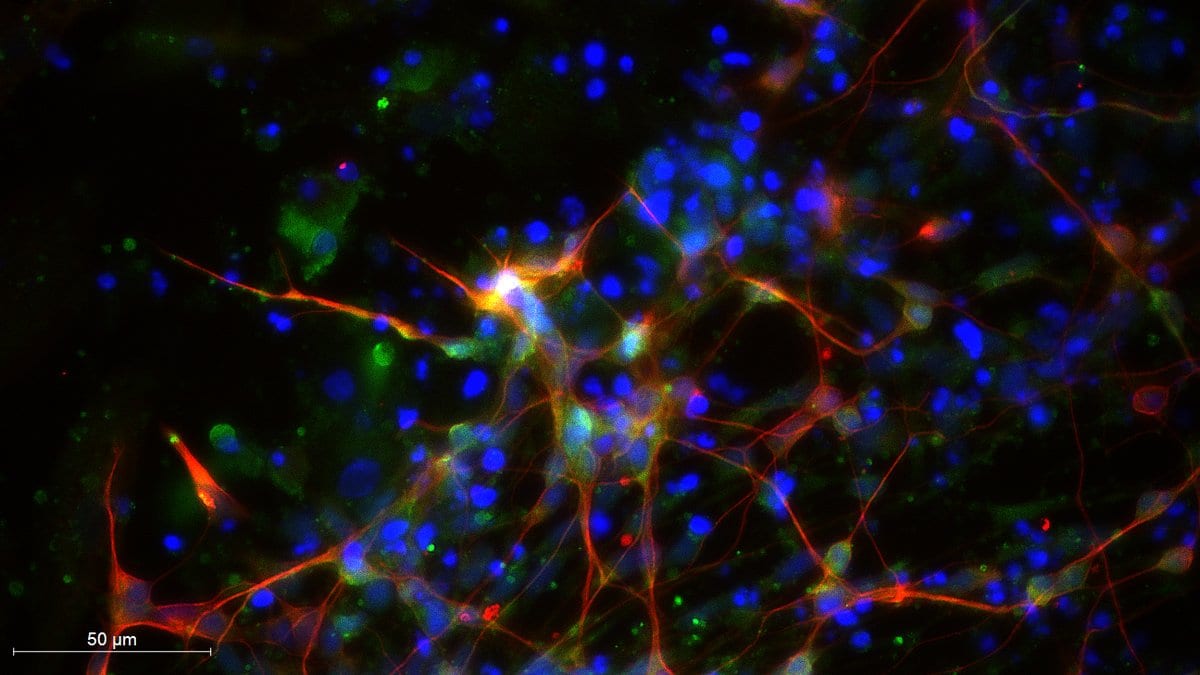
Server racks do not usually need plumbing. The one at the National University of Singapore, demonstrated to guests on 6 August 2026 and announced on 17 August, has it in every unit: pumps, filters, a gas mixer and a temperature controller, all wrapped around the part that does the computing. That part is alive. Each of the twenty boxes holds human neurons grown from donated stem cells, spread over a chip that can listen to them and shock them.
The rack is the work of three partners. DayOne Data Centers, a Singapore-headquartered operator, designed and supports the infrastructure. Cortical Labs, a Melbourne company, makes the units, which it calls CL1s. The Yong Loo Lin School of Medicine at NUS grows the cells at its Life Sciences Institute, under the neuroscientist Rickie Patani. DayOne describes the result as "the first independently operated biologically integrated server rack in the world." Those are four qualifiers doing a great deal of work, and they are worth coming back to.
The pitch is power. Living neurons, the launch announcement says, "perform certain computing tasks on a fraction of the wattage required by digital computers." That would make them a cheap way to add AI capacity in a country that has put its data centers under an efficiency roadmap.
What the neurons have actually learned to do
Strip away the plumbing and a CL1 is a dish of neurons on a microelectrode array, wired into a closed loop. The chip stimulates the cells, records what they fire back, and returns a consequence. Cortical Labs' founding result, published in Neuron in 2022, put cultures of human and mouse cortical neurons inside a simulated version of Pong. The paddle followed the cells' activity, and the ball's position arrived as stimulation. The paper reports "apparent learning within five minutes of real-time gameplay not observed in control conditions," and that cultures given stimulation without feedback showed none.
That paper is titled "In vitro neurons learn and exhibit sentience when embodied in a simulated game-world," and the word sentience in it is a technical term the authors invoke in their own introduction: responsive to sensory impressions, by way of adaptive internal processes. It does not mean consciousness, and it does not claim the culture experiences anything. Thirty neuroscientists still wrote to Neuron that the word was "not justified by the data presented," and the authors replied in the same issue. The paper is also company work. Its corresponding address is Cortical Labs, Melbourne.
The stronger evidence arrived this February, from a laboratory with no stake in the company. Researchers at UC Santa Cruz and UC Santa Barbara, writing in Cell Reports, embodied mouse cortical organoids in a pole-balancing task. For most organoids, training signals chosen by a reinforcement-learning algorithm beat randomly chosen signals or none at all. Blocking the receptors that carry ordinary excitatory signaling abolished the gain, which is what you would expect if real synaptic change is doing the work. The improvement also did not survive a 45-minute rest. The learning is real and has now been shown in a second, unaffiliated laboratory, and so far it does not stick.
That is roughly where the capability sits today. When Cortical Labs ran a CL1 against Doom earlier this year, The Register reported the company's own description of the result: a performance resembling "a complete beginner who has never seen a keyboard, mouse, or indeed a computer before." Alon Loeffler of Cortical Labs explained the gap plainly: "Pong was much simpler. There was a direct relationship. The ball went up, the paddle went up."
Not everyone in neuroscience thinks the direction is sound. Tony Zador of Cold Spring Harbor Laboratory told STAT News that "getting them to wire up to do what we want them to do is completely beyond what we could even conceive of right now," and that hoping to bypass that problem "by putting them all together in a dish and reading out their activity in a way that's useful to us is misguided." Lena Smirnova of Johns Hopkins described a different use for the same hardware: "It's a tool to study the relevant physiological functionality of these brain organoids. We're not trying to create a mind in a dish." Brett Kagan, Cortical Labs' chief scientific officer, replied that "there are fair criticisms that need to be addressed."
The numbers that do not agree
Anyone trying to size up the machine hits a wall: the vendor publishes almost no specifications, and the press figures do not reconcile. IEEE Spectrum reported in 2025 that each CL1 contains 800,000 lab-grown human neurons, reprogrammed from the skin or blood of adult donors. The Register, nine months later, wrote of "roughly 200,000 living human neurons grown on a microelectrode array," and an ACS report the same month agreed on that order. Two figures a factor of four apart, nine months apart, for the same product, both traceable to the company.
Power is the same story. The Next Web reported this month that Cortical Labs puts a single CL1 at around 25 watts and a fully populated rack at 800 to 1,000 watts. The ACS piece has 30 watts per unit. Twenty units at 25 watts is 500, so the rack figure is carrying the life support and whatever else sits in the frame. One outlet has already published and corrected a per-unit wattage.
The one number Cortical Labs publishes itself is a lifespan. "A robust environment keeps neurons alive for up to 6 months," its product page says, which is a design specification rather than an observed average. Holding to it is work. Kagan has described the perfusion circuit as "a life support system for the cells," with "filtration for waste products, temperature control, gas mixing, and pumps to keep everything circulating."
How much work is visible only at Cortical Labs' own Melbourne facility, where The Register watched the routine earlier this year. Technicians remove and replace the fluid every 24 hours, because the neurons strip the oxygen and glucose out of it. Nitrogen and carbon dioxide are pumped in to hold the atmosphere near five percent oxygen. Preparing the machines for a job takes about a week. Nothing comparable has been published for the Singapore units, and Melbourne is a company site rather than this one.
The units are for sale, which is the most concrete thing about them. As of 2025, IEEE Spectrum reported a price of $35,000 each, or $20,000 apiece by the rack, with remote access to a hosted unit at $300 a week. A buyer needs a suitable cell-culture laboratory, and ethics approval to generate the cell lines. "It's not something you should be doing in your garage," as Kagan put it.
Nobody has published the number that matters
No peer-reviewed measurement compares the energy cost of a computation run on cultured neurons with the same computation on silicon. The Next Web put the gap as precisely as anyone: "There is no benchmark, no workload comparison and no figure for what the rack accomplishes per watt, which is the number that decides whether low power is an advantage or just a small machine." A conventional server rack draws several kilowatts and a dense AI rack can pass a hundred, so the Singapore rack is only remarkable if it does comparable work.
Other claims in the field are no easier to reconcile. FinalSpark, a Swiss company that runs human neurons for remote research, says its processors use around a million times less energy than digital chips, while its co-founder describes the company's goal as artificial intelligence for 100,000 times less energy than training today's models. Two claims, an order of magnitude apart, and neither measured in the literature. Silicon has a competing answer with numbers already attached, and the Netherlands is building a research hub around neuromorphic chips that imitate neurons, run on electricity alone and have benchmarks to point at.
Cortical Labs opened its own 120-unit facility in Melbourne in March, but that site is company-operated, and Singapore's claim turns on being run by someone else. Continuously operated human-neuron computing is older than both. FinalSpark's Neuroplatform was described in a peer-reviewed paper in 2024: human organoids monitored around the clock, open to remote researchers, and more than 1,000 organoids used by the time it was published.
The Singapore rack is a prototype in the literal sense. DayOne's March announcement describes a phased expansion that "could potentially reach up to 1,000 units" in one of its facilities, subject to technical validation and regulatory approvals. That is far beyond the current rack, and conditional on evidence that does not yet exist.
Whose cells these are
The cells are not brain tissue. They come from adult donors' blood or skin, reprogrammed into induced pluripotent stem cells and then coaxed into neurons, which makes the pathway materially less fraught than "human brain cells in a data center" sounds. Nothing is taken from a brain, and nothing is grown into one.
The ethics of the material is being argued in the literature, including by people at the institution now hosting the rack. A neuroethics working group that met at NUS in November 2024 published its recommendations in Asian Bioethics Review in April, with nine co-authors at the NUS Centre for Biomedical Ethics and Brett Kagan of Cortical Labs as second author, which makes it something other than an arm's-length review. The paper sets out to identify and dispel "common misconceptions and 'ethical red herrings' arising from sensationalized portrayals," and argues for "proportionate responses to consciousness concerns." It also calls for "responsible science communication to manage public expectations," which cuts at the marketing as much as at the panic.
A sharper reading is available. Writing in Science and Engineering Ethics, bioethicists argued that anyone who accepts Cortical Labs' own theoretical framing has to take seriously "the risk of creating synthetic phenomenology" and artificial suffering. Kagan has said the cultures "don't show any markers of consciousness," only "markers of structural organization." Sergiu Pasca of Stanford, who works on brain organoids, has aimed his objection at the language rather than the biology: "Using accurate terms that neither hype nor misrepresent the work really does matter. Overly expansive claims can confuse the public and policymakers about what these systems actually do."
Neither DayOne's release nor its March partnership announcement describes the consent or oversight pathway for the Singapore cells, and no NUS ethics statement about this facility is public.
Also, what would settle the energy argument is dull and specific: a stated workload, a measured wattage, and a silicon machine doing the same job, published somewhere outside the three partners. Patani's own description of the rack points at the part that does not wait on that answer. He calls it a platform "that can help us understand learning and adaptation at their biological source," which is a claim about neuroscience, and the neurons are already good enough for it.