Teaching AI to Find Where a System Breaks, Without the Equations

Predicting what a system will do next is one problem. Predicting the moment it stops behaving the way it used to is a much harder one, and for most of the systems scientists care about, the more important one. A lake stays clear for years, then turns green almost overnight. A power grid hums along until one more load tips it into cascade. A patch of excitable tissue conducts a signal cleanly right up to the point it doesn't. The instant of the flip has a name in mathematics: a bifurcation, the point where a system's qualitative behaviour changes as some underlying parameter is nudged past a threshold.
Locating those thresholds usually demands the equations that govern the system, plus a century of numerical machinery for tracing how their solutions appear, vanish, and lose stability. That is exactly what a study published in July 2026 in Nature Machine Intelligence sets out to sidestep. The work, by Gianluca Fabiani, Hannes Vandecasteele, Somdatta Goswami, Constantinos Siettos, and Ioannis Kevrekidis, shows how to hand that analysis to a machine-learning surrogate that never sees the equations at all.
Start with the surrogate. A neural operator is a network trained to approximate not a single function but an entire operator: the rule that carries a system from one state to the next. Feed it enough short simulated or observed trajectories and it learns to march the dynamics forward far faster than solving the original equations, which is why the field has leaned on these models as accelerators for brute-force simulation. But a fast forward-simulator, on its own, can only ever tell you where the system goes. It has no built-in way to answer the sharper question. Where does the system break?
The paper's move is to treat the trained neural operator not as a black-box predictor but as a component you can plug into classical numerical analysis. Once you have a surrogate that maps a state to its successor, a fixed point of the dynamics is simply a state the surrogate returns unchanged, and its stability is encoded in how the surrogate responds to small perturbations around it. Those are exactly the objects that decades-old continuation and bifurcation methods are built to track. The authors couple the learned operator to iterative solvers working in the Krylov subspace, the same matrix-free machinery numerical analysts already use for large problems, so the surrogate's derivatives never have to be formed explicitly. The result is a pipeline that can find fixed points, judge their stability, and trace bifurcations, all driven by a data-trained model rather than a hand-written set of equations.
They lean on more than one flavour of surrogate. Local temporal operators handle the fixed-point and stability work; local spatial and space-time "patch" operators speed up the analysis of systems that vary across space as well as time. The framing sits in the tradition of equation-free multiscale computation: an approach, associated with Kevrekidis's group over many years, that asks a fine-grained simulator only the questions a coarse analysis needs, rather than running it end to end.
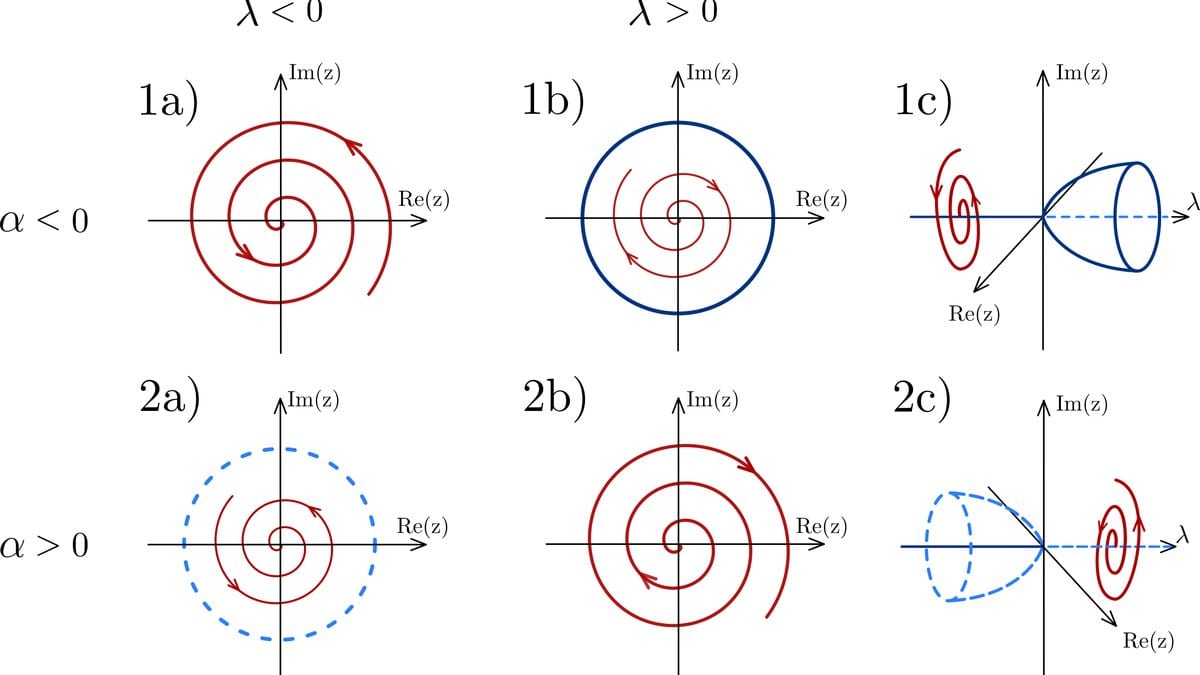
To show the approach holds up, the team put it through three benchmark problems that any dynamical-systems researcher would recognise. The one-dimensional Allen-Cahn equation, a workhorse for modelling phase separation, throws off a series of pitchfork bifurcations as its parameter changes. The Liouville-Bratu-Gelfand equation, which turns up in combustion and reaction models, has a saddle-node point where a solution branch folds back on itself and stability is lost: the mathematical signature of a tipping point. The FitzHugh-Nagumo model, a two-equation caricature of an excitable nerve or heart cell, carries both Hopf and saddle-node bifurcations. In each case, without ever being handed those equations, the surrogate-plus-solver pipeline recovered the bifurcation structure that the governing equations predict.
None of this makes the equations obsolete, and the paper is narrower than a plain-language summary might suggest. The three test systems are canonical, well-behaved, and low-dimensional by the standards of real applications; the results are the authors' own, on problems where the right answer is already known and can be checked. That is the honest state of the evidence: a peer-reviewed demonstration that the method works on cases with a ground truth, not yet a track record on the messy, high-dimensional systems (the ecosystems, grids, and climates) where equation-free bifurcation detection would actually earn its keep. Whether it scales is the open question.
What makes the result worth marking anyway is the seam it closes. Machine learning for science has spent much of its recent momentum on speed: surrogates that reproduce a simulation in a fraction of the time. This is a different ambition: getting a learned model to do the reasoning a numerical analyst does, to say not just what a system does but where its behaviour changes character. For the tipping points that dominate so many warnings about complex systems, a data-driven tool that can point to the edge (rather than only replay the fall) is the more useful instrument. The proving ground is everything that comes after the benchmarks.
Sources
- Nature Machine IntelligencePeer-reviewed
- Nature Machine IntelligencePeer-reviewed
- arXivPreprint