Keeping AI From Forgetting Us Needs More Human Text Than the Math Implied


Feed a model its own output, generation after generation, and the answers start to thin out. The rare words go first, then the odd turns of phrase, until what comes back is a smooth average of itself. The failure has a name, model collapse, and the obvious remedy has been known almost as long: keep stirring fresh human writing into the training mix. What nobody has been able to say is how much.
That it really happens was settled in 2024, when Ilia Shumailov and colleagues reported in Nature that indiscriminate training on machine-generated content does irreversible damage, and that the tails of the original distribution are the first thing to go. The question has been quantitative ever since. On Sept. 16, 2026, four control theorists posted an answer with an unexpected shape: Matteo Marchi, João Pedro Silvestre and Paulo Tabuada at UCLA, with Bahman Gharesifard at Queen's University in Kingston, Ontario. They have re-derived the threshold under a different notion of distance. The paper has been accepted for presentation at the 2026 IEEE Conference on Decision and Control and is not yet published.
The setting is a loop. A model is trained; it generates data; that data goes back into the training pool alongside some quantity of fresh human material; and a new model is trained on the result. The quantity that matters is the ratio of human to synthetic items added on each pass. An earlier result in this line proved that if the ratio is high enough, the loop settles: the model's output distribution stops drifting and stays inside a small ball around a fixed point.
The trouble is what a small ball means when there are many possible outputs. The earlier proof measured the distance between two distributions the ordinary way, as a straight line through the space their coordinates live in. The new paper gives the cleanest illustration of why that fails. Take two distributions with nothing in common: one spreads its probability evenly across the first half of the possible outputs and puts zero on the rest; the other does the reverse. They can never produce the same thing. Yet the straight-line distance between them shrinks like 1 over the square root of n, where n is the number of possible outputs, and vanishes as n grows. A promise that the model ends up within a fixed straight-line distance of its target therefore promises less and less, until it covers most of the space and means nothing.
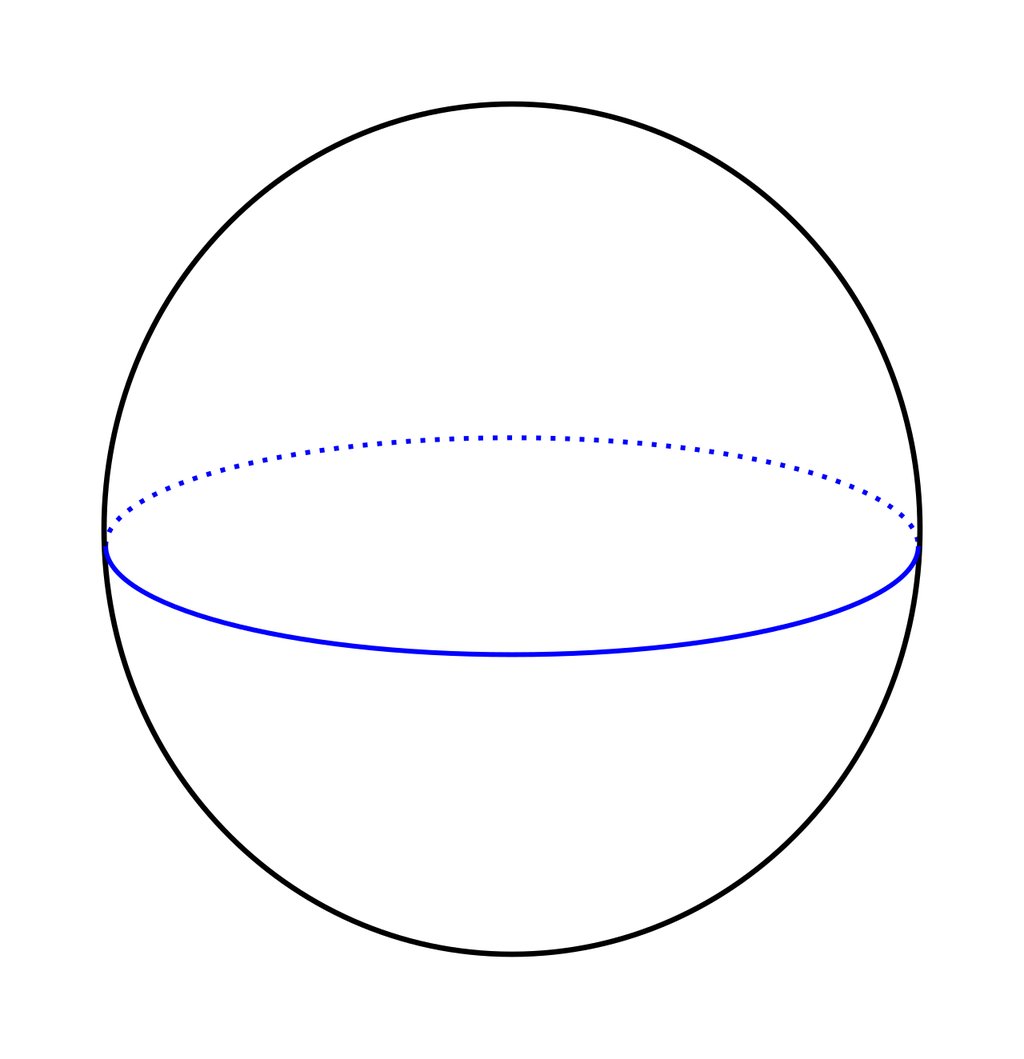
So they changed the ruler. The Fisher-Rao metric, the natural yardstick for probability, measures distance along the curved surface that distributions actually live on rather than straight through the flat space they are written in. Under it, the two distributions above sit a constant π/2 apart however many outputs there are. Everything after it is the stability argument redone on the curved surface.
Redone, the answer gets harder. The introduction says it outright: the effective amount of human data needed to prevent collapse is "greater than previously implied." Under the old reading, letting the human share grow roughly in step with the number of possible outputs looked sufficient. The new analysis finds that it is not, and that holding the error down calls for growth above n to the power of 2.5. That exponent measures nothing. It is what the bound requires under the scaling assumptions the authors adopt, and no training run in the world operates anywhere near it.
The n being raised to a power counts the distinct outputs a model can emit, not its parameters, so none of this is a statement about models getting bigger. And because the result is a scaling law in n rather than a share of a corpus, there is no percentage in the paper, and none can be honestly extracted from it. What the theorem gives is a threshold that is sufficient: cross it and stability is guaranteed. The exact minimum, the number a laboratory would actually want, is something the authors call an open question.
The guarantee carries two conditions, both stated up front. Every possible output has to carry some strictly positive probability in the human data. Real text is sparse, and wherever that smallest probability is zero the theorem does not apply at all. The second condition is that the human-to-synthetic ratio multiplied by that smallest probability must exceed the model's own training error, which is what keeps the model's output away from the edges of the space, where the curved-surface measurement breaks down.
Preventing collapse, in this sense, is not the same as getting human language back. The output distribution converges to a small neighborhood of a fixed point that sits near the human distribution without matching it, and the gap closes only as the human ratio rises. It is bounded drift, not recovery.
The earlier bound being sharpened here belongs to the same group. It was presented by Gharesifard and Tabuada at the 2025 IEEE Conference on Decision and Control, and the closed-loop training model underneath both papers came from Marchi, Soatto, Chaudhari and Tabuada at the same conference the year before. This is a team tightening its own work, not an outside correction of it. The paper runs to eight pages of theory with no experiments and no simulations. The version posted online is an extended one, carrying proofs cut from the conference paper for space.
Other groups have arrived at the same direction from elsewhere. Using random-matrix methods rather than geometry, Dohmatob and colleagues reported at the 2025 International Conference on Learning Representations that any fixed mixing ratio still leaves a floor under the error when dimensions are high. Different tools, different bound, same qualitative answer: a small fixed dose of human writing does not scale. What the Fisher-Rao result adds is a reason. The ruler was flattering us, and correcting it moves the requirement in the harder direction.