A Fusion Machine's Control Settings Were Generated Mid-Shot by a Neural Network

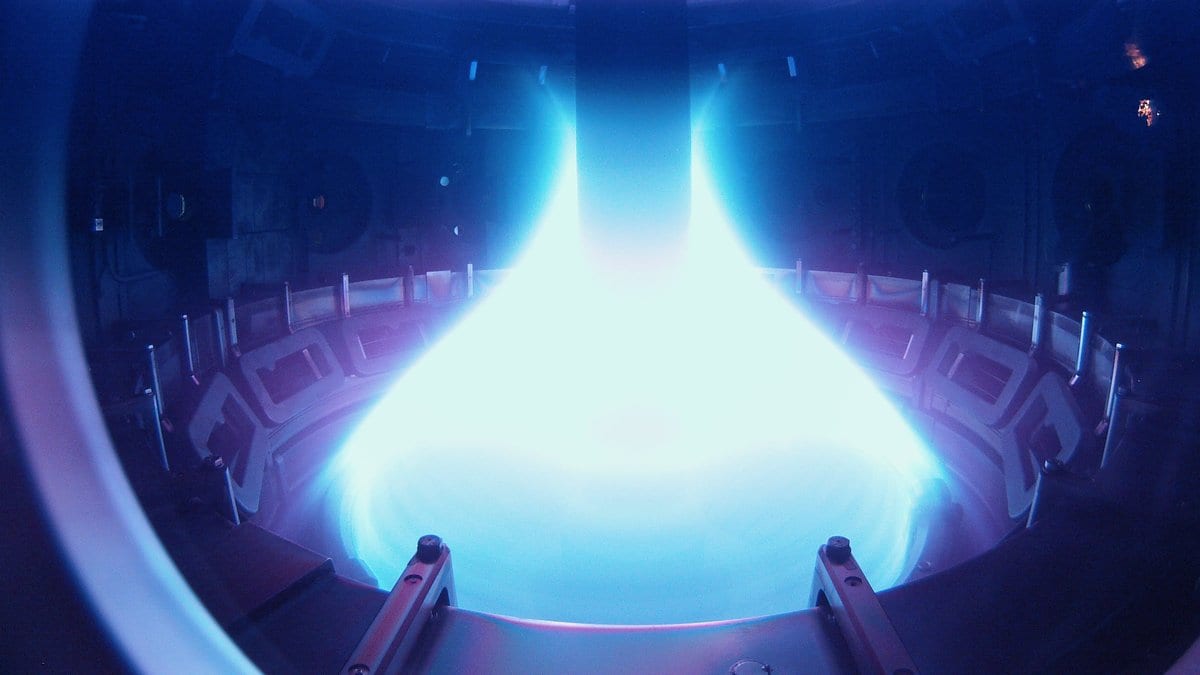
Before a fusion shot fires, someone sits down with the plan for it and decides, phase by phase, which set of control instructions the machine will follow. Those instructions are called virtual circuits. Each is a small recipe: to move the plasma's outer edge out a little, turn these magnet coils up and those down, by amounts chosen so the rest of the shape stays put. They are worked out beforehand, from a handful of reference states along the planned trajectory, and switched by the clock. Once the plasma is running, they do not change.
On MAST Upgrade, the UK Atomic Energy Authority's spherical tokamak at Culham, a team led by Nicola Amorisco has now had those recipes generated while the shot was in progress, by a neural network trained on a large library of simulated plasma states. In a preprint posted on Aug. 28 and not yet peer reviewed, Amorisco and colleagues at UKAEA and the STFC Hartree Centre report four discharges in which the live-generated settings held a steady shape, enacted deliberate changes to it, and swept the plasma's exhaust leg across the divertor floor.
Exactly one component changed, and the paper is careful about which. MAST Upgrade's shape controller runs at 10 kHz and was left as it was, along with its gains and its machine-protection limits. So was LEMUR, the algorithm that works out where the plasma boundary actually is, moment to moment, from magnetic measurements. What the network supplies is the piece in between: a local model of how much each magnet coil moves each part of that boundary. A dedicated server takes the coil currents and the plasma current, evaluates the emulator, and hands back that response model roughly every five milliseconds; the control system inverts it and drops the result into selected slots of the existing recipe table. "Rather than replacing the feedback controller," the authors write, the emulators update the plasma-response model the circuits are derived from.
Each shot asked for more than the last
The first discharge was deliberately conservative: a steady, unchanging shape. The network handled the plasma's inner and outer edges and the height of its lower X-point, while the divertor nose stayed on the old preset schedule. It ran to its programmed duration, both kinds of recipe working side by side. The second added step changes to the core shape and a feedback-driven sweep of the exhaust strike point outward, from about 0.8 to 1.4 meters. The tracking followed both. The discharge did not last: it terminated at 563 milliseconds on a Langmuir-probe protection trip, which the authors do not attribute to the new system and which matched an operational limit met elsewhere in the same session.
The third shot was the one the method exists for. It drove a fast transition into a more elongated plasma with a Super-X exhaust, a configuration MAST Upgrade has found hard to hold, and precisely the case where a pre-computed recipe goes stale as the plasma evolves. Six of the seven shape parameters were under live control. The transition completed, and offline magnetic reconstructions made after the fact confirm the change in elongation and leg position that the real-time system believed it was producing. Then, about 380 milliseconds in, the plasma touched the divertor nose, the one parameter not being constrained that shot, and shape control was lost. The pre-shot simulation had not predicted the interaction.
The stress test was the one that misbehaved
The fourth was an exploratory stress test: all seven shape parameters under simultaneous feedback control, which MAST Upgrade does not normally attempt because several of them respond to the magnets in nearly the same way. It reached its programmed ramp-down, but tracking was, in the paper's phrase, "markedly less smooth," with two transient departures from the requested shape along the way. When two of the shape directions become nearly indistinguishable from the coils' point of view, the inversion that turns a wanted correction into coil currents starts asking for very large currents in response to small requests. That amplification is visible in the recorded data, strongest right at the first departure. The remedy the authors propose is a damped inversion, a change downstream of the emulator that leaves the network and the surrounding control system untouched.
Part of the plasma's state came from earlier shots
That "real time" is exact about the loop and only partly true of the state it works from. The coil currents and the plasma current arrive live from the control system. The parameters describing how current is distributed across the plasma cross-section do not: they were prescribed, taken from reconstructions of earlier representative discharges. Currents induced in the machine's passive structure are not in the emulator's picture at all. Both approximations held well enough for the shapes tested here, and the paper says plainly that this does not make them negligible in general, particularly during rapidly evolving phases. Feeding in a live profile estimate and the passive currents is named the priority for the next round of development.
The paper does not claim that live recipes control the plasma better than pre-computed ones.That comparison would have needed a dedicated run of discharges built for it, and the machine time was not available. What these shots establish is narrower: the same trained emulators worked across four different scenarios without being retrained for any of them. That is the part that would take the hand-built, phase-by-phase schedule out of the preparation an operator does before each shot.
For years, neural networks have handled vertical stability on DIII-D and EAST, and reinforcement-learning controllers have shaped plasmas on TCV and elsewhere. A separate group posted an experimental demonstration of a different learned magnetic-control method on TCV three days before this one appeared; the MAST Upgrade authors call it contemporaneous and complementary. Their own list of what routine use still requires includes a richer real-time picture of the plasma, a better-conditioned inversion, and validation over a wider slice of the operating space.
Sources
- arXivPreprint