A Humanoid Built to Lift With You, Not for You

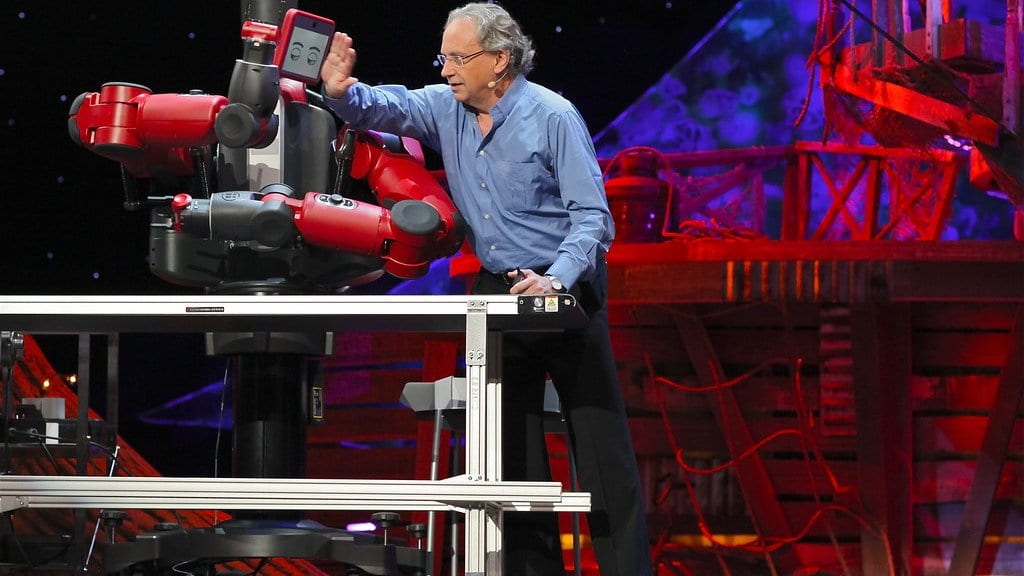
Most humanoid robots are designed in the order you would expect. First, the engineers settle the body: the length of the limbs, where the motors sit, and how much each joint can push. Only then does a second team write the software that decides how the finished machine should move. Hardware, then control, in sequence, with the shape of the robot fixed long before anyone asks what a human standing next to it will feel.
A team at the Italian Institute of Technology (IIT) has challenged that assumption. In a paper published on 13 July in Nature Machine Intelligence, Carlotta Sartore, Daniele Pucci, and fourteen colleagues describe a humanoid called ergoCub that was built the other way round, with the body and the way it moves treated as one problem, and with a specific human metric sitting at the centre of that problem: how much strain the robot spares the person working beside it.
The robot itself is modest by the standards of the humanoids that go viral. It stands about 1.5 metres tall, weighs 55.7 kilograms, and is rated to handle loads of roughly 10 kilograms. It is an evolution of IIT's long-running iCub, but where iCub was a research platform for studying cognition, ergoCub has a blunter job description: physical collaboration. The target user is not a hobbyist or a lab demo but a warehouse or factory worker whose back is slowly worn down by lifting.
That is the problem ergoCub is designed to address. Wearable sensors can already tell a worker that a lift is risky, but as the group notes, such devices are passive: they warn, they do not take any of the weight. The ambition behind ergoCub is a machine that actually shoulders part of the load, coordinating with a person the way two people coordinate when they carry a table together.
Building and moving, optimised together
The technical heart of the work is a co-optimisation. According to the preprint version of the paper, the researchers optimised the robot's hardware and its control jointly, and did so "for human metrics" rather than for the robot's own efficiency in isolation. In practice, that means the choice of how long a link should be, or how strong a joint's motor needs to be, is not made first and frozen; it is decided in the same loop that decides how the robot should move, with the objective being the ergonomic cost borne by the human partner.
The group frames this as modelling human-robot interaction "as a function of hardware configurations." Read plainly: change the robot's body, and you change the physics of the shared lift, and therefore the strain on the person. So the body and the controller are searched for together, against a model of a human doing the task, so that the finished machine is already shaped to make the collaboration easy on its human partner, rather than merely possible.
It is not that ergoCub can lift; plenty of machines lift. It is that human comfort was written into the design objective from the start, treated as the thing to be optimised rather than checked afterward.
Tested on the real robot, with a real person
Co-design arguments can live entirely in simulation, where a favourable body is easy to conjure and never has to be manufactured. The IIT work does not stop there. The method was validated on the physical ergoCub platform, in a lifting task carried out in collaboration with a sensorised human, a person instrumented so the researchers could measure the biomechanical load the collaboration actually placed on them, not just estimate it. The researchers, therefore, tested the approach on a physical robot sharing a load with a person in a controlled task.
Sources
- Nature Machine IntelligencePeer-reviewed
- arXivPreprint