A Brain-Style 'Cognitive Map' Lets a Small Network Solve Problems It Never Trained On

Ask a person to drive from a friend's house to a restaurant they've never visited, in a city they know only in patches, and something quietly remarkable happens. They don't consult a lookup table of every possible route. They picture the map they carry in their head, imagine a few plausible ways to get there, and settle on one. The brain does this cheaply, on a power budget of roughly twenty watts, and it does it for goals it has never faced before.
Reproducing that flexibility has been one of the sticking points of modern AI, and the dominant answer has been scale: bigger networks, more training data, more electricity. A study published on 21 July in Nature Machine Intelligence takes the opposite tack. Its authors argue that a central feature of brain intelligence, the capacity to generate solutions to problems never encountered before, does not require a deep neural network or a large language model at all.
The work comes from Hui Lin, Yukun Yang, Rong Zhao, Giovanni Pezzulo and Wolfgang Maass, whose group has spent years studying how brains plan. Their new model rests on three ideas borrowed from neuroscience rather than from mainstream machine learning: cognitive maps, stochastic computing and compositional coding.
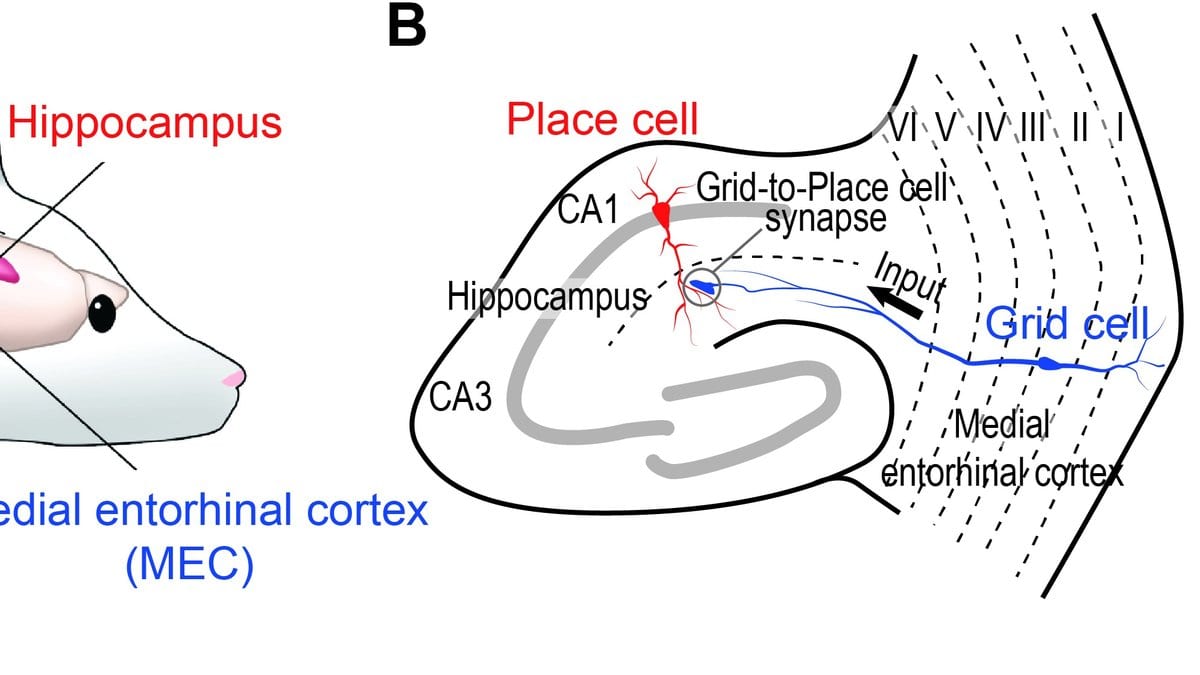
The first is the oldest and the most intuitive. A cognitive map is the brain's internal model of how things relate to one another: which places connect to which, which states lead to which. Decades of experiments on the hippocampus have shown that animals build such maps and use them to navigate. The map is not a photograph. It is a web of relationships that can be recombined, which is exactly what lets an animal reach a spot by a path it has never walked.
The second idea, stochastic computing, is where the model departs sharply from a conventional planner. Instead of calculating one optimal route through exhaustive search, the network samples. It draws random trajectories through its learned map, biased toward routes that reach the goal, and lets useful solutions emerge from that noise. Randomness, usually treated as a nuisance in computing, becomes the engine of imagination. The network is, in effect, daydreaming candidate plans and keeping the ones that work.
The third, compositional coding, is what lets the same machinery handle a goal it was never trained on. Because knowledge is stored as reusable relational pieces rather than as fixed input-output pairs, the network can assemble a plan for a novel target by combining fragments it already holds, the way you might route to an unfamiliar address using streets you already know.
Put together, the system plans and solves problems in a way its authors describe as flexible and, notably, transparent. That last word carries weight. A large neural network is famously a black box; you can watch what it outputs but not easily read why. Because this model's reasoning runs over an explicit map, its steps can be inspected. You can see the route it imagined and the samples it drew.
The claim that draws the most attention is also the most concrete, and it is worth stating carefully. The model requires only self-supervised local synaptic plasticity. In plainer terms, it learns using simple rules that adjust the strength of each connection based on nearby activity, without a global error signal shipped backward through the whole network. That mechanism matters because it is a natural fit for neuromorphic hardware: brain-inspired chips built to compute where they store memory, running on a fraction of the power a graphics processor draws. Learning rules of this kind are what such chips can execute efficiently, which is why the authors point to energy-efficient edge devices, the small, battery-powered processors in phones, sensors and robots, as a plausible home for the approach.
A few caveats keep the result in proportion. This is a research model demonstrated in the controlled settings of a scientific paper, not a product, and "solves problems it never trained on" refers to planning tasks of the sort the study examined, not open-ended reasoning about the world. Nothing here is a language model or a general-purpose assistant, and the paper does not claim to be a step toward one. Improvising a route through a learned map is a real and hard-won piece of cognition, but it is a piece, not the whole of intelligence. The work also has a long provenance: it circulated as a bioRxiv preprint from May 2025, revised twice, before clearing peer review. It builds on the group's earlier published work on cognitive-map planning rather than arriving from nowhere.
What the study does offer is an existence proof, and existence proofs are useful precisely when a field has settled on one recipe. Today's headline AI runs on enormous models and enormous power bills. Here is a demonstration that at least one thing those models do, planning a way through an unfamiliar problem, can also be done by a small, legible network learning the way a brain might, on hardware that sips electricity. Whether that path scales beyond navigation-style tasks is the open question. For now, it is a reminder that scale is a choice, not the only road to a machine that can plan.
Sources
- Nature Machine IntelligencePeer-reviewed
- bioRxivPreprint