The Dying Star Should Have Dragged Its Companion In. It Did Not.


Nine or ten billion years ago, the heavier of two stars 28 light-years from the Sun began to approach the end of its life. It swelled into a red giant, its surface expanding until it reached nearly halfway to its companion, a small red star that had orbited it since both were born. Then it shed more than half of its mass into space. Encounters like that are supposed to end one way: the two stars sink toward each other and finish in an orbit measured in hours. This one did not. The survivor is still there, and its orbit is wider than it was before.
The pair sits at the center of Welopō‘ai, a three-star system, and was found by accident. A planet search with SPIRou, a near-infrared spectrograph on the Canada-France-Hawaii Telescope, had monitored the small red star since 2019 and found it accelerating far too rapidly for the motion to be caused by a planet. Speckle imaging at Gemini North then picked out the culprit, almost on top of the red star in the image: a white dwarf, the burned-out core left behind by a dying star. Étienne Artigau of the Université de Montréal and the Institut Trottier de recherche sur les exoplanètes, with 20 colleagues, published the orbit Nov. 19 in Astronomy & Astrophysics. It is the closest known triple system containing more than one white dwarf.
Today the two stars are 4.644 astronomical units apart, where one unit is the Earth-Sun distance, and take 9.83 years to orbit each other. That measurement is where the reconstruction starts, and the team works backward. The white dwarf's mass, interpreted through the standard relationship between a white dwarf and its progenitor star, points to an original mass of roughly 1.4 solar masses. Roughly 0.8 solar masses went into space as the star evolved. The inner pair's combined mass dropped by almost half, and an orbit that loses mass in this way widens in inverse proportion. Before the mass loss, the two stars were only about 2.6 astronomical units apart. A red giant of that mass reaches a maximum radius near 1.2 astronomical units. The gap between the stars was barely twice the radius of the swelling giant. Artigau and colleagues put the consequence carefully: "Simplistic orbital evolution scenarios point to strong tidal interactions and plausible partial common envelope evolution," a common envelope being the state in which one star ends up inside the other's outer layers. They do not claim that the system went through a full common envelope phase. The numbers instead point to severe tidal interactions and a grazing encounter with the envelope, not the textbook case of a star swallowed whole.
Every known survivor of this ends up closer in
That is the part that does not fit. The present orbit, the authors write, "stands in stark contrast to the hour-to-day periods that characterise the vast majority of post-common-envelope binaries" — the pairs cataloged by Zorotovic and colleagues, which emerged from their common-envelope phase orbiting each other once or twice a day. The classical picture has the smaller star spiraling inward as it plows through the envelope, shedding orbital energy with every turn. Welopō‘ai's inner pair emerged with a wider orbit instead. The system also has a third member: another white dwarf, cataloged long before the inner one, circling far outside the pair. Its gravitational pull drives a Kozai-Lidov cycle in the inner orbit, a slow exchange between orbital tilt and eccentricity, which must have repeatedly brought the red dwarf's closest approach "towards, and perhaps into, the expanding giant envelope."
Two questions follow, and the paper leaves both open: why the Kozai-Lidov cycles never drove the pair into a spiral-in while both stars were still alive, and what stopped the tides raised on the dying giant from shrinking the orbit. The authors write that arriving at today's wide orbit instead of a tight one "indicates that the evolutionary pathway was complex and remains poorly understood."
The only comparable pair in the neighborhood
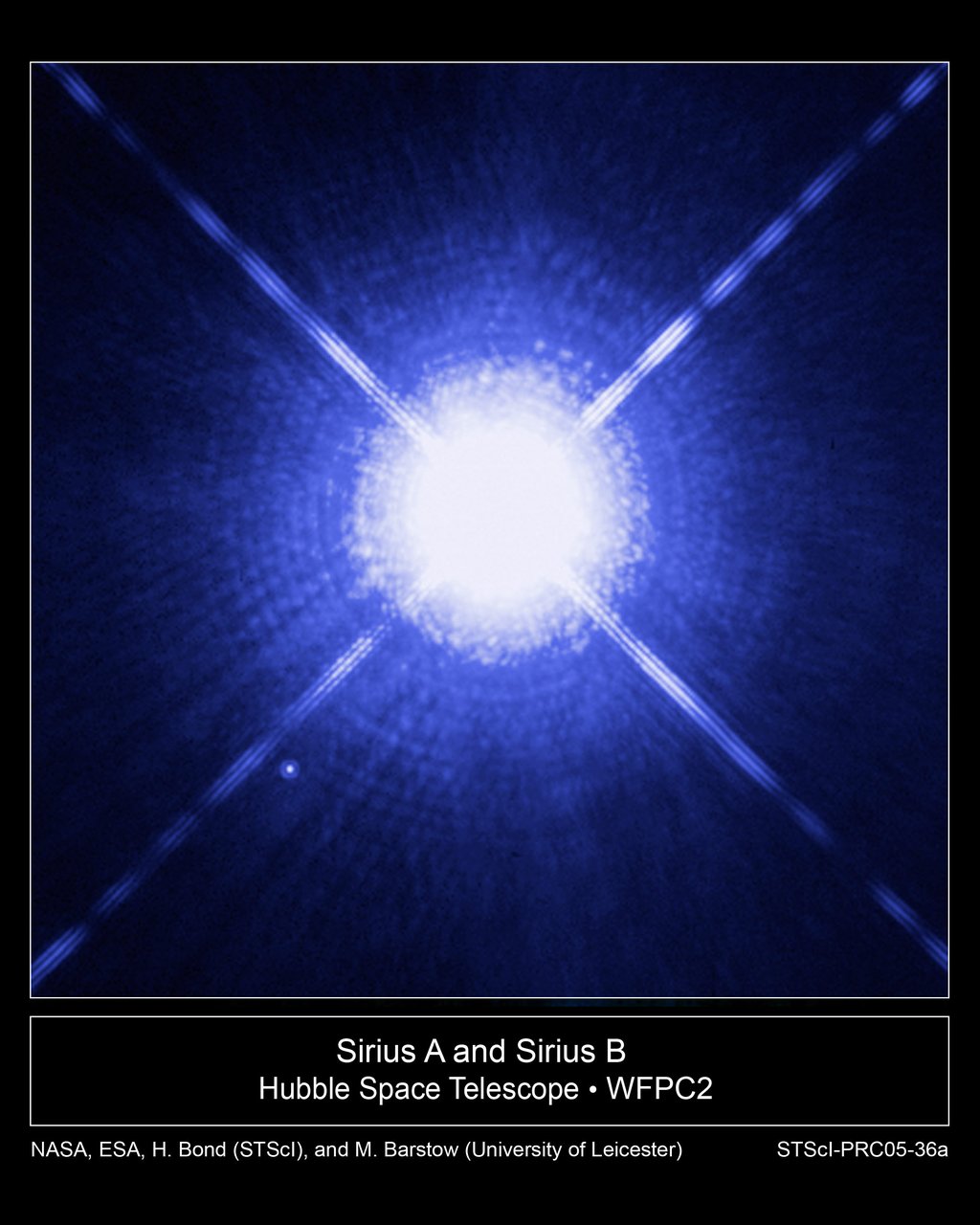
There is exactly one nearby system to compare it with. G 203-47 is also a red dwarf with a white dwarf companion, and it followed the expected path: the two orbit each other every 14.7 days. Together, the two systems are, in the paper's words, "one of only two such confirmed systems within 10 pc" of the Sun, roughly 33 light-years away. Even that pair holds a surprise: its red dwarf is "not tidally locked despite its" short orbit, and O'Brien and colleagues interpret its slow spin as evidence of a brief encounter. Welopō‘ai offers what G 203-47 cannot: its white dwarf is resolved and imaged, so its light can be measured directly. Its mass comes from the orbit itself, not from an indirect inference, and the third star provides independent constraints on the system's history and age. That mass is also the most precisely measured among the few nearby white dwarfs weighed through their orbits, a group that includes Sirius B.
Heavy elements with no hydrogen, and a hint of dust
Both white dwarfs point to a total system age of 9 to 11 billion years, making it among the oldest systems in the Galaxy. Yet the red dwarf carries measurably more heavy elements than the Sun, unlike most very old stars. One possible explanation is pollution from material its neighbor ejected. Artigau and colleagues run the numbers: this would require roughly two-thirds of every heavy element the giant ejected to have landed on the red dwarf, while almost none of the hydrogen and helium that made up nearly all the expelled envelope reached it. Otherwise, the accreted material would dilute the red dwarf's surface rather than enrich it. No known accretion process can account for this. The authors' least exotic explanation is also the one they prefer: "the system may simply be a rare outlier of the age-metallicity distribution."
The other oddity is a faint glow. The white dwarf is brighter at two near-infrared wavelengths than any model of its bare surface predicts, by three times the measurement's uncertainty in one band and only 1.5 times in the other. "We emphasise that this is a tentative detection," the paper says. Its near-infrared brightness could only be calibrated against catalog stars in the same image, and any error in that calibration would feed directly into the apparent excess. If the excess is real, it could come from a ring of dust a few Earth radii across or a cool brown dwarf nearby. An archival mid-infrared measurement that initially looked like further evidence for the excess turned out to be faulty or variable, unrelated to any dust. "Neither the resolved nor the unresolved excess is yet a firm detection," the authors write. JWST photometry could help settle the question.
What the system offers, in the end, is a test. Welopō‘ai "offers direct dynamical constraints on common-envelope evolution and hierarchical triple stability," the authors write: a real orbit, measured precisely, where theory had largely relied on models. The name is Hawaiian, from welo, an inherited family trait, and pō‘ai, an encircling path.